

TL;DR:
- Natural moisturizers use plant-based humectants, emollients, and occlusives for better aging skin support.
- Key ingredients like hyaluronic acid, rosehip oil, shea butter, and ceramides provide deep hydration and barrier repair.
- Proper formulation and consistency are essential for effective natural skincare, especially for sensitive and mature skin.
Not all moisturizers are created equal, and if you’re over 40, you’ve probably noticed that the cream that worked in your 30s just doesn’t cut it anymore. Skin changes dramatically after 40: natural oil production slows, collagen declines, and the skin barrier becomes less efficient at holding water. Many women assume any moisturizer will do the job, but the ingredients inside make all the difference. Natural moisturizers, built from plant-derived compounds, offer a genuinely different approach to hydration and aging. This guide breaks down exactly what they are, which ingredients to look for, and how to choose the right one for your skin.
Table of Contents
- What are natural moisturizers? Science and basics
- Key ingredients in natural moisturizers and their effects
- How natural moisturizers compare to synthetic options
- Choosing the best natural moisturizer for your skin
- A fresh perspective: Why natural isn’t always simple — insider lessons
- Discover tailored natural skincare solutions for women 40+
- Frequently asked questions
Key Takeaways
| Point | Details |
|---|---|
| Natural moisturizer benefits | Plant-based moisturizers offer hydration, barrier support, and anti-aging effects for mature skin. |
| Key ingredients to seek | Look for hyaluronic acid, rosehip oil, shea butter, and ceramides for best hydration and wrinkle prevention. |
| Sensitive skin advice | Choose fragrance-free, essential oil-free moisturizers for sensitive, aging skin. |
| Patch test every new product | Always patch test natural moisturizers to check for allergic reactions—even when labeled ‘natural’. |
What are natural moisturizers? Science and basics
Natural moisturizers are skincare products formulated primarily with plant-based, minimally processed ingredients rather than petroleum derivatives, synthetic polymers, or lab-made compounds. The distinction matters because the source of an ingredient shapes how it interacts with your skin at a cellular level.
At their core, natural moisturizers consist of plant-derived humectants, emollients, and occlusives that hydrate skin, repair the barrier, and combat aging in mature skin. Each category plays a different role:
- Humectants draw water from the environment and deeper skin layers up to the surface. Think hyaluronic acid, glycerin, and aloe vera.
- Emollients fill the microscopic gaps between skin cells, smoothing texture and making skin feel soft. Plant oils like jojoba and rosehip fall here.
- Occlusives form a protective layer on the skin’s surface to seal moisture in. Shea butter and plant waxes are classic examples.
For mature skin, this trio works together in a way that purely synthetic formulas often don’t replicate. After 40, the skin’s lipid barrier naturally thins, making it harder to retain moisture. Natural emollients and occlusives physically reinforce this barrier using compounds structurally similar to your skin’s own lipids. That compatibility is a core reason why so many women over 40 find natural formulas more effective.
Popular natural ingredients include rosehip oil, argan oil, shea butter, beeswax, aloe vera, and plant-fermented hyaluronic acid. Each brings a specific benefit, from antioxidant protection to deep hydration. You’ll find detailed breakdowns of these in the next section.
Pro Tip: When reading a product label, ingredients are listed in order of concentration. If a natural active ingredient appears near the bottom of a long list, its impact will be minimal. Look for products where key naturals appear in the top five ingredients.
Exploring beauty routines designed for mature skin can also help you understand how to layer natural moisturizers with other products for the best results.
Key ingredients in natural moisturizers and their effects
Understanding the ingredients is crucial for making informed choices. Here are the natural compounds that matter most in your moisturizer.
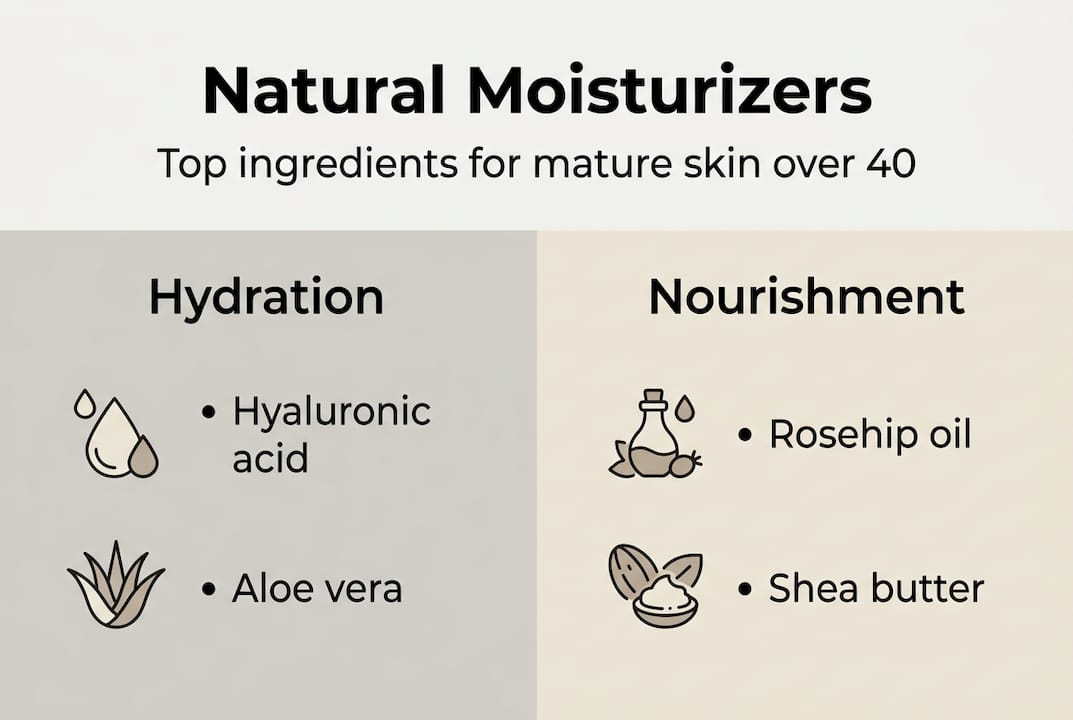
Hyaluronic acid is one of the most studied hydrating ingredients available. Plant-fermented versions are considered natural and are widely used in clean beauty formulations. Oral hyaluronic acid improved skin hydration by 7 to 30% and elasticity in clinical trials, with topical application showing similar benefits. The problem is that levels of hyaluronic acid in your skin decline significantly after 40, which is exactly when topical application becomes most valuable. It holds up to 1000 times its weight in water, plumping fine lines and giving skin that dewy, full appearance.
Rosehip oil is rich in omega-3 and omega-6 fatty acids, as well as vitamins A, C, and E. Vitamins and essential fatty acids in rosehip oil actively regenerate skin cells, boost elasticity, and deliver measurable anti-aging effects. It’s one of the few plant oils with a meaningful concentration of natural retinoids, making it a popular retinol alternative for women whose skin is too sensitive for synthetic retinol.
Shea butter is an occlusive and emollient powerhouse. It contains triglycerides, essential fatty acids, and vitamin E, all of which nourish, protect, and support the skin barrier. For dry and mature skin, it’s particularly effective at locking in moisture overnight.

Plant oils like jojoba, argan, and safflower work as emollients that physically fill the gaps between skin cells. This is why skin feels smoother immediately after application. They also carry antimicrobial properties, which is a useful bonus for skin that may be more prone to sensitivity.
Ceramides from plant sources help restore the lipid barrier, which is critical for aging skin. Here’s a quick comparison of key natural ingredients:
| Ingredient | Primary function | Best for |
|---|---|---|
| Hyaluronic acid | Deep hydration, plumping | All mature skin types |
| Rosehip oil | Cell regeneration, elasticity | Dry, dull, aging skin |
| Shea butter | Barrier support, moisture lock | Very dry, sensitive skin |
| Jojoba oil | Texture smoothing, balancing | Combination, aging skin |
| Ceramides | Barrier repair, protection | Sensitive, inflamed skin |
Pro Tip: Pair a hyaluronic acid serum with a shea butter or plant oil moisturizer on top. The serum pulls water in; the moisturizer seals it. This layering technique is one of the most effective strategies for mature skin hydration.
For a deeper look at how plant oils support anti-aging for women over 40, or to explore anti-aging serums that pair well with natural moisturizers, both are worth exploring as part of your routine.
How natural moisturizers compare to synthetic options
With the ingredient science in mind, let’s see how natural formulas stack up against synthetics, especially for mature and sensitive skin.
Synthetic moisturizers are often praised for consistency. Because they’re lab-produced, the concentration of each ingredient can be precisely controlled. Natural ingredients, on the other hand, can vary slightly depending on harvest conditions and sourcing. That said, clinical evidence increasingly supports the performance of natural formulas.
Hyaluronic acid trials show real hydration and elasticity gains, and plant oils like argan, jojoba, and safflower outperform synthetic emollients in long-term hydration for some skin types, while also offering antimicrobial benefits that synthetic alternatives don’t provide.
“For women over 40 with sensitive or reactive skin, the absence of synthetic fragrances, parabens, and petroleum derivatives in natural formulas often means fewer flare-ups and more comfortable daily wear.”
Here’s a direct comparison:
| Factor | Natural moisturizers | Synthetic moisturizers |
|---|---|---|
| Hydration depth | Often superior long-term | Effective short-term |
| Anti-aging benefits | Ingredient-driven, evidence-backed | Varies by formula |
| Sensitive skin safety | Generally better tolerated | Risk of synthetic irritants |
| Ingredient consistency | Variable by source | Standardized |
| Fragrance risk | Low (if fragrance-free) | Higher with synthetic scents |
When choosing between the two, consider these factors in order:
- Your skin’s sensitivity level. If you react easily, natural and fragrance-free is almost always the safer starting point.
- Your primary concern. Deep hydration, wrinkle reduction, and barrier repair all respond well to natural actives.
- The formula’s transparency. A natural product with a clear ingredient list is far more trustworthy than one hiding behind vague “botanical blend” language.
- How your skin responds over 4 to 6 weeks. Real results from natural moisturizers often build gradually rather than appearing overnight.
For women who have experienced irritation from conventional products, switching to a well-formulated natural option can be genuinely transformative. Learning more about preventing skin aging naturally can also help you build a routine that supports your skin long-term.
Choosing the best natural moisturizer for your skin
Knowing the practical differences, the next step is making the right choice for your unique skin needs.
For mature, dry, or sensitive skin, not every natural moisturizer will deliver the same results. The right formula depends on your skin type, your primary concerns, and the quality of the ingredients inside.
Start with this checklist when evaluating any product:
- Does it contain at least one proven humectant (hyaluronic acid, aloe vera, glycerin)?
- Does it include a nourishing emollient (rosehip oil, jojoba, argan)?
- Is it free from synthetic fragrances and alcohol, which can strip and irritate mature skin?
- Are ceramides or plant-based lipids included to support barrier repair? Plant-sourced ceramides restore the lipid barrier, which declines with age and is critical for skin health.
- Does shea butter or a similar occlusive appear in the formula to lock water in and plump fine lines?
For dry and mature skin, prioritize rich emollients and occlusives. Shea butter, rosehip oil, and ceramides together create a deeply nourishing formula that addresses both moisture loss and the visible signs of aging.
For sensitive skin, avoid essential oils and synthetic fragrances. Stick to fragrance-free plant oils and gentle humectants. Patch testing is non-negotiable before committing to a new product.
Here’s how to transition to a new natural moisturizer without disrupting your skin:
- Patch test on your inner arm for 48 hours before applying to your face.
- Introduce the new moisturizer once daily for the first week, then twice daily.
- Give it a full 4 to 6 weeks before judging results. Natural actives work progressively.
- Avoid switching multiple products at once so you can identify what’s working.
Pro Tip: If your skin feels tight after applying a natural moisturizer, it may need more occlusive support. Try adding a few drops of plant oil on top while your skin is still slightly damp.
Browsing moisturizer product options formulated for mature skin, or filtering for sensitive skin safe moisturizers, can save you a lot of trial and error.
A fresh perspective: Why natural isn’t always simple — insider lessons
Here’s something the skincare industry rarely says out loud: natural doesn’t automatically mean safe, effective, or better. It means the source is plant-based. What happens after that, how the ingredient is extracted, concentrated, preserved, and formulated, determines everything.
Essential oils are natural. So is poison ivy. The point isn’t to scare you away from natural skincare; it’s to help you approach it with the same critical eye you’d bring to any other product. Some of the most reactive ingredients in skincare are natural, including certain essential oils, nut-based butters, and highly fragrant botanical extracts.
For women over 40, whose skin barrier is already more permeable and reactive, this matters more than ever. Plant-sourced ceramides and carefully chosen plant lipids genuinely support barrier repair, but only when formulated correctly and used consistently.
The real lesson from years of working with natural skincare is this: the label matters less than the formulation. A thoughtfully made product with five clean, well-dosed ingredients will outperform a product with twenty natural ingredients thrown together without purpose. When you find a formula that works, built around proven naturals like hyaluronic acid, rosehip oil, and ceramides, stick with it. Consistency is what delivers results, not constant switching. Explore natural oil solutions that are specifically designed with mature skin in mind.
Discover tailored natural skincare solutions for women 40+
You now have a solid foundation for choosing natural moisturizers that genuinely work for mature skin. The next step is finding products that put all of this into practice.

At Miracle Gel Natural Skincare, every formula is developed with women over 40 in mind, using clinically tested natural actives, clean ingredient lists, and formulations that address real concerns like dryness, fine lines, and barrier weakness. The natural skincare shop features a curated range of moisturizers, serums, and treatments built around the ingredients covered in this guide. If you’re ready to experience what a well-formulated natural moisturizer can do, the 2 Minute Miracle Moisturizer is a strong place to start.
Frequently asked questions
What makes a moisturizer ‘natural’?
A natural moisturizer is made from plant-derived humectants, emollients, and occlusives, free of synthetic fillers, petroleum derivatives, and lab-made preservatives. The quality of sourcing and formulation determines how effective it actually is.
Is hyaluronic acid natural and safe for mature skin?
Yes, plant-fermented hyaluronic acid is natural and one of the most evidence-backed hydrating ingredients available. Clinical trials show it improves hydration by 7 to 30% and boosts elasticity, making it especially valuable for skin over 40 where natural levels have declined.
Which natural moisturizer is best for sensitive skin?
Look for fragrance-free formulas with gentle plant oils and humectants, avoiding essential oils and synthetic scents. Plant oils fill cell gaps, smooth texture, and carry antimicrobial benefits without the irritation risk that comes with synthetic additives.
Do natural moisturizers help with wrinkles?
Yes, and the evidence is solid. Rosehip oil’s vitamins and fatty acids actively regenerate skin cells and boost elasticity, while shea butter locks water in and physically plumps fine lines. Used consistently, these naturals deliver real, visible anti-aging results.