
TL;DR:
- The skin microbiome consists of trillions of microorganisms that actively protect and support skin health. Its composition varies by body site and is influenced by lifestyle and environment. Restoring microbial balance through targeted therapies is more effective than eliminating microbes with harsh treatments.
The skin microbiome is defined as the diverse community of bacteria, fungi, viruses, and mites that live on and within your skin, working together to maintain its health and resilience. Scientists also call this community the cutaneous microbiome, and understanding it has become one of the most important shifts in modern dermatology. Advances in genomic sequencing have revealed that your skin hosts trillions of microorganisms, and these microbes play vital roles including immune modulation, skin barrier maintenance, and metabolic regulation. Far from being passive passengers, they are active defenders. Key players include phyla like Actinobacteria and pathogens like Staphylococcus aureus, whose balance directly determines whether your skin stays clear and strong or becomes inflamed and reactive.
What is skin microbiome composition and how does it vary by site?
Your skin is not a single uniform surface. It is a collection of distinct microenvironments, and each skin site hosts a unique microbial profile shaped by its moisture, oil production, and temperature.

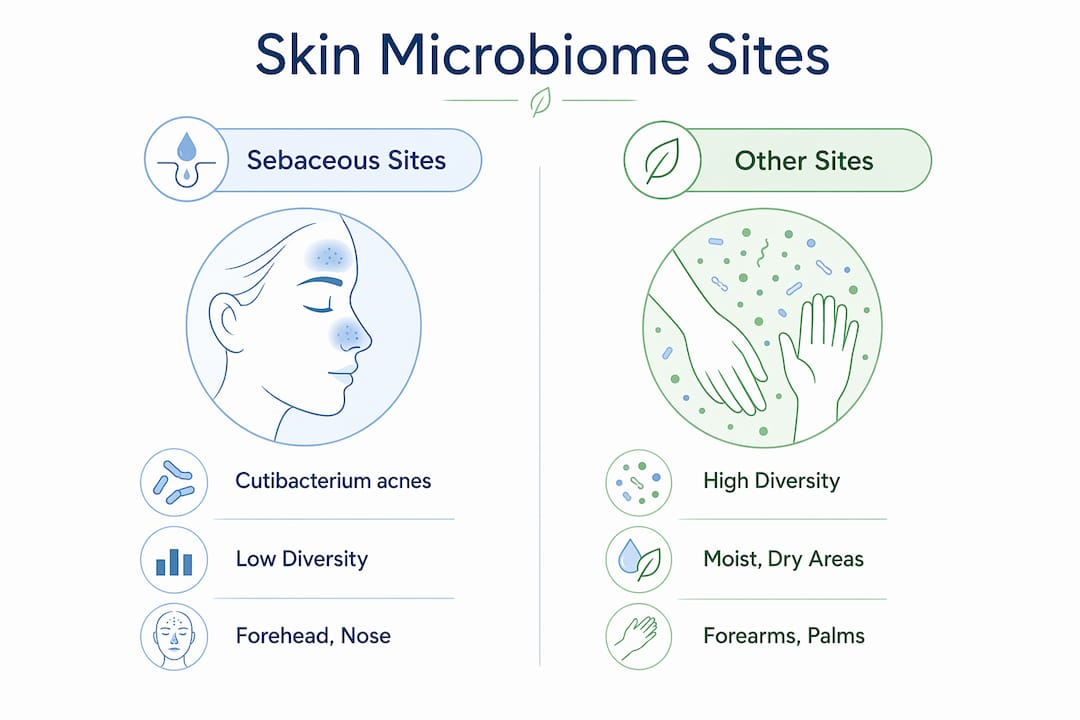
Four major bacterial phyla dominate the skin: Actinobacteria, Firmicutes, Bacteroidetes, and Proteobacteria. Their proportions shift dramatically depending on where you look on the body. Sebaceous (oily) zones like the forehead and nose are dominated by Cutibacterium acnes, which thrives on the fatty acids in sebum. Moist areas like the armpits and groin favor Staphylococcus and Corynebacterium species. Dry areas like the forearm show the highest microbial diversity of all.
This spatial variation matters for skincare. A product that works well on your oily T-zone may disrupt the more delicate microbial balance on your dry cheeks. Skincare must account for these niche differences to avoid unintended harm.
| Skin site | Dominant microbes | Diversity level |
|---|---|---|
| Sebaceous (forehead, nose) | Cutibacterium acnes | Low |
| Moist (armpits, groin) | Staphylococcus, Corynebacterium | Moderate |
| Dry (forearm, leg) | Mixed phyla | High |
| Palms | Proteobacteria-dominant | Moderate |
Environmental and lifestyle factors also shape these communities. Hygiene habits, climate, physical activity, and even contact with pets or other people all influence which microbes colonize your skin and in what numbers.
How does the skin microbiome protect and support skin health?
The skin microbiome functions as a defensive partner, not a threat. Skin acts as an active ecosystem where beneficial microbes are co-opted through nutrient exchange with host cells, creating a mutually protective relationship.
The protective benefits of a balanced skin microbiome include:
- Immune training. Resident microbes educate your immune system to distinguish between harmless organisms and genuine pathogens, reducing the risk of overreaction.
- Antimicrobial production. Microbes produce short-chain fatty acids and bactericide compounds that directly inhibit harmful invaders from taking hold.
- Barrier support. Microbial activity supports the production of ceramide lipids and fatty acids that reinforce the skin’s physical barrier against water loss and irritants.
- pH regulation. Commensal bacteria help maintain the skin’s slightly acidic pH, which itself discourages pathogen growth.
Ceramide and fatty acid production by microbiota directly impacts how well your skin holds moisture and resists environmental damage. When this microbial activity is disrupted, barrier function declines, and inflammation follows.
Pro Tip: Avoid washing your face more than twice daily with a foaming cleanser. Aggressive cleansing strips the skin of commensal microbes that produce the antimicrobial compounds your barrier depends on. A gentle, pH-balanced cleanser preserves this protection.
Understanding the skin barrier and microbiome connection helps you make smarter choices about every product you apply.
What happens when the skin microbiome is out of balance?
Microbial imbalance on the skin, known clinically as cutaneous symbiosis disruption or, more precisely, dysbiosis, occurs when the normal community of microbes is destabilized. Pathogens displace commensals, inflammation rises, and the skin’s defenses weaken. Dysbiosis often precedes visible skin symptoms, meaning the microbial shift happens before you see a breakout or rash.
Four common skin conditions are directly linked to microbial imbalance:
- Atopic dermatitis (eczema). Overgrowth of Staphylococcus aureus displaces protective commensals, triggering the chronic inflammation and itch cycles that define this condition.
- Acne. An overgrowth of specific Cutibacterium acnes strains, combined with reduced microbial diversity, drives the inflammatory response behind breakouts. Microbiome-friendly acne treatments now target this imbalance directly rather than simply killing bacteria.
- Psoriasis. Altered microbial communities on psoriatic plaques show reduced Firmicutes and elevated Proteobacteria, correlating with immune dysregulation.
- Rosacea. Demodex mites and altered bacterial populations are consistently found in higher numbers on rosacea-affected skin, suggesting a microbial driver.
The critical insight here is that microbial balance matters more than pathogen eradication. Treating eczema or acne with broad-spectrum antibiotics kills the protective commensals alongside the pathogens, which is why treating symptoms without restoring microbial balance leads to recurrence. The goal is restoration, not sterilization.
What are the latest therapies targeting the skin microbiome?
The science of treating skin through its microbiome has advanced significantly. The shift is away from antibiotics and toward precision interventions that restore healthy microbial communities without collateral damage.
Diagnostic advances
Multi-omics platforms and 16S rRNA gene sequencing now allow clinicians to map a person’s exact microbial profile with high precision. Precision medicine using biomarker-based diagnostics can identify specific imbalances before symptoms become severe. This moves dermatology from reactive treatment to proactive management.
Therapeutic approaches: traditional vs. modern
| Approach | Traditional method | Modern microbiome method |
|---|---|---|
| Acne treatment | Topical antibiotics | Bacteriophage therapy targeting specific strains |
| Eczema management | Topical corticosteroids | Probiotic skin applications restoring commensals |
| Barrier repair | Petroleum-based occlusives | Prebiotic formulations feeding beneficial microbes |
| Infection prevention | Broad-spectrum antiseptics | Metabolite-based treatments preserving microbial diversity |
Bacteriophage therapy is particularly promising. Phages are viruses that target specific bacteria with surgical precision, eliminating Staphylococcus aureus without touching the surrounding commensal community. Probiotic and prebiotic topicals work differently. They either introduce beneficial microbes directly or feed the ones already present, nudging the community back toward balance.
Emerging therapies in 2026 also include metabolite-based treatments, where the beneficial compounds microbes naturally produce are applied directly to the skin. This bypasses the need to maintain live cultures while still delivering the protective effects.
Pro Tip: When choosing a probiotic skincare product, look for formulations that list specific bacterial strains like Lactobacillus or Bifidobacterium on the label. Generic “probiotic complex” claims without named strains offer no guarantee of efficacy.
Clinical skincare formulations designed with these principles in mind are becoming the standard for anyone serious about long-term skin health.
Key takeaways
The skin microbiome is an active, site-specific ecosystem whose balance determines skin health, and restoring that balance is more effective than eliminating microbes.
| Point | Details |
|---|---|
| Microbiome definition | The skin hosts trillions of bacteria, fungi, viruses, and mites that actively protect and regulate skin health. |
| Site-specific variation | Sebaceous, moist, and dry skin zones each host distinct microbial communities that require targeted care. |
| Protective functions | Resident microbes produce antimicrobial compounds, train the immune system, and reinforce the skin barrier. |
| Dysbiosis and disease | Imbalance precedes conditions like eczema, acne, and rosacea; restoration outperforms eradication as a treatment strategy. |
| Modern therapies | Bacteriophage therapy, probiotics, and metabolite treatments now offer precision alternatives to broad-spectrum antibiotics. |
Why I stopped trying to sterilize my skin (and what changed)
The biggest mistake I see people make with their skincare is treating their skin like a surface to be disinfected. The instinct makes sense. We associate clean with sterile, and sterile with healthy. But the science says the opposite is true.
I spent years recommending aggressive cleansing routines to people dealing with breakouts or sensitivity, and the results were consistently disappointing. The skin would clear briefly, then flare worse than before. What I now understand is that we were stripping the very microbial defenses that were supposed to prevent those flares. Personalized dermatology integrating microbial data is the future, and it starts with respecting what is already living on your skin.
The practical shift is simple but counterintuitive. Use fewer products, not more. Choose formulations with gentle, pH-balanced ingredients that feed your skin’s existing microbial community rather than disrupting it. Look for natural ingredients for mature skin that work with your biology rather than against it. The most effective skincare routine is one your microbiome can survive intact.
— Barbara
Natural skincare that works with your skin microbiome
Your skin microbiome needs products that support it, not strip it. Miraclegelnaturalskincare formulates its products with exactly this principle in mind, using natural and organic ingredients that respect the skin’s microbial balance while delivering real anti-aging and brightening results for skin over 40.
The 2 Minute Miracle Gel and the full Miraclegelnaturalskincare range are built around gentle, effective ingredients that work with your skin’s biology. Founder Shelly Maguire designed these formulations specifically for mature skin that needs results without harsh chemicals. If you want skincare that supports your microbiome while visibly reducing fine lines and brightening your complexion, the Miraclegelnaturalskincare collection is worth exploring.
FAQ
What is the skin microbiome in simple terms?
The skin microbiome is the community of trillions of microorganisms, including bacteria, fungi, and viruses, that live on your skin and help keep it healthy, balanced, and protected from harmful invaders.
What affects the skin microbiome most?
Hygiene habits, climate, physical activity, skincare products, and contact with people, pets, and the environment all shape which microbes live on your skin and in what numbers.
How is the skin microbiome connected to acne?
An overgrowth of specific Cutibacterium acnes strains combined with reduced microbial diversity drives the inflammation behind acne. Restoring microbial balance is more effective long-term than killing bacteria with antibiotics.
Can skincare products damage the skin microbiome?
Yes. Aggressive cleansers, broad-spectrum antiseptics, and over-exfoliation remove commensal microbes that produce protective compounds. Choosing pH-balanced, gentle formulations preserves this microbial defense layer.
What is the difference between probiotics and prebiotics in skincare?
Probiotic skincare introduces live beneficial bacteria to the skin’s surface. Prebiotic skincare feeds the microbes already present. Both approaches support microbial balance, but prebiotics are generally more stable in topical formulations.