
TL;DR:
- Genuine natural skincare uses ingredients derived from nature with minimal processing and no synthetic additives.
- Certified natural products backed by seals like NPA, COSMOS, or Soil Association ensure authenticity.
- Botanicals in natural skincare can effectively reduce wrinkles, brighten skin, and improve resilience for women over 40.
Most women over 40 have stood in a skincare aisle, picked up a product labeled ‘natural,’ and wondered whether it actually means anything. The honest answer is: sometimes yes, sometimes no. The word ‘natural’ is not always legally regulated in Ireland or the UK, which means it can appear on products that still contain synthetic additives, artificial fragrances, or harsh preservatives. But here is the good news. Genuinely natural skincare, backed by real science, delivers measurable anti-aging and brightening results for mature skin. This article cuts through the label confusion so you can make smarter choices for your skin.
Table of Contents
- What is natural skincare?
- Science-backed benefits for mature skin
- How to spot truly natural skincare products
- Natural vs. synthetic: Which is best for anti-aging and brightening?
- A fresh perspective: Why ‘natural’ works best when personalized
- Take your next step to radiant, age-defying skin
- Frequently asked questions
Key Takeaways
| Point | Details |
|---|---|
| Natural defined clearly | Natural skincare means minimally processed ingredients primarily from plants, minerals, and botanicals without synthetic additives. |
| Proven anti-aging results | Clinical studies show significant wrinkle and pigmentation reductions with natural products for women 40 and above. |
| Certifications matter most | Third-party certifications like NPA or COSMOS are the best indicators of true natural skincare. |
| Personalization beats labels | Tailoring routines to your unique needs is more effective than chasing the word ‘natural’ alone. |
What is natural skincare?
With the confusion around the term clarified, let’s examine what natural skincare truly involves.
Natural skincare refers to products made primarily with ingredients derived from nature, such as plants, minerals, vegetables, fruits, and seeds, with minimal processing and without synthetic additives like parabens, silicones, artificial fragrances, colorants, or microplastics. That is the core definition. But the reality on store shelves is messier.
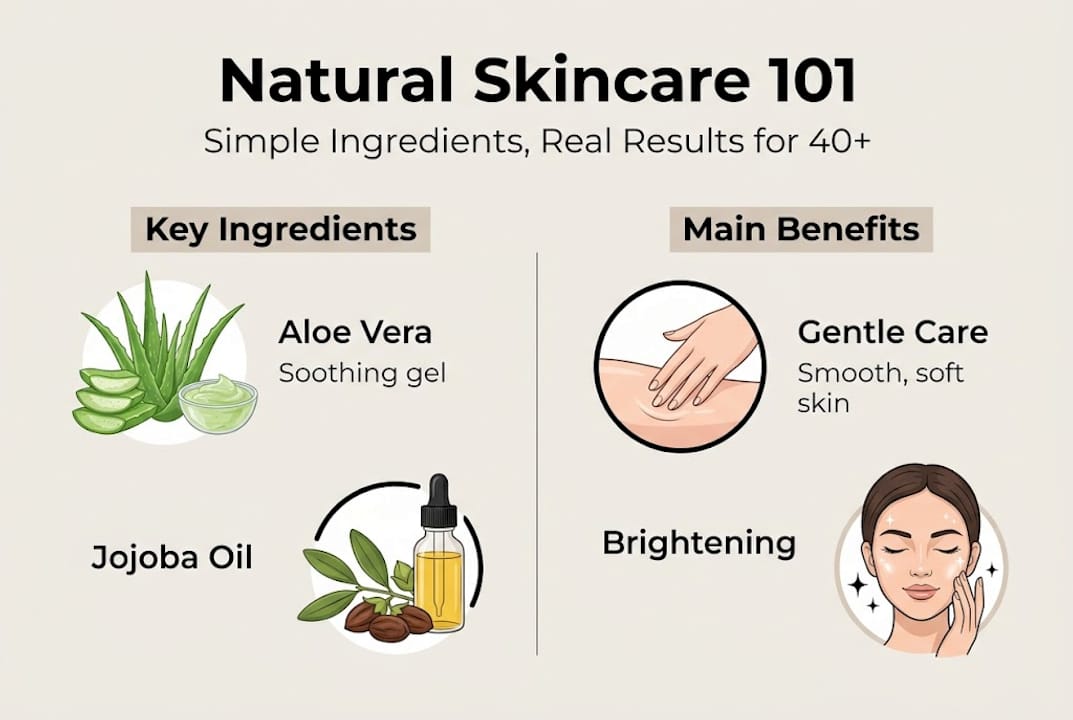
In both Ireland and the UK, there is no single legal standard that forces a brand to prove its product is natural before using that word on the label. A moisturizer with 2% chamomile extract and a long list of synthetic fillers can legally call itself ‘natural.’ This regulatory gap is why third-party certifications matter so much.
The most trusted certifications to look for are:
- NPA (Natural Products Association): Requires at least 95% natural ingredients and prohibits harmful synthetics.
- COSMOS: A European standard covering both natural and organic claims, with strict processing rules.
- Soil Association: A UK-based organic certification that also covers natural personal care products.
It is also worth knowing the difference between ‘natural,’ ‘clean,’ and ‘organic.’ Natural focuses on ingredient origin. Clean focuses on the absence of potentially harmful ingredients, whether natural or synthetic. Organic means ingredients were grown without pesticides and are certified accordingly. A product can be natural without being organic, and clean without being either.
| Ingredient type | Natural example | Conventional example |
|---|---|---|
| Moisturizer | Shea butter, jojoba oil | Mineral oil, dimethicone |
| Preservative | Rosemary extract, vitamin E | Parabens, phenoxyethanol |
| Fragrance | Essential oils | Synthetic parfum |
| Brightener | Licorice root, vitamin C from acerola | Hydroquinone, synthetic kojic acid |
| Exfoliant | Lactic acid from fermentation | Synthetic glycolic acid |
What to look for on an ingredient label:
- Ingredients listed by their Latin botanical name (e.g., Rosa canina for rosehip)
- A short, recognizable ingredient list
- A certification seal from NPA, COSMOS, or Soil Association
- No PEGs, parabens, synthetic dyes, or ‘parfum’ without disclosure
- Water listed as Aqua with botanicals in the top five ingredients
“The safest shortcut is a recognized certification seal. It tells you a third party has already checked the work so you do not have to decode every ingredient.”
Science-backed benefits for mature skin
Now that we know what natural skincare is, let’s look at how it benefits mature skin, especially for anti-aging and brightening.
There is a persistent myth that natural skincare is gentle but not powerful. The science says otherwise. Clinical research on botanicals shows that a 0.1% pterostilbene emulsion reduced wrinkles and improved elasticity and firmness after just 28 days in women aged 32 to 53. A separate botanical nutricosmetic study found a 23.3% reduction in forehead wrinkles and a 24% reduction in pigmentation after 12 weeks in women aged 30 to 66.
Those are not small numbers. They are comparable to results seen with many conventional anti-aging products, without the irritation risk.
How natural botanicals support mature skin:
- Collagen support: Ingredients like rosehip oil, sea buckthorn, and vitamin C from natural sources stimulate collagen production, which declines sharply after 40.
- Brightening: Licorice root extract, niacinamide from natural sources, and turmeric reduce melanin overproduction that causes age spots and uneven tone.
- Skin resilience: Adaptogenic botanicals like ashwagandha and green tea polyphenols protect against environmental stress that accelerates skin aging.
- Hydration: Plant-based hyaluronic acid precursors and ceramides from wheat or rice bran restore the moisture barrier that thins with age.
For women over 40, sensitivity often increases as the skin barrier becomes less robust. Natural formulas, free from synthetic fragrances and harsh preservatives, typically cause less redness, stinging, and breakouts. This makes them a practical first choice for anyone whose skin has become more reactive in midlife.
You can explore organic skincare benefits and review clinical results for 40+ to see how specific formulations perform on mature skin.
Pro Tip: When switching to a new botanical active, patch-test on your inner arm for two full weeks before applying to your face. Some natural ingredients, like essential oils and fruit acids, can still cause reactions in sensitive skin.
How to spot truly natural skincare products
Understanding the science behind natural ingredients, it’s crucial to know how to choose products that are genuinely natural.

The most reliable shortcut is a certification seal. NPA Natural Seal criteria require brands to prioritize certifications over unsubstantiated ‘natural’ claims, precisely because some products contain only minimal plant extracts alongside a base of synthetic ingredients. A seal from NPA, COSMOS, or the Soil Association means an independent body has verified the formula.
Greenwashing is widespread in beauty. Watch for these misleading tactics:
- ‘Made with natural ingredients’: Could mean just one botanical in a synthetic base.
- ‘Free from parabens’: Does not mean the product is natural, only that one preservative is absent.
- ‘Botanical formula’: A marketing phrase with no regulatory meaning.
- Green packaging: Visual cues designed to suggest naturalness without any ingredient proof.
| Product type | Certified natural | ‘Natural’ labeled only |
|---|---|---|
| Moisturizer | COSMOS or Soil Association seal | ‘Natural formula’ on front label |
| Serum | Full ingredient transparency, botanical INCI names | ‘Infused with botanicals’ claim |
| Cleanser | NPA certified, no synthetic surfactants | ‘Gentle, natural cleanser’ claim |
Step-by-step label check:
- Flip the product over and find the full ingredient list (INCI list).
- Check the first five ingredients. These make up the bulk of the formula.
- Search for synthetic red flags: PEG compounds, parabens, synthetic parfum, phenoxyethanol.
- Look for a certification seal on the front or back of the packaging.
- If in doubt, search the brand name plus the certification body to verify the claim online.
For a broader view of how this fits into a holistic skincare for 40+ approach, consider how your cleanser, serum, and moisturizer work together as a system, not just as individual products.
Pro Tip: A trusted certification seal is the single fastest shortcut to knowing a product is genuinely natural. It saves you from decoding a 30-ingredient list every time you shop.
Natural vs. synthetic: Which is best for anti-aging and brightening?
With product selection tips in mind, it’s helpful to clear up myths about natural versus synthetic ingredients, especially for mature needs.
This debate is often framed as all-or-nothing, but the reality is more nuanced. Expert analysis shows that synthetics offer stability and consistency for brightening, such as stabilized vitamin C, while naturals excel in multi-target anti-aging without the irritation risk for sensitive mature skin. A hybrid approach often serves women over 40 best.
Natural ingredients: Strengths and limitations
- Work on multiple skin concerns simultaneously (e.g., rosehip addresses wrinkles, pigmentation, and dryness at once)
- Generally better tolerated by sensitive or reactive skin
- Biodegradable and often more sustainable
- Can be less stable in formulas and may have shorter shelf lives
- Potency can vary depending on plant source and harvest conditions
Synthetic ingredients: Strengths and limitations
- Highly consistent and stable across batches
- Some, like lab-made retinol or stabilized L-ascorbic acid, are proven brightening powerhouses
- Can be more precisely dosed for targeted results
- Higher risk of irritation, especially on mature or sensitized skin
- Some carry long-term safety concerns (certain preservatives, PEGs)
“The best skincare routine for a woman over 40 is not the most natural or the most advanced. It is the one that works consistently for her specific skin, with the fewest side effects and the clearest evidence behind it.”
For practical guidance on ingredients that deliver results, explore best natural anti-aging ingredients and find anti-aging skincare tips built around what genuinely works for women in their 40s, 50s, and beyond.
A fresh perspective: Why ‘natural’ works best when personalized
Bringing all these layers together, it’s time to reframe how we view the best approach to natural skincare.
Here is something most skincare content will not tell you: chasing the ‘natural’ label is not the same as building a routine that actually works. Many women over 40 spend years switching between products because they are label-shopping rather than skin-listening. The label is a starting point, not a guarantee.
What actually drives results is the combination of ingredient quality, clinical evidence, and how well a product suits your individual skin. Two women the same age with the same skin tone can have completely different responses to the same botanical serum. One glows. The other breaks out. Neither is wrong. Their skin is just different.
The most effective approach is to use high-quality, certified naturals as your foundation, stay consistent for at least 8 to 12 weeks before judging results, and adjust based on how your skin responds rather than what a trend recommends. Explore natural moisturizers for mature skin as a practical starting point for building a routine that fits your skin, not someone else’s.
Take your next step to radiant, age-defying skin
Ready to see what natural skincare can do for your unique skin?
At Miracle Gel Natural Skincare, we have built our entire range around women who want real results without compromising on what goes on their skin. Our formulations are designed specifically for mature skin, combining certified natural ingredients with clinically supported actives.

Whether you are starting fresh or refining an existing routine, our organic skincare workflow gives you a clear, step-by-step path to brighter, firmer skin. Browse our natural moisturizers guide to find your ideal daily hydrator, or explore our full holistic anti-aging collection for a complete, personalized approach to age-defying skincare.
Frequently asked questions
How do I know if a skincare product is truly natural?
Look for third-party certification seals like NPA, Soil Association, or COSMOS, and always read the full ingredient list for synthetics like parabens, PEGs, or synthetic parfum.
What results should I expect from natural skincare after age 40?
Studies show botanical formulas can reduce forehead wrinkles by over 23% and pigmentation by 24% after 12 weeks, with less irritation than many conventional alternatives.
Can I combine natural and synthetic skincare products?
Yes. A hybrid approach often delivers the best of both worlds, pairing the stability of certain synthetics with the gentleness and multi-target benefits of natural botanicals.
Is natural skincare always better for sensitive or mature skin?
Natural skincare typically causes less irritation because it avoids harsh synthetics, but you should still patch-test any new product since even natural ingredients like essential oils can trigger reactions in some skin types.