
TL;DR:
- Age spot treatment includes topical creams and professional procedures that target pigmented skin marks caused by UV exposure. Proper diagnosis and sun protection are essential for effective treatment and preventing further spots.
Age spot treatment is the process of using topical creams or professional procedures to reduce or eliminate flat, pigmented skin marks caused by UV exposure. Clinically called solar lentigines, these marks appear most often after 40, when decades of sun exposure accumulate in the skin. The Mayo Clinic notes that age spots are usually harmless but can resemble cancerous growths, making a proper diagnosis the right first step. The good news: what is age spot treatment today covers a wide range of options, from gentle over-the-counter serums to in-office laser procedures, giving you real choices based on your skin, budget, and lifestyle.
What is age spot treatment and how does it work?
Age spot treatment targets pigment concentrated at the base of the epidermis, the skin’s outermost layer. Effective treatments must penetrate deep enough to reach that pigment layer, which is why surface-level moisturizers alone never fade spots. Both topical agents and physical procedures work by disrupting or destroying the melanocytes, the cells that produce excess pigment. The result is a gradual lightening of the darkened area and a more even skin tone overall.
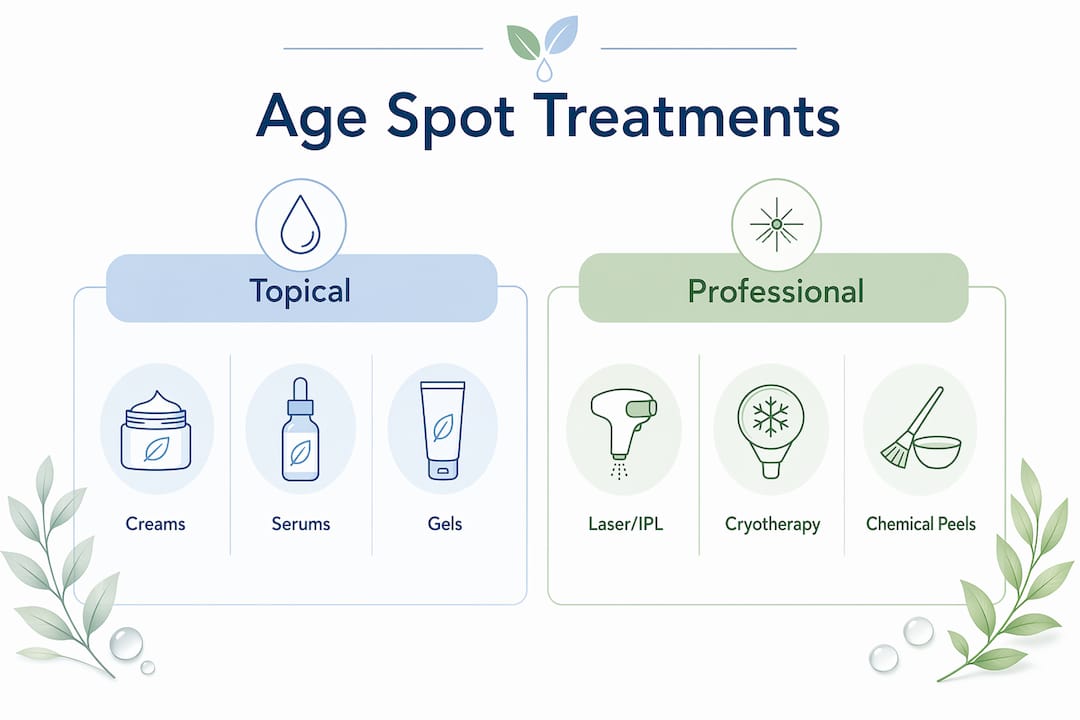
Two broad categories cover most age spot removal options. Topical treatments use active ingredients applied daily over weeks or months. Professional procedures use physical energy, such as cold, light, or chemical agents, to remove pigment faster. Dermatologists often recommend starting with topical methods and escalating to procedures when spots are deep, numerous, or resistant to creams.
How do topical treatments work for age spots?
Topical treatments are the most accessible age spot treatment methods, available both by prescription and over the counter. Prescription creams containing hydroquinone, tretinoin, and mild steroids fade spots gradually over months. Hydroquinone blocks the enzyme that triggers melanin production. Tretinoin speeds up cell turnover, pushing pigmented cells toward the surface where they shed. Temporary redness and dryness are common side effects, especially in the first few weeks.

Over-the-counter options work more slowly but suit people with sensitive skin. Fade creams with hydroquinone, glycolic acid, kojic acid, vitamin C, and niacinamide all target pigment through different pathways. Vitamin C inhibits melanin synthesis. Glycolic acid exfoliates the surface to speed fading. Kojic acid, derived from fungi, blocks the same enzyme as hydroquinone but with less irritation risk. Results depend on spot depth and how consistently you apply the product.
Key habits that improve topical treatment results:
- Apply your chosen cream or serum every night to clean, dry skin.
- Use a broad-spectrum SPF 30+ sunscreen every morning without exception.
- Give any topical treatment at least 8–12 weeks before judging results.
- Avoid mixing multiple active ingredients without dermatologist guidance, as irritation compounds quickly.
- If redness or peeling persists beyond two weeks, reduce application frequency before stopping entirely.
Pro Tip: Pair a vitamin C serum in the morning with a retinoid at night. This combination addresses pigment from two angles simultaneously and is well-tolerated by most skin types over 40 when introduced gradually.
Many people underestimate how long topical treatments take. Pigment sits deep in the epidermis, not on the surface, so results take time. Patience and consistency matter more than product price.
What professional procedures are available for age spot removal?
Professional age spot removal procedures work faster than topical creams and suit people with stubborn or numerous spots. Each method targets pigment differently, and the right choice depends on your skin tone, spot size, and tolerance for downtime.
| Procedure | Mechanism | Sessions needed | Recovery time | Key risk |
|---|---|---|---|---|
| Cryotherapy | Liquid nitrogen freezes pigment cells | 1–2 | Days to weeks | Scarring, skin lightening |
| Laser (non-ablative) | Destroys melanocytes without surface damage | 2–3 | Minimal | Temporary redness |
| Laser (ablative) | Removes top skin layers | 1–2 | 1–2 weeks | Infection, color change |
| IPL (Intense Pulsed Light) | Broad-spectrum light targets pigment | 2–3 | Minimal | Mild redness |
| Chemical peel | Acid removes outer skin layers | 2–4 | Days to weeks | Scarring, pigment change |
| Dermabrasion | Physical abrasion removes surface skin | 1–2 | 1–2 weeks | Scarring, infection |
Cryotherapy uses a cotton-tipped swab or spray to apply liquid nitrogen directly to the spot. The freezing destroys excess pigment cells, and as the skin heals, it appears lighter. Sessions are short, often under 10 minutes, but the treated area can blister and take weeks to fully heal. Scarring is a real risk, particularly on darker skin tones.
Laser and IPL treatments may require 2–3 sessions to fully destroy melanocytes. Non-ablative lasers leave the skin surface intact and require minimal downtime. Ablative lasers remove the top skin layers entirely, producing faster results but demanding a longer recovery. IPL uses broad-spectrum light rather than a single wavelength, making it effective for multiple spots across a large area in one session.
Chemical peels remove the skin’s outer layers using acids such as glycolic, trichloroacetic, or salicylic acid. Redness can persist for weeks after a medium or deep peel. Multiple treatments are often needed, and there is a real risk of infection or permanent pigment changes if aftercare is not followed precisely.
Pro Tip: Ask your dermatologist about non-ablative laser or IPL before committing to cryotherapy or ablative procedures. Non-ablative options deliver strong results with significantly less downtime, which matters when you have a busy schedule.
What role does sun protection play in age spot treatment?
Sun protection is not optional when treating age spots. Without consistent sunscreen use, new spots develop even after successful treatment, because the underlying UV sensitivity remains. The American Academy of Dermatology confirms that starting with sun protection enhances the effectiveness of every fading treatment and prevents new pigmentation from forming.
A practical sun protection routine for people over 40:
- Apply a broad-spectrum SPF 30+ sunscreen 15–30 minutes before going outside.
- Reapply every two hours during outdoor activity, or immediately after swimming or sweating.
- Wear UPF 40–50 clothing, including wide-brim hats, for extended outdoor time.
- Avoid peak UV hours between 10 a.m. and 4 p.m. when possible.
- Choose a tinted sunscreen containing iron oxide. Tinted sunscreens with iron oxide block visible light, an often-overlooked trigger for dark spots that regular sunscreens miss entirely.
Sun protection is a permanent part of any age spot treatment plan, not just a phase. Treatments remove existing pigment. They do not reprogram your skin’s response to UV light. Building a summer skincare routine that centers on daily SPF use is the single most effective way to protect your results long-term.
How to choose the best age spot treatment for your skin
Choosing the right treatment starts with a dermatologist visit, not a product search. Confirming that spots are benign before any cosmetic treatment is critical, because some skin cancers closely mimic age spots in appearance. A dermatologist can rule out melanoma and recommend the safest path forward based on your specific skin.
Factors that shape the right treatment choice:
- Skin tone: Darker skin tones carry a higher risk of post-treatment discoloration from cryotherapy and ablative lasers. Non-ablative options and topical agents are generally safer starting points.
- Spot depth and size: Superficial spots respond well to topical creams and light chemical peels. Deep or large spots often need laser or cryotherapy.
- Downtime tolerance: Professional procedures require recovery time. If your schedule does not allow for visible redness or peeling, topical treatments are the practical choice.
- Budget: Topical creams cost far less than in-office procedures. Laser sessions typically run several hundred dollars each, and multiple sessions are standard.
- Preference for natural methods: Ingredients like vitamin C, niacinamide, and kojic acid offer gentler, plant-adjacent options. A multi-step skincare routine that layers these actives can produce meaningful results over time without clinical intervention.
Combining approaches often works best. Many dermatologists recommend a topical maintenance routine alongside periodic professional treatments. Exfoliation tips for mature skin can also support treatment by accelerating the shedding of pigmented surface cells between sessions.
Key Takeaways
Age spot treatment works best when topical agents, professional procedures, and daily sun protection are used together as a coordinated plan rather than as isolated fixes.
| Point | Details |
|---|---|
| Diagnosis comes first | See a dermatologist to confirm spots are benign before starting any cosmetic treatment. |
| Topical treatments need time | Hydroquinone, vitamin C, and retinoids require 8–12 weeks of consistent use to show results. |
| Professional procedures work faster | Laser, IPL, and cryotherapy deliver quicker fading but carry risks and require recovery time. |
| Sun protection is non-negotiable | SPF 30+ daily prevents new spots and protects results from every treatment method. |
| Skin tone affects your options | Darker skin tones need gentler approaches to avoid post-treatment discoloration. |
What I’ve learned about treating age spots after years in skincare
The biggest mistake I see is people skipping the dermatologist and going straight to the strongest product they can find online. Age spots that look identical can have very different causes, and one of them is skin cancer. Getting a clear diagnosis first is not overcautious. It is the only way to treat with confidence.
The second mistake is expecting fast results from topical treatments. Pigment sits deep in the skin. A cream applied for three weeks has barely reached the layer it needs to affect. I tell anyone starting a topical routine to commit to three months before making any judgment. The people who quit at week four are the ones who say “nothing works.”
I also think the industry undersells sun protection as a treatment tool. Most people treat SPF as a finishing step. The research is clear: ongoing UV damage undoes treatment results faster than any cream can reverse them. A tinted SPF with iron oxide worn daily does more for long-term skin clarity than most serums.
My honest recommendation: start with a dermatologist visit, build a consistent topical routine using vitamin C and a retinoid, and wear SPF every single day. Add professional procedures only when you have a clear diagnosis, realistic expectations, and the time to recover properly. Natural and clinical approaches are not opposites. The best results come from using both intelligently.
— Barbara
Natural skincare for age spots and brighter skin after 40
Miraclegelnaturalskincare offers a curated range of natural skincare for 40+ skin, formulated specifically for mature skin prone to pigmentation and uneven tone. The products focus on plant-based actives that complement both topical treatment routines and post-procedure maintenance, without the harsh chemicals that can irritate sensitive skin.
Founder Shelly Maguire built the Miraclegelnaturalskincare line around the principle that effective skincare does not require aggressive ingredients. The range includes brightening serums, moisturizers, and targeted treatments designed to work with your skin’s natural renewal process. For anyone over 40 managing age spots alongside other signs of aging, the brightening product range offers a gentle, evidence-informed starting point that fits naturally into a daily routine.
FAQ
What is the fastest age spot treatment available?
Professional laser and IPL treatments produce the fastest results, often visibly fading spots within 2–3 sessions. Topical creams take 8–12 weeks of consistent use to show comparable improvement.
Can age spots be treated at home without seeing a doctor?
Over-the-counter creams with hydroquinone, glycolic acid, or kojic acid can lighten spots at home, but a dermatologist visit is strongly recommended first to rule out skin cancer.
How long does age spot treatment take to work?
Topical treatments typically require several weeks to months of regular application. Professional procedures like laser or cryotherapy show results faster, though full healing may take additional weeks.
Does sunscreen help with existing age spots?
Sunscreen does not fade existing spots, but consistent SPF 30+ use prevents new ones from forming and stops UV exposure from darkening spots that are already being treated.
Are natural remedies effective for age spots?
Natural ingredients like vitamin C, niacinamide, and kojic acid have real evidence supporting their ability to inhibit melanin production and gradually lighten spots with consistent use over time.