

TL;DR:
- Choosing fragrance-free, ceramide-rich moisturizers helps hydrate and protect sensitive skin effectively.
- Using short ingredient lists and performing patch tests reduces the risk of irritation and reactions.
Choosing gentle moisturizers means selecting products that hydrate effectively while minimizing irritation through fragrance-free, hypoallergenic formulations backed by dermatological research. For anyone over 30 with sensitive skin, the stakes are higher. Your skin barrier naturally thins with age, making it more reactive to harsh ingredients. The gold standard for how to choose gentle moisturizers comes down to three non-negotiables: a short ingredient list, no added fragrance, and clinically recognized hydrating agents like ceramides. Get those three right, and you have a strong foundation for calm, well-hydrated skin.
How to choose gentle moisturizers: the core criteria
A gentle moisturizer is defined by what it leaves out as much as what it includes. Fragrance is one of the most common causes of allergic contact dermatitis in sensitive skin. That single fact rules out a large portion of mainstream products on the shelf.
Dermatological guidance recommends looking for the National Eczema Association Seal as a reliable marker of safety for reactive skin. Products carrying this seal have been reviewed for irritating ingredients and are considered suitable for conditions like eczema and rosacea. If you have persistent sensitivity, that seal is a shortcut worth using.
Ingredient list length matters too. A list of about 10 or fewer ingredients reduces the risk of triggering a reaction, especially for skin prone to rosacea. Each additional ingredient is another potential irritant. Simplicity is not a compromise. It is the most effective strategy for sensitive skin.
The term “hypoallergenic” is widely used but not regulated by the FDA. That means any brand can print it on a label without clinical proof. Pair that label with fragrance-free status and allergy-tested certification for real confidence.
What ingredients actually hydrate sensitive skin?
The four ingredient classes that define effective, gentle hydration are ceramides, humectants, emollients, and occlusives. Each plays a different role, and the best moisturizers for sensitive skin combine all four.
Ceramides are lipids that naturally occur in your skin barrier. They hold skin cells together and prevent water from escaping. Ceramide-rich moisturizers can retain moisture for up to 120 hours, and 92% of sensitive skin users report immediate soothing relief on application. That combination of long-term retention and fast comfort makes ceramides the most important ingredient to look for on a label. You can learn more about how ceramides and humectants work together to support the skin barrier.
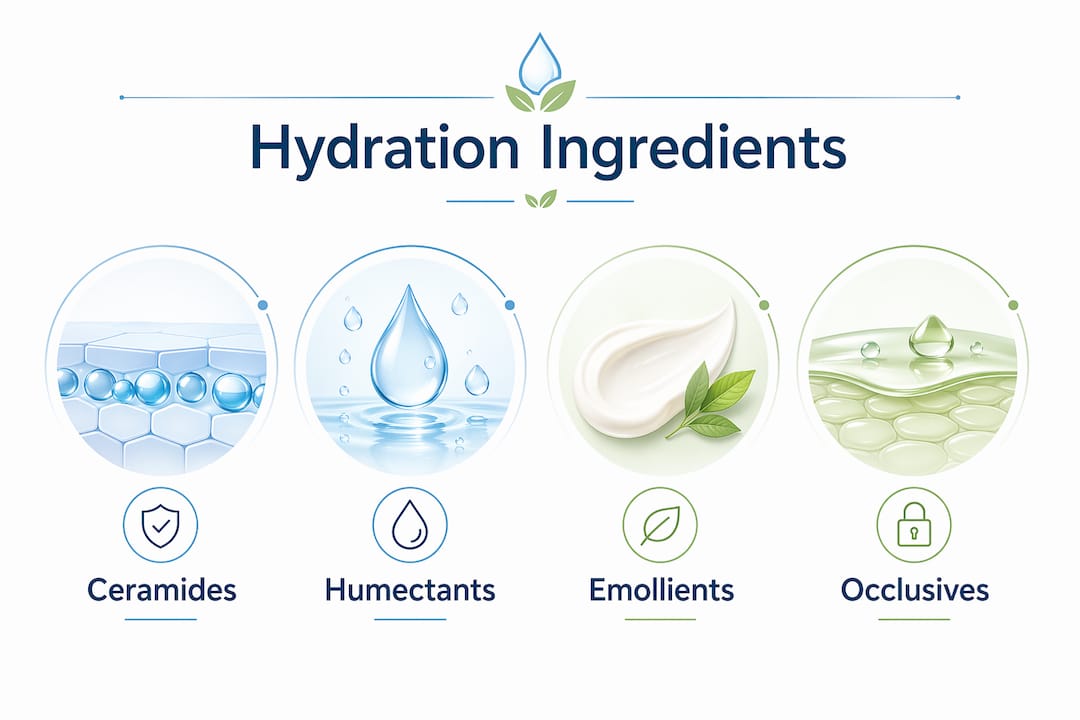
Humectants pull water into the skin from the environment. Glycerin and hyaluronic acid are the two most common. They work well in humid conditions but have a catch: in low humidity, humectants can pull moisture from deeper skin layers instead of the air, which can actually dry skin out. That is why humectants should always be paired with an occlusive.
Emollients smooth the skin surface by filling gaps between skin cells. Ingredients like squalane, shea butter, and jojoba oil fall into this category. They improve texture and reduce the rough, tight feeling that sensitive skin often experiences.
Occlusives form a physical seal over the skin to lock in moisture. Petrolatum is the most effective occlusive known, but plant-based options like beeswax and candelilla wax work well for those preferring natural formulas.
Here is a quick reference for each ingredient class:
| Ingredient class | Function | Common examples |
|---|---|---|
| Ceramides | Restore and reinforce skin barrier | Ceramide NP, ceramide AP, ceramide EOP |
| Humectants | Draw water into the skin | Glycerin, hyaluronic acid, aloe vera |
| Emollients | Smooth and soften skin surface | Squalane, shea butter, jojoba oil |
| Occlusives | Seal in moisture and prevent water loss | Petrolatum, beeswax, candelilla wax |
Pro Tip: Apply your moisturizer on damp skin, right after cleansing. Occlusives lock in hydration most effectively when there is already surface moisture to seal in, especially in dry or low-humidity environments.
Does texture matter when picking a moisturizer for sensitive skin?
Texture is a reliable indicator of how a moisturizer will perform on your specific skin type. Getting this right prevents the two most common complaints: greasiness and tightness.
Thick, frosting-like creams suit dry sensitive skin best. They deliver a higher concentration of emollients and occlusives, which is exactly what dry skin needs to feel comfortable and stay hydrated through the day. If your skin feels tight after cleansing or flakes in winter, a rich cream is your best option.
Gel-based moisturizers absorb quickly and feel lightweight on the skin. They suit oily or reactive sensitive skin well because they deliver hydration without leaving a greasy residue. Gel-creams, which blend both textures, work for combination skin types that are sensitive in some zones and oily in others.
Lotions sit between creams and gels. They spread easily and absorb at a moderate pace. They are a practical choice for sensitive skin that is neither very dry nor very oily, and they work well as a daily moisturizer under makeup.
Key texture guidelines for sensitive skin:
- Dry sensitive skin: choose a rich cream with ceramides and shea butter
- Oily or reactive skin: choose a gel or gel-cream with glycerin and hyaluronic acid
- Combination sensitive skin: choose a lotion or lightweight gel-cream
- Skin prone to rosacea: avoid anything with fragrance, alcohol, or menthol regardless of texture
Avoiding irritants matters as much as choosing the right texture. Fragrance, denatured alcohol, and strong actives like retinol or AHAs can all trigger flares in sensitive skin. For a deeper look at which ingredients to avoid, the guide on harsh chemicals in skincare is worth reading before you shop.
How do seasons and humidity change what your skin needs?
Your skin’s hydration needs shift with the weather, and the moisturizer that works perfectly in summer may leave your skin dry and tight in winter. This is not a product failure. It is physics.
High humidity above 70% allows humectants like glycerin to pull moisture directly from the air into your skin. In those conditions, a lightweight gel or lotion with humectants is often enough. You do not need a heavy cream when the air itself is doing part of the work.
Low humidity flips the equation. When the air is dry, humectants have no external moisture source to draw from. They pull from deeper skin layers instead, which can worsen dryness over time. In low-humidity conditions, occlusives become the priority. A richer cream or a dedicated occlusive layer applied over your humectant seals in what is already there.
Practical seasonal adjustments for sensitive skin:
- Spring and summer: use a lightweight gel-cream with glycerin or hyaluronic acid
- Fall and winter: switch to a richer cream with ceramides and an occlusive like beeswax or shea butter
- Heated indoor environments: add a humidifier and layer a humectant serum under your cream
- Air travel: apply an occlusive balm before boarding; cabin air is extremely low humidity
Pro Tip: Gel moisturizers can pill when layered under certain makeup formulations. Test your moisturizer under your foundation before committing to a full-face routine. Apply, wait 60 seconds, then apply makeup over a small patch first.
Step-by-step guide to selecting and using a gentle moisturizer
Choosing the right moisturizer is a process, not a single decision. These steps reduce the risk of irritation and help you find a product that genuinely works for your skin.
- Check the label for key certifications. Look for fragrance-free status, hypoallergenic testing, and the National Eczema Association Seal if your skin is highly reactive. Avoid products labeled “unscented” only. Unscented can still contain masking fragrances.
- Count the ingredients. A list of 10 or fewer ingredients is safer for sensitive skin. Scan for ceramides, glycerin, or hyaluronic acid in the top half of the list. Ingredients are listed by concentration, so position matters.
- Patch test before full application. Apply a small amount to the inside of your wrist or behind your ear. Wait 24–48 hours. If no redness, itching, or swelling appears, the product is likely safe for your face.
- Apply on damp skin. Pat your face dry after cleansing, leaving a little moisture on the surface. Apply your moisturizer within 60 seconds. This technique maximizes absorption and helps occlusives lock in hydration.
- Troubleshoot common problems. Pilling usually means the moisturizer is incompatible with a product underneath it. Try applying on bare skin first. Breakouts after starting a new moisturizer suggest a comedogenic ingredient. Check the label for coconut oil, cocoa butter, or isopropyl myristate.
- Consult a dermatologist for persistent issues. If your skin reacts to multiple products or you have a diagnosed condition like eczema, a dermatologist can recommend prescription-strength barrier repair options. Over-the-counter products have limits.
| Issue | Likely cause | Fix |
|---|---|---|
| Pilling under makeup | Gel formula incompatible with foundation | Wait longer before applying makeup; switch to a lotion |
| Breakouts after use | Comedogenic ingredient in formula | Check for coconut oil or isopropyl myristate; choose non-comedogenic options |
| Tightness after application | Insufficient occlusives for your skin type | Switch to a richer cream with ceramides and shea butter |
| Redness or itching | Fragrance or alcohol in formula | Switch to a certified fragrance-free product |
For those over 40, the guide on choosing an organic moisturizer adds useful context on natural ingredient priorities for mature, sensitive skin.
Key Takeaways
The most effective approach to choosing gentle moisturizers is to prioritize fragrance-free, ceramide-rich formulas with short ingredient lists, then adjust texture and weight to match your skin type and seasonal conditions.
| Point | Details |
|---|---|
| Fragrance-free is non-negotiable | Fragrance is a leading cause of allergic contact dermatitis in sensitive skin. |
| Ceramides anchor barrier repair | Ceramide-rich formulas retain moisture for up to 120 hours and soothe on contact. |
| Match texture to skin type | Rich creams suit dry skin; gel-creams suit oily or reactive skin. |
| Adjust for humidity and season | Use occlusives in low humidity; humectants work best when air moisture is high. |
| Patch test every new product | Apply to the wrist for 24–48 hours before using on your face. |
What I have learned after years of watching skin respond to less
After working with skincare formulations and watching how skin behaves across different ages and climates, one pattern stands out clearly. The people who see the most consistent improvement in sensitive skin are the ones who do less, not more.
The instinct after 30 is to add. Add an active, add a serum, add something that promises faster results. But sensitive skin does not reward that approach. Every additional ingredient is a variable. The more variables you introduce, the harder it becomes to identify what is helping and what is causing a reaction.
What actually works is a short, consistent routine built around barrier support. Ceramides, glycerin, and a good occlusive applied on damp skin will outperform a 10-step routine loaded with actives for most sensitive skin types. I have seen this play out repeatedly. Simplicity is not a beginner strategy. It is the advanced one.
The seasonal adjustment piece is also underestimated. Most people use the same moisturizer year-round and wonder why their skin feels different in winter. Switching from a gel to a ceramide-rich cream when temperatures drop is one of the highest-return changes you can make with almost no cost or effort.
Natural ingredient formulas have a real advantage here. Botanical emollients like squalane and jojoba oil tend to be well-tolerated by sensitive skin and provide a gentler alternative to synthetic emollients. When you pair those with proven humectants and a clean, short ingredient list, you get a moisturizer that supports the skin barrier without adding unnecessary risk. That is the standard worth holding every product to.
— Barbara
Gentle hydration for sensitive, mature skin at Miraclegelnaturalskincare
Miraclegelnaturalskincare formulates its moisturizers specifically for sensitive skin over 30, with fragrance-free, natural ingredient profiles built around ceramides, humectants, and soothing botanicals. Every product skips the irritants and focuses on what the skin barrier actually needs.

The 2-Minute Miracle Moisturizer delivers deep hydration through a natural formula designed for daily use on sensitive, mature skin. For those looking at a complete routine, the natural skincare range for 40+ includes cleansers, serums, and moisturizers formulated to work together without triggering sensitivity. If you are ready to simplify your routine and see what a clean, gentle formula can do, the full product range is a good place to start.
FAQ
What makes a moisturizer gentle for sensitive skin?
A gentle moisturizer is fragrance-free, hypoallergenic, and formulated with a short ingredient list of 10 or fewer items. It contains barrier-supporting ingredients like ceramides and glycerin, and carries certifications such as the National Eczema Association Seal.
How do I know which moisturizer texture suits my skin?
Thick creams suit dry sensitive skin; gel or gel-cream formulas suit oily or reactive skin. Texture directly predicts performance, so matching texture to your skin type reduces the risk of greasiness or tightness.
Can I use the same moisturizer in summer and winter?
Skin hydration needs change with humidity and temperature, so the same formula may not perform equally across seasons. Switch to a richer, ceramide-based cream in winter and a lightweight gel-cream in summer for best results.
Why does my moisturizer pill under makeup?
Pilling happens when a gel-based moisturizer is incompatible with the makeup formula applied over it. Gel moisturizers can pill under certain foundations. Wait at least 60 seconds after applying your moisturizer before layering makeup, and patch test the combination first.
Should I patch test a new moisturizer even if it says hypoallergenic?
Yes. “Hypoallergenic” is not an FDA-regulated claim, so it does not guarantee your skin will not react. Apply a small amount to your inner wrist and wait 24–48 hours before using the product on your face.