

Cleanse first, then exfoliate. Dermatologists at the American Academy of Dermatology and researchers reviewing topical acid treatments agree that a clean face lets exfoliants reach dead skin cells instead of wasting effort on makeup, sunscreen, and daily grime. The only exception is a handful of specialized professional techniques, which don’t apply to a home routine. Do this a few times per week, in the evening, and you’ll see improvement within some weeks.
TL;DR:
- Cleansing before exfoliating ensures acids reach dead skin cells directly without interference from makeup, sunscreen, or oil residues.
- Waiting about 60 seconds after cleansing before applying acids stabilizes skin pH and prevents unpredictable penetration or irritation.
- Exfoliating once or twice weekly in the evening supports skin repair and avoids sun sensitivity, with sensitive skin requiring caution and less frequent treatments.
- Over-exfoliation causes redness, tightness, or burns, which can be remedied with rest, increased hydration, and patch testing before reapplication.
- Using gentle, multi-functional products designed for a cleanse-then-treat routine simplifies adherence and reduces irritation risk.
Table of Contents
- Why Cleanse Before Exfoliating? The Evidence and the Mechanism
- How to Exfoliate Safely After Cleansing
- When and How Often Should You Exfoliate?
- Common Exfoliation Mistakes (and How to Fix Them)
- Where Our Products Fit Into This Routine
- A Simple Evening Routine That Follows This Order
- Build the Routine With the Right Products
- Sources
- FAQ
Why Cleanse Before Exfoliating? The Evidence and the Mechanism
Skip the cleanse and your exfoliant spends its energy on the wrong target. Sunscreen residue, oil, and makeup sit on top of your skin like a film, and an acid or scrub applied over that film reacts with debris instead of the dead cells you actually want to remove. Medical News Today’s breakdown of the cleanse-versus-exfoliate order confirms the consensus among skin experts: cleansing first lets exfoliants work directly on the stratum corneum, the outermost layer where dead cells accumulate.
There’s a second risk nobody mentions enough. Exfoliating over unremoved surface debris can push that grime deeper into pores rather than lifting it away, which is the opposite of what you want from a treatment step. The American Academy of Dermatology’s guide to safe at-home exfoliation specifically calls for removing makeup and sunscreen before any active exfoliation step.
The mechanism is straightforward once you see it laid out:
- Cleansing dissolves oil, sunscreen filters, and makeup binders that would otherwise coat the skin’s surface.
- A clean surface lets chemical exfoliants (acids) contact skin cells at a consistent concentration, instead of getting diluted by whatever they land on.
- Physical exfoliants glide over clean skin rather than dragging trapped debris across pores, which lowers the chance of micro-irritation.
A peer-reviewed review of topical acid treatments adds a technical layer: variables like pH, exposure time, and skin hydration all change how deeply an acid penetrates. That’s not a minor footnote. It’s the reason the next section spends real time on dry versus damp skin and exact wait periods, rather than treating “apply exfoliant” as a single generic step.
How to Exfoliate Safely After Cleansing
The exact steps change depending on whether you’re using a chemical exfoliant (an acid, like glycolic or lactic) or a physical one (a scrub or textured tool). Both start the same way.
- Double-cleanse if you’re wearing sunscreen or long-wear makeup. An oil-based cleanser first, then a water-based one, clears residue that a single wash often misses, a method AAD’s face-washing guidance supports for evening routines.
- Pat your face dry. Don’t rub. Most chemical exfoliants are formulated for dry skin unless the label says otherwise, and applying acid to a damp face can push penetration up unpredictably.
- Wait about 60 seconds before applying a chemical exfoliant. This gives your skin’s surface pH a chance to normalize after rinsing, which keeps the acid’s activity closer to what the formula intends.
- Apply a thin layer and let it sit for the time the product specifies. More product or longer contact doesn’t mean better results. It usually means more redness.
- Patch-test any new acid on your inner arm for 24 hours before a full-face application, then introduce it once a week and increase frequency only if your skin tolerates it without redness or flaking.
Pro Tip: Set a phone timer for that 60-second wait after cleansing. It feels unnecessary until you notice your skin stings less on acid nights when you actually pause.
When and How Often Should You Exfoliate?
Evening wins over morning, and not by a small margin. Overnight is when skin does its repair work, so freshly exfoliated cells get to recover without makeup, pollution, or UV exposure sitting on top of them. If you exfoliate with an AHA in the morning instead, you’re taking on extra sun sensitivity for the rest of the day, and that means diligent SPF, not optional SPF.
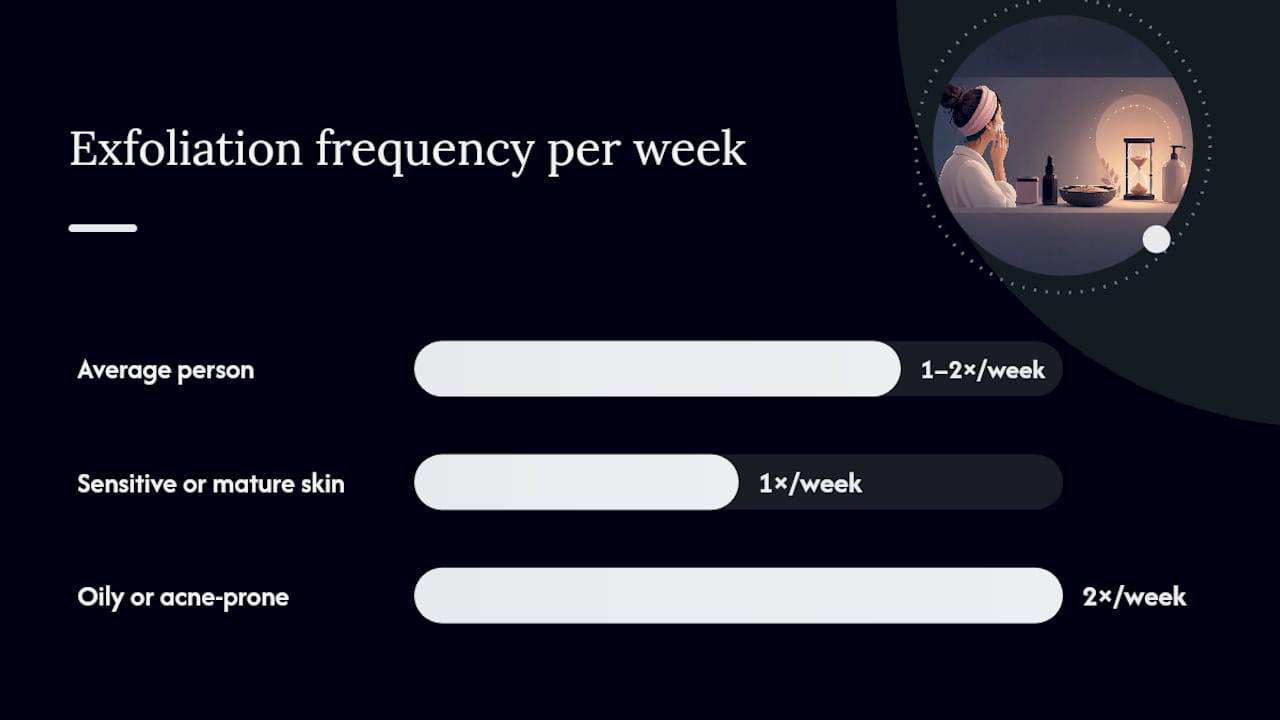
Frequency depends on your skin, but the baseline most dermatology sources point to is one to two times per week for the average person, according to Medical News Today. Push past that and you risk weakening your skin’s barrier rather than improving its texture.
- Sensitive or mature skin: once a week is often the safer starting point, with barrier support prioritized between sessions.
- Oily or acne-prone skin: two times a week is usually fine, but jumping higher should happen only under a clinician’s advice, not on a whim.
- Anyone using prescription retinoids or benzoyl peroxide: space exfoliation days away from active-treatment nights entirely. Layering two strong actives back to back is the fastest route to a compromised barrier.
Common Exfoliation Mistakes (and How to Fix Them)
Redness that lingers, a tight or shiny look, or stinging when you apply a normally gentle moisturizer are early signs of over-exfoliation. Catch it early and the fix is simple.
- Stop all active exfoliants immediately and let skin rest for several days to a week.
- Moisturize consistently, leaning on richer formulas while the barrier recovers.
- Patch-test before reintroducing any acid or scrub, even one you’ve used before without issue.
Exfoliating on damp skin or before cleansing causes more irritation than most people expect, partly because unpredictable acid penetration and partly because grinding debris across the skin’s surface can aggravate pores instead of clearing them. If you’re combining exfoliation with retinoids, alternate nights rather than stacking both. And if irritation persists beyond a week of rest, or you notice broken skin, persistent burning, or breakouts that look infected, that’s the point to see a dermatologist. Bring a list of every active product you’re using, including strength and frequency, so they can pinpoint what’s actually causing the reaction.
Where Our Products Fit Into This Routine
Getting the order right matters more than which specific formula you use, but the right products make the routine easier to stick with. Shelly Maguire, founder of Miraclegelnaturalskincare, built the brand’s line around gentle, multi-step-friendly formulas rather than harsh acids or grainy scrubs, which fits neatly into a cleanse-then-treat sequence without adding extra irritation risk.
A gentle cleansing workflow clears the surface first, then a thin, multitasking treatment step can follow once skin is dry and settled. That’s the same sequence dermatology sources recommend, just mapped onto real products instead of generic categories. None of this replaces a dermatologist’s advice for diagnosed skin conditions. It’s a starting framework for people who want a routine that respects the barrier while still targeting texture and tone.

A Simple Evening Routine That Follows This Order
Here’s the short version worth keeping on your bathroom mirror: remove makeup if you’re wearing any, cleanse gently, exfoliate once or twice a week, then follow with moisturizer or serum while skin is still slightly damp. Wait roughly a minute between cleansing and any acid step, and skip the exfoliation night entirely if your skin already feels tight or reactive. Mature or sensitive skin does better sticking to once weekly rather than pushing to twice.
The morning after an exfoliation night is not optional SPF territory. Freshly exfoliated skin is more reactive to UV, so sunscreen isn’t a nice extra, it’s the step that protects the work you just did.
— Barbara
Build the Routine With the Right Products
Most exfoliation problems trace back to fighting your products instead of working with them. Harsh acids and gritty scrubs demand precise timing and constant vigilance for irritation, which is exactly the opposite of what a busy evening routine needs. The line is built around gentle, multi-functional formulas so the cleanse-then-treat order this article describes is easy to follow without babysitting every step.

Start with a cleanser from the cleanser collection to clear the surface properly, then follow with the 2 Minute Miracle Gel (€50.00) as your treatment step once skin is dry and settled. Seal it in with the 2 Minute Miracle Moisturizer (€47.95) to support barrier recovery overnight. If your skin runs on the reactive side, the Sensitive Skin Safe collection narrows the options further. Browse the full shop to put together a routine that matches your skin type tonight.
This article is general information, not a substitute for advice from a qualified doctor. Consult a qualified healthcare professional about your own circumstances before acting on anything here.
Sources
- Should a person cleanse or exfoliate first? (Medical News Today)
- Safely exfoliate at home (American Academy of Dermatology)
- Topical acid treatments review (NCBI/PMC)
FAQ
What Is the Correct Order to Clean Your Face?
Cleanse first to remove makeup, sunscreen, and oil, then exfoliate if it’s your one or two scheduled days that week, then apply serum or treatment, and finish with moisturizer. Exfoliating before cleansing risks pushing surface debris deeper into pores rather than removing it, according to Medical News Today.
What Is the “4-2-4” Rule in Skincare?
There’s no single, widely recognized dermatology standard called the “4-2-4 rule.” Some skincare content uses it loosely to describe a simplified routine structure, but definitions vary across sources, so it’s worth treating any version you see with caution rather than as an official framework.
What Is the Correct Way to Exfoliate?
Cleanse and pat dry first, then apply a thin layer of chemical exfoliant or massage a physical scrub gently for one to two minutes before rinsing. Stick to one or two sessions a week, and always follow with moisturizer to support the barrier, per Healthline.
What Are the Basic Steps of a Skincare Routine?
A practical evening routine runs: makeup removal if needed, gentle cleanse, exfoliation on scheduled nights only, treatment or serum, and moisturizer to lock everything in. Morning routines skip exfoliation and prioritize sunscreen, especially the day after an exfoliation night.
Does Miraclegelnaturalskincare Offer Products for This Routine?
Yes. The brand’s shop includes gentle cleansers, the 2 Minute Miracle Gel treatment, and moisturizers designed to fit a cleanse-then-treat sequence without harsh acids or abrasive scrubs. Current prices are listed on each product page.