
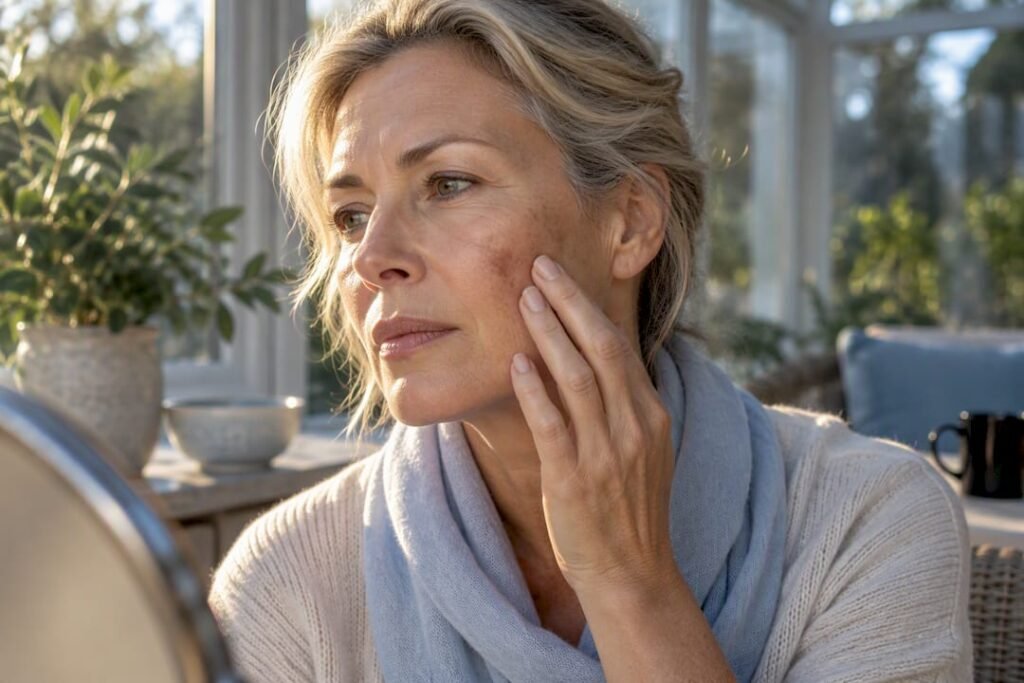
Most dark spots that show up after 40 trace back to two overlapping causes: decades of cumulative sun exposure finally surfacing as visible damage, and hormonal shifts tied to perimenopause that make skin more reactive to UV light. The fix starts immediately, regardless of which cause applies to you: strict daily sun protection, and a dermatologist visit if any spot is new, growing, bleeding, or asymmetrical. Everything else, including which treatment to try, comes second.
TL;DR:
- Daily broad-spectrum sunscreen with SPF 50 is recommended, especially for melasma-prone skin, with reapplication every two hours and use on cloudy days.
- In-office procedures like chemical peels and microneedling provide faster results but carry higher risks, particularly for darker skin tones, and require ongoing sun protection to prevent recurrence.
- Topical treatments such as hydroquinone, tranexamic acid, retinoids, azelaic acid, and antioxidants need three to twelve months of consistent use to show significant improvement.
- Sun damage and hormonal fluctuations are the primary causes of hyperpigmentation after 40, with inflammation and medication triggers also playing a role, especially in sensitive skin.
- Prevention and gentle daily maintenance are key, with products designed to support skin barrier health and avoid harsh exfoliants that can trigger post-inflammatory hyperpigmentation.
Table of Contents
- What Does Hyperpigmentation After 40 Look Like?
- Why Do Dark Spots Show Up or Worsen After 40?
- Building a Daily Routine That Prevents New Spots
- What Treatments Actually Fade Dark Spots, and How Long Do They Take?
- A Gentle Maintenance Routine That Supports What You’re Already Doing
- Realistic Expectations for Skin After 40
- Simple, Gentle Maintenance for Skin You’re Already Protecting
- Sources
- FAQ
What Does Hyperpigmentation After 40 Look Like?
Not every dark mark is the same condition, and telling them apart matters because the treatment for one can make another worse. Four patterns show up most often once you cross into your 40s.
- Solar lentigines (age spots). Flat, tan to dark brown, sharply defined. They cluster on the face, backs of the hands, shoulders, and upper back, the areas that catch the most sun over a lifetime, according to Mayo Clinic.
- Melasma. Larger, blotchy, often symmetrical patches on the cheeks, forehead, or upper lip. It’s driven heavily by hormones and worsens with sun and even visible light.
- Post-inflammatory hyperpigmentation (PIH). Marks left behind after acne, a burn, a cut, or an aggressive facial treatment. The shape mirrors whatever injury caused it.
- Maturational hyperpigmentation. A general dulling and unevenness across the whole face, a slower, cumulative type tied to aging skin rather than one specific trigger.
Harvard Health groups melasma, PIH, and maturational hyperpigmentation together because sun exposure, hormones, inflammation, and genetics drive all three, often at the same time.
Here’s the line that actually matters for safety: a spot that changes shape, bleeds, itches, or develops uneven borders within weeks is not a pigmentation problem to treat at home. That’s a reason to get it looked at, full stop.
Why Do Dark Spots Show Up or Worsen After 40?
Sun damage is the biggest lever you can actually pull. Ultraviolet exposure accumulates invisibly for years before it shows up as a lentigo on your hand or a patch on your cheek, and by your 40s, decades of exposure have caught up with you.
Hormones complicate the picture in a way sun exposure alone doesn’t. Perimenopause and menopause bring estrogen and progesterone fluctuations that appear to increase melanocyte activity, and that shift can trigger new melasma or intensify pigment that was previously manageable. Harvard Health notes that some spots may actually fade once hormones settle after menopause, but the transition years are when proactive sun protection matters most.
Three other factors deserve attention:
- Inflammation and skin injury. Acne breakouts, cuts, insect bites, or an overly aggressive peel or laser session can leave PIH behind, and skin over 40 tends to hold onto that discoloration longer than younger skin does.
- Medication triggers. Certain antibiotics, hormone therapies, and some acne treatments increase photosensitivity, raising the odds that sun exposure during use leaves a mark.
- Slower cell turnover and a thinner barrier. Skin renews itself more slowly with age, which means pigment sits closer to the surface longer, and a compromised barrier makes skin more reactive to treatments that would have been tolerated fine at 30.
Darker skin tones face an added complication worth naming directly: more melanin-producing cells means a higher baseline risk of PIH from any inflammatory event, including some cosmetic procedures, which shapes which treatments are appropriate later in this guide.
Building a Daily Routine That Prevents New Spots
Prevention is the one part of this equation almost entirely under your control, and it’s less complicated than most product marketing makes it sound.
- Wear broad-spectrum sunscreen every day, rain or shine. SPF 30 is the baseline; SPF 50 makes sense if you’re melasma-prone, spend real time outdoors, or live somewhere with intense year-round sun. Reapply every two hours outdoors, and don’t skip it on cloudy days, since UV penetrates cloud cover.
- Choose a tinted, iron oxide sunscreen if you have melasma or dark spots. Visible light, the kind that comes through windows and screens, can worsen melasma on its own, and the American Academy of Dermatology specifically recommends tinted formulas containing iron oxide for meaningful protection against it. Standard clear sunscreens don’t block visible light the same way.
- Add physical barriers. A wide-brimmed hat and UPF-rated clothing cut your UV exposure without relying on reapplication timing, which is useful on long outdoor days when reapplying sunscreen every two hours isn’t practical.
- Support your skin barrier before you chase brightening. A compromised barrier makes every active ingredient more irritating and every irritation more likely to leave PIH behind. A gentle, hydrating moisturizer isn’t optional at this stage; it’s the foundation everything else sits on.
- Introduce brightening actives slowly. Vitamin C in the morning, niacinamide layered underneath or mixed into serums, and a gentle retinoid at night, introduced one at a time, a few nights a week to start, so you can spot irritation before it becomes a new source of pigment.
- Skip harsh exfoliation. Physical scrubs and high-strength acid peels done at home carry real risk of micro-injury, and micro-injury is exactly what triggers PIH in mature skin. If you exfoliate, choose the gentlest option available and watch how your skin responds.
Pro Tip: Apply sunscreen as the last step of your morning routine, not the first, and use roughly a nickel-sized amount for your face alone. Most people apply less than a quarter of the amount tested to achieve labeled SPF, which quietly undermines the whole routine.
What Treatments Actually Fade Dark Spots, and How Long Do They Take?
Realistic timelines matter here, because most disappointment with hyperpigmentation treatment comes from expecting two-week results from a process that runs on a three-to-twelve-month clock. The Cleveland Clinic is direct about this: topical therapies and in-office procedures both take months to show visible improvement, and pigment often returns without ongoing sun protection.
Topical options you apply at home:
- Hydroquinone. The long-standing benchmark for lightening pigment, typically used at 2% to 4% under guidance, since higher strengths and prolonged unsupervised use carry a risk of skin irritation and, rarely, a paradoxical darkening called ochronosis.
- Tranexamic acid (TXA). A newer topical option that a randomized trial comparing niosomal and conventional TXA plus niacinamide creams found produced reductions in melasma severity comparable to hydroquinone after several months, with fewer adverse reactions in some formulations, according to research published in PMC. That trial followed 99 patients and measured meaningful drops in melasma severity scores and melanin index.
- Retinoids. Speed up cell turnover so pigmented cells shed faster, though they take patience and can cause dryness on mature skin if introduced too aggressively.
- Azelaic acid. A gentler alternative for reactive or sensitive skin, useful for people who can’t tolerate hydroquinone or retinoids.
- Vitamin C and niacinamide. Lower-intensity but genuinely useful for maintenance and for slowing new pigment formation while you address existing spots with something stronger.
Procedures done in a clinician’s office:
- Chemical peels remove pigmented surface layers but need calibration to your skin tone to avoid triggering PIH instead of resolving it.
- Microneedling, particularly when used to deliver topical TXA directly into skin, has shown improved outcomes in trials compared with some comparator regimens, especially for melasma in darker skin types, though longer-term follow-up data is still limited according to research published in a 2025 European journal.
- Laser and light-based treatments can be highly effective for isolated age spots but carry real risk for melasma, where aggressive heat-based treatments frequently backfire and worsen pigment, particularly in medium to dark skin tones.
- Cryotherapy freezes off individual, well-defined spots and works reasonably well for isolated age spots, though it’s a poor choice for melasma’s diffuse patches.
- Microdermabrasion offers a milder surface exfoliation, more useful for gradual maintenance than for stubborn pigment.
At-home approaches generally take longer to show results than in-office procedures, but UC Davis Health points out that faster in-office options come with higher cost and higher risk, a trade-off worth discussing openly with a dermatologist rather than assuming faster automatically means better.
Melasma deserves a specific warning: dermatology guidance from the Primary Care Dermatology Society notes it’s notoriously difficult to treat and frequently recurs, which means the real goal isn’t a one-time fix. It’s ongoing management, anchored by sun protection, with realistic expectations about maintenance rather than cure. The sequencing that works best: stabilize skin with sun protection and gentle topicals first, then escalate to stronger actives or procedures only once your barrier is calm, and always with a dermatologist weighing in if your skin tone puts you at higher PIH risk.

A Gentle Maintenance Routine That Supports What You’re Already Doing
Sun protection and clinical treatment do the heavy lifting against active pigmentation, but the maintenance layer around them, the moisturizer, serum, and eye care you use every single day, either supports that work or quietly undoes it through irritation.
The formulas are built around that idea specifically for mature skin. The 2 Minute Miracle Peptide+ Serum uses peptides and antioxidants to support skin’s natural repair processes without the abrasive acids or grains that can trigger PIH in reactive skin. The 2 Minute Miracle Moisturizer leans on its Tri-Moisture Cryo Complex to reinforce the barrier that makes every other step in your routine, including sunscreen, work better.
A practical, non-prescriptive routine looks like this:
- Morning: gentle cleanse, antioxidant serum, peptide moisturizer, then broad-spectrum sunscreen (tinted with iron oxide if you’re melasma-prone).
- Evening: gentle cleanse, any dermatologist-prescribed treatment (hydroquinone, TXA, retinoid), followed by a barrier-supporting moisturizer to offset dryness.
The brand’s formulations are designed to avoid harsh chemicals and abrasives, which matters more after 40, when skin has less tolerance for irritation. None of this replaces medical-grade therapy for stubborn or worsening pigment. It’s the everyday layer underneath it.
Realistic Expectations for Skin After 40
Prevention beats treatment every time, and that’s not a consolation prize, it’s the actual math of how pigmentation behaves over decades. A sunscreen habit you keep for the next ten years will do more for your skin than any single peel or serum you try this year.
Patience matters more than people expect going in. Whether you’re using TXA, hydroquinone, or a series of peels, you’re realistically looking at three to twelve months before you see the change you’re hoping for, and melasma in particular tends to come back without ongoing sun protection. That’s not failure. That’s just what the condition does.
If you have medium to dark skin, be more cautious with aggressive procedures than the general advice suggests, and lean on a dermatologist who has specific experience with your skin tone. And if anything you’re watching starts to look different, not just persistent, get it checked. Pigmentation gets a lot of attention. Skin cancer screening deserves the same.
— Barbara
Simple, Gentle Maintenance for Skin You’re Already Protecting
There are products designed for the daily maintenance layer between sunscreen and dermatologist-prescribed treatment, built without the harsh acids, grains, or abrasives that can trigger new PIH in reactive, mature skin.

The lineup is straightforward. The 2 Minute Miracle Gel delivers visible results in minutes using its Tri-Moisture Cryo Complex, the 2 Minute Miracle Peptide+ Serum supports repair with peptides and antioxidants rather than exfoliating acids, and the Ice Elements Eye Serum targets the thin under-eye skin that shows irritation fastest. All three pair easily alongside anything your dermatologist has prescribed, since none of them contain the aggressive ingredients that compete with medical-grade treatments for your skin’s tolerance. If you want a starting point, the shop page lists current pricing on the full range, and the guide to brightening mature skin walks through how to sequence these products around your existing sun protection habit.
This article is general information, not a substitute for advice from a qualified doctor. Consult a qualified healthcare professional about your own circumstances before acting on anything here.
Sources
- Age spots (liver spots) – Symptoms & causes – Mayo Clinic
- Demystifying hyperpigmentation: Causes, types, and effective treatments – Harvard Health
- Hyperpigmentation: What it is, Causes, & Treatment – Cleveland Clinic
- Randomized trial comparing niosomal TXA/NCA cream and hydroquinone in melasma – PMC
FAQ
How Can You Reduce Pigmentation Naturally After 40?
Consistent daily sunscreen use is the single most effective natural step, since it prevents existing spots from darkening further and stops new ones from forming. Beyond that, antioxidant serums like vitamin C, gentle retinoids, and barrier-supporting moisturizers help fade existing pigment gradually over several months, though natural approaches work more slowly than prescription treatments like hydroquinone or TXA.
Does Hyperpigmentation Fade on Its Own With Age?
Sometimes, yes. Some hormonally driven spots can lighten once hormone levels stabilize after menopause, according to Harvard Health, but sun-induced age spots typically don’t fade without active treatment and tend to worsen with continued UV exposure.
What Fades Dark Spots the Fastest?
In-office procedures like laser treatment and chemical peels generally work faster than at-home topicals, though they carry higher cost and greater risk of triggering post-inflammatory hyperpigmentation, especially in darker skin tones. Topical tranexamic acid combined with niacinamide showed meaningful improvement within three months in a clinical trial, making it one of the faster at-home options with a solid safety profile.
How Do You Treat Menopausal Hyperpigmentation?
Menopausal hyperpigmentation, often melasma triggered or worsened by hormonal fluctuation, responds best to strict daily sun protection using a tinted, iron oxide sunscreen, since visible light worsens melasma specifically. Topical treatments like TXA, azelaic acid, or dermatologist-guided hydroquinone can help, but expect a three to twelve month timeline and understand that melasma frequently recurs without ongoing sun protection.