
TL;DR:
- Clinical trials show natural skincare can reduce wrinkles by 20-40% within 4 to 12 weeks.
- Rigorous evidence includes randomized controlled trials, objective measurements, and statistical significance.
- Consistent use of proven active ingredients, combined with sun protection, yields the best long-term results.
Most women over 40 have stood in a pharmacy aisle, product in hand, wondering if “clinically proven” actually means anything. It’s a fair question. The beauty industry has a long history of stretching the truth. But here’s what’s real: recent trials show natural skincare actives can deliver wrinkle reduction of 20-40% and measurable firmness improvements in as little as four weeks. That’s not marketing copy. That’s data from structured clinical studies. Understanding how to read that evidence, and which results are realistic for your skin, is the smartest thing you can do before spending another euro on skincare.
Table of Contents
- What clinically proven means in skincare
- Real results: Anti-aging and firming for women 40+
- Skin brightening and pigmentation: Natural vs. synthetic results
- What influences real-life results: Factors, timelines, and expert benchmarks
- Why ‘clinically proven’ is only the starting line for real results
- Get proven results with natural skincare for 40+
- Frequently asked questions
Key Takeaways
| Point | Details |
|---|---|
| Clinical proof defined | True clinical studies use control groups and expert measurements to show real results, not just opinions. |
| Measured improvements | Women over 40 can expect 20-40% wrinkle reduction and firmer skin with specific natural actives in 4-12 weeks. |
| Brightening challenges | Synthetic actives outperform naturals for pigmentation, but antioxidants offer cumulative benefits and prevention. |
| Individual factors matter | Personal skin type, consistency, and sun protection sharply influence your real-life results. |
| Prevention works best | SPF and antioxidant use are the most effective long-term defenses against aging and dark spots. |
What clinically proven means in skincare
The phrase “clinically proven” sounds official. But it covers a wide range of study types, and not all of them carry the same weight. At the top of the evidence ladder sits the randomized controlled trial, or RCT. In an RCT, participants are randomly assigned to either the active product or a placebo (called a vehicle), and neither the participants nor the evaluators know who is using what. That blinding is critical because it removes bias.
Below RCTs, you’ll find split-face studies, where one side of the face uses the active and the other uses the control. These are practical and useful, but they can’t fully account for the fact that both sides of your face share the same blood supply and hormonal environment. Self-assessment studies, where participants report their own results, are the weakest form of evidence and the most common in commercial marketing.
Here’s what separates rigorous clinical skincare evidence from a brand’s self-reported claims:
- Blinded expert grading: A trained dermatologist scores skin using standardized photonumeric scales (typically 0 to 10) without knowing which product was used
- Cutometer measurements: A device that physically measures skin elasticity and firmness with precision
- 3D imaging: Captures wrinkle depth and surface texture in ways a photo cannot
- mMASI and ITA° scoring: Validated tools for measuring pigmentation and skin tone changes
- Statistical significance: Results must clear a p-value threshold (usually p<0.05) to count as real
According to clinical trial methodology, rigorous studies typically run 4 to 12 weeks with 20 to 200 participants, use double-blind vehicle-controlled designs, and measure outcomes with at least two objective tools. Study duration matters too. A four-week trial can show hydration changes. Structural changes like collagen density or elasticity take longer to appear and require longer studies to confirm.
Pro Tip: When evaluating a product’s clinical claims, look for the sample size and whether a control group was used. A study of 15 people with no control group is not the same as a double-blind RCT with 150 participants.
Real results: Anti-aging and firming for women 40+
With the basics of clinical testing clear, let’s turn to what real-world studies have found for women 40 and older. The numbers are more encouraging than many expect.
Trials on phyto-collagen formulations from bareMinerals and Myoxinol (derived from hibiscus) from Irene Forte both showed measurable anti-aging improvements in wrinkle depth and skin firmness within 4 to 12 weeks. Pterostilbene emulsions, a polyphenol found in blueberries, also showed significant reductions in fine lines. These aren’t obscure lab experiments. They’re peer-reviewed results.
One of the most striking findings comes from a sirtuin-targeting regimen study. Sirtuins are proteins involved in cellular repair. In a randomized controlled trial, participants using a sirtuin-based skincare regimen saw their predicted skin age drop by an average of 4.0 years. A separate resveratrol study with 122 participants over eight weeks showed reduced wrinkle depth. These are the kinds of results that make natural wrinkle reduction a credible goal, not a wishful one.
Here’s a quick comparison of what different natural actives have shown in trials:
| Active ingredient | Study type | Duration | Key result |
|---|---|---|---|
| Phyto-collagen (bareMinerals) | RCT | 8 weeks | Reduced wrinkle depth, improved firmness |
| Myoxinol from hibiscus | Controlled trial | 12 weeks | Visible firming, smoother texture |
| Sirtuin-targeting regimen | RCT, multiethnic | 12 weeks | Skin age reduced by 4.0 years |
| Resveratrol emulsion | RCT, n=122 | 8 weeks | Reduced wrinkle depth |
| Pterostilbene | Controlled | 8 weeks | Fine line reduction |
What do these numbers look like in practice? A 20 to 40% wrinkle reduction means lines are noticeably softer and less defined. Your skin won’t look 25 again, but the change is visible in photos and in the mirror. Polyphenol supplementation data also supports the idea that antioxidant-rich formulas work from the outside in when applied consistently.
The holistic anti-aging benefits of combining actives matter too. No single ingredient does everything. The strongest results come from layered routines that address hydration, collagen support, and oxidative stress together.
“Realistic expectations matter. Clinical trials show 20 to 40% improvements are achievable, but consistency and correct application are what separate women who see results from those who don’t.”
Skin brightening and pigmentation: Natural vs. synthetic results
Beyond wrinkles and sagging, uneven skin tone and dark spots are top concerns. So how do clinically proven solutions for skin brightening compare, and where do natural actives stand?
The most rigorously tested synthetic brightening ingredient right now is Thiamidol. In a 12-week RCT with 196 participants, Thiamidol achieved a 36% reduction in mMASI score compared to just 16% for the vehicle control. mMASI (modified Melasma Area and Severity Index) is the gold-standard measurement for pigmentation in clinical trials. A 36% reduction means noticeably lighter spots and more even tone across the face.
Natural alternatives tell a different story, but not a discouraging one. Carotenoids and antioxidants like beta-carotene, lycopene, and vitamin C derivatives reduce reactive oxygen species (ROS), which are the cellular damage signals that trigger excess melanin production. They improve elasticity and hydration alongside brightening. The key difference is that natural actives tend to work preventively, slowing the formation of new spots rather than rapidly fading existing ones.
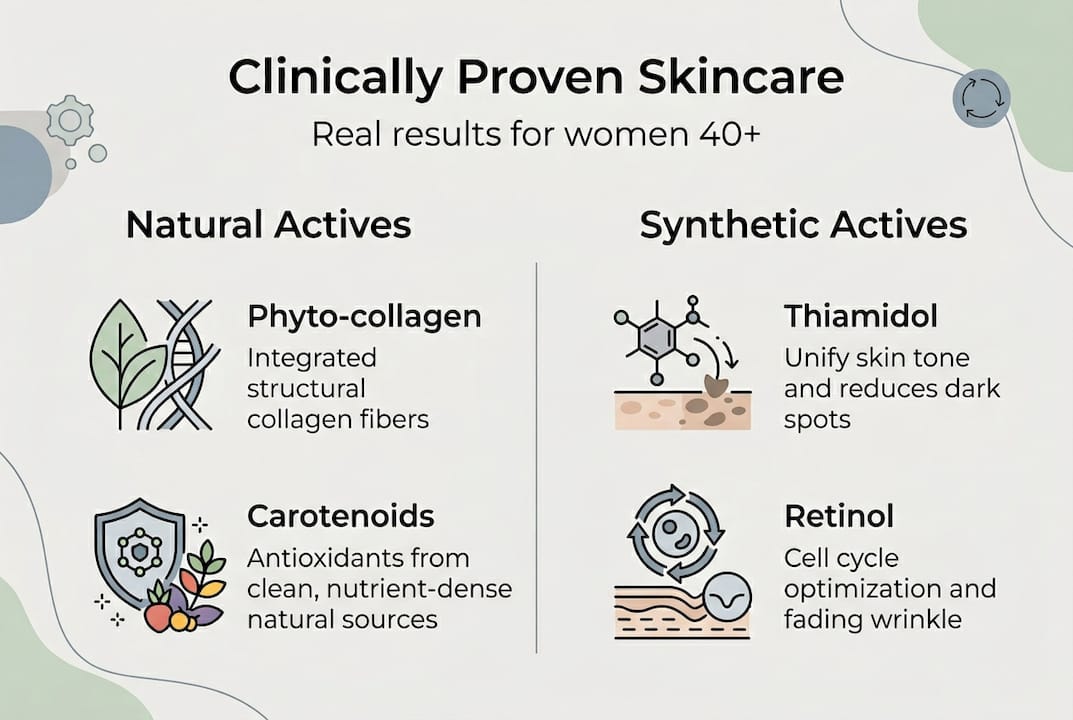
Here’s how the two categories compare on key measures:
| Factor | Synthetic (Thiamidol) | Natural actives (carotenoids, antioxidants) |
|---|---|---|
| mMASI reduction | 36% at 12 weeks | Fewer direct RCTs available |
| Mechanism | Tyrosinase inhibition | ROS reduction, melanin regulation |
| Best for | Fading existing spots | Preventing new pigmentation |
| Skin sensitivity | May cause irritation | Generally well tolerated |
For women exploring skin brightening options, the smartest approach combines both strategies. Use antioxidant-rich natural formulas daily to protect and prevent, and consider targeted treatments for existing spots. To prevent hyperpigmentation from worsening, SPF is non-negotiable.
- Vitamin C: Brightens and protects, well-tolerated in most formulas
- Niacinamide: Reduces melanin transfer, strong tolerability profile
- Carotenoids: Antioxidant protection, supports glow and elasticity
- Alpha arbutin: Natural tyrosinase inhibitor with a gentler profile than hydroquinone
Pro Tip: If you’re dealing with stubborn age spots, layer a natural antioxidant serum under SPF 50 every morning. This combination addresses both existing pigmentation and future damage simultaneously.
What influences real-life results: Factors, timelines, and expert benchmarks
With a sense of what’s possible, understanding why results vary helps you focus your routine for best effect. Clinical trials use controlled populations. Real life is messier.
For women 40 and older in Ireland and the UK, realistic expectations sit around 20 to 30% improvements in key markers like wrinkle depth, firmness, and tone. Expert consensus supports peptides, ceramides, and hyaluronic acid as the backbone of any mature skin routine, with natural phyto-actives playing a strong supporting role.
Several factors influence how quickly and dramatically you see results:
- Degree of photoaging: Sun-damaged skin responds more slowly to topical actives because structural changes run deeper
- Hormonal status: Postmenopausal women have lower estrogen, which reduces collagen production and skin thickness. Studies show soy isoflavones can reduce crow’s feet roughness by 5.6% in S-equol producers
- Consistency: Most trials measure results after daily use for 4 to 12 weeks. Skipping applications slows progress significantly
- SPF use: Without daily sun protection, even the best actives are fighting an uphill battle
- Barrier health: A compromised skin barrier absorbs actives poorly. Ceramide-based moisturizer strategies should come first
Pro Tip: Before adding a new active to your routine, spend two weeks focusing on barrier repair with a ceramide and hyaluronic acid moisturizer. Your skin will absorb the next product far more effectively.
One thing worth knowing: monadic studies (where only one product is tested, with no comparison group) are common in commercial skincare research. They can show improvement, but without a control group, you can’t know how much of that improvement would have happened anyway. Eco-friendly anti-aging formulas with strong ingredient transparency are worth prioritizing, especially when brands share their actual study design.
Why ‘clinically proven’ is only the starting line for real results
Here’s an honest take: clinical proof is a filter, not a finish line. A product that performed well in a controlled study on 80 women aged 45 to 55 in a lab setting may behave very differently on your skin, in your climate, with your stress levels and sleep patterns. That’s not a reason to dismiss the evidence. It’s a reason to use it wisely.
The biggest mistake we see women make is chasing the most dramatic clinical claim rather than building the most consistent routine. Prevention, specifically daily SPF and antioxidants, outperforms correction for the majority of visible aging signs. A woman who has used SPF 50 and a vitamin C serum every morning for five years will show fewer signs of aging than one who spent those years cycling through high-potency actives without sun protection.
Clinical data also rarely captures the holistic approach that real skin transformation requires. Sleep, hydration, nutrition, and stress all affect how skin responds to topical products. Use clinical proof as your starting filter, then build a routine you can actually maintain.
Get proven results with natural skincare for 40+
If you’re ready to see what evidence-based, natural skincare can do for your skin in real life, here’s how to take action.
At Miracle Gel, every formulation is built around ingredients with real clinical backing, not just good marketing. Whether your main concern is firming, brightening, or restoring a healthy glow, we have targeted solutions designed for women 40 and older. Start with our organic skincare routines to find a regimen that fits your skin goals, explore our moisturizer results for barrier-first hydration, or go straight to our brightening solutions if uneven tone is your priority. Real results start with the right foundation.
Frequently asked questions
How long does it take to see clinically proven results from natural skincare?
Most clinical studies show improvements in 4 to 12 weeks with consistent daily use. Wrinkle reduction of 20-40% has been documented within this window in multiple trials.
Are natural products as effective as synthetic actives for brightening or anti-aging?
Natural actives show significant improvements in firmness and wrinkle depth, but for brightening, synthetic ingredients currently lead. Thiamidol achieves 36% mMASI reduction versus 16% for vehicle in direct RCTs, while natural alternatives excel at prevention.
What is the most important step to see lasting changes in skin over 40?
Daily sunscreen combined with consistent use of clinically proven actives yields the best long-term outcome. Prevention outperforms correction for most visible aging signs in expert consensus.
What does a 20-40% reduction in wrinkles look like in real life?
Lines appear noticeably softer and less defined in photos and in the mirror. Skin looks smoother overall, but phyto-collagen and polyphenol trials confirm this is a visible improvement, not a full erasure of lines.
Can postmenopausal women benefit from natural actives?
Yes. Soy isoflavones and resveratrol have shown measurable reductions in wrinkle roughness and depth in clinical studies, though results are modest and depend on consistent use.
Recommended
- Clinical skincare: fast natural anti-aging results for 40+
- Eco-friendly skincare for women 40+: fast anti-aging
- Natural body care essentials for youthful skin over 40
- Holistic skincare: natural anti-aging for women 40+
- Rejuvenecimiento Facial sin Cirugía: Tratamientos Efectivos – Dr. Oriol Vernetta
- Women’s – Anti Aging Cream – Brainwellness