
Choose an enzyme exfoliant if your skin is sensitive, reactive, or recovering from a procedure and you want a gentle surface polish with almost no downtime. Choose an AHA if you’re targeting hyperpigmentation, rough texture, or fine lines and can tolerate mild stinging and some peeling. Either way, patch test first, since the right format matters as much as the ingredient.
TL;DR:
- Enzyme exfoliants work at neutral to skin pH, mainly targeting surface dead skin, and are ideal for sensitive, reactive, or barrier-compromised skin with minimal downtime.
- AHAs require a low pH to penetrate deeper, effectively addressing hyperpigmentation, uneven texture, and signs of aging, but they carry a higher risk of irritation and need cautious use.
- Enzymes are formulated as short-contact masks with limited stability, making them suitable for maintenance, while AHAs often come as leave-on serums or professional peels for more targeted, intensive treatment.
- For sensitive or compromised skin, enzyme or PHA exfoliants are safer options, whereas active, aged, or pigmented skin benefits more from the deeper action of AHAs, especially glycolic or lactic acid.
- Combining gentle enzyme use weekly with targeted AHA treatments for specific concerns maximizes results while minimizing irritation and over-exfoliation risks.
Table of Contents
- Enzyme Exfoliant vs AHA: The Quick Comparison
- How Enzyme Exfoliants Actually Work
- How AHAs Work and When Acids Win
- Which Skin Type Should Choose Which Exfoliant?
- Is It Safe to Combine Exfoliants With Other Actives?
- How to Choose and Introduce Your Exfoliant Safely
- Why Miraclegelnaturalskincare’s Approach Fits the Gentle Camp
- Why the Enzyme vs. AHA Debate Misses the Real Question
- A Gentler Option That Still Delivers Results
- Sources
- FAQ
Enzyme Exfoliant vs AHA: The Quick Comparison
The core difference comes down to how each one dissolves dead skin. Enzymes are proteins that break the bonds holding dulling cells to the surface, working at or near your skin’s natural pH. AHAs are acids that dissolve those same bonds through a low pH environment, which reaches deeper but irritates more easily.
That pH gap explains almost everything else. Enzymes typically function well between pH 4.5 and 7, depending on the specific enzyme, which is why formulators can pair them with delicate ingredients like peptides without destabilizing anything. AHAs need a pH around 3 to 4 to stay active in their effective “free acid” form, and that acidity is what causes the tingling, redness, or peeling some people experience.
Here’s how the two stack up on the factors that actually affect your routine:
- Mechanism: enzymes use proteolytic action (protein breakdown); AHAs use acid-driven dissolution of cell bonds.
- pH requirement: enzymes work near skin pH (roughly 5 to 7); AHAs need low pH (roughly 3 to 4) to be effective.
- Depth of action: enzymes stay largely at the surface; AHAs penetrate further into the stratum corneum and can influence deeper collagen activity at higher strengths.
- Downtime: enzyme peels are generally described as treatments with minimal recovery; AHA peels, especially professional-strength ones, carry a higher risk of redness and downtime.
- Results timeline: enzymes deliver a subtle, immediate glow that fades within days without repeat use; AHAs build cumulative results over weeks with consistent use.
- Sensation: enzymes feel warm or tingly at most; AHAs can sting, especially on first use or at higher concentrations.
Neither approach is universally “better.” Enzymes suit maintenance and sensitive routines. AHAs suit readers chasing visible texture or tone correction who can handle a bit of irritation along the way.
How Enzyme Exfoliants Actually Work
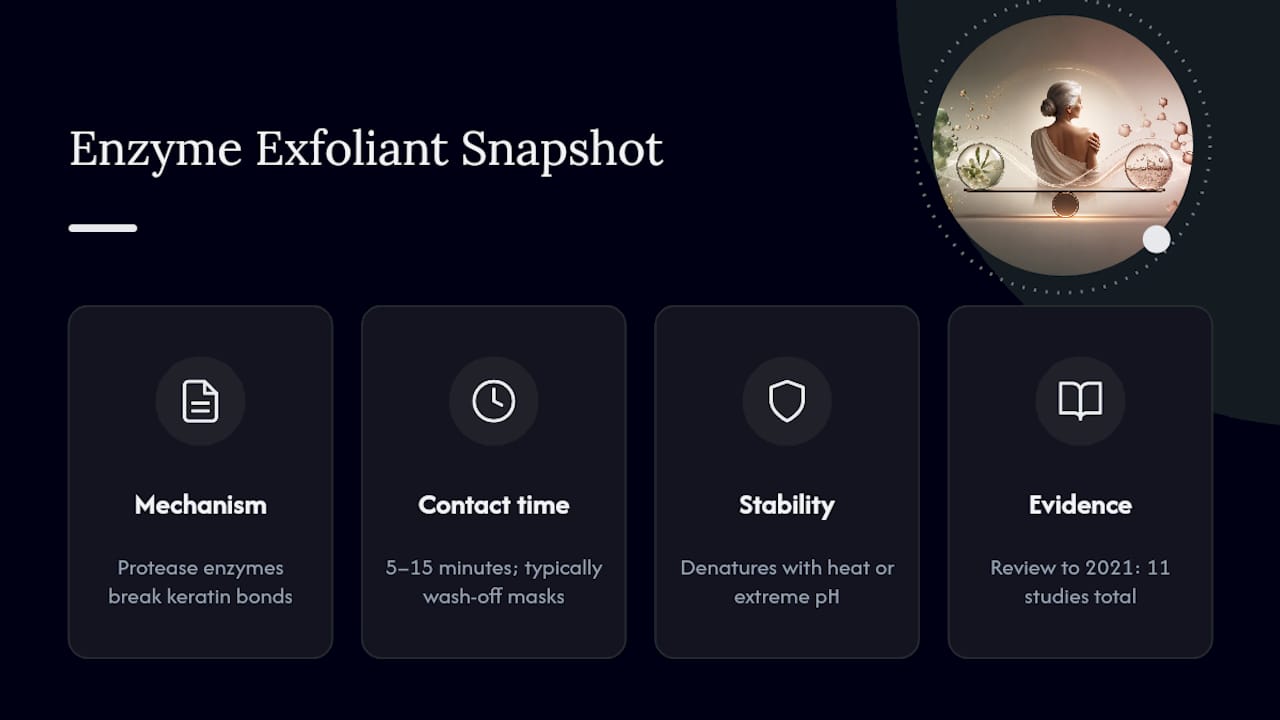
Enzyme exfoliants rely on proteases, enzymes that break down the keratin proteins holding dead skin cells together. The most common actives are papain (from papaya), bromelain (from pineapple), pumpkin enzymes, and various keratinases. Each one targets the same basic job. Loosen the surface without disrupting the skin barrier underneath.
Contact time matters more with enzymes than with most other actives. Most enzyme products are formulated as wash-off masks with a short window of activity, often five to fifteen minutes, rather than leave-on serums. That short exposure is part of why they feel gentle. It’s also why they rarely deliver dramatic transformation in a single use.
Stability is the real limiting factor. Enzymes denature under heat, extreme pH, or poor preservation, which is why formulators often need cool processing and careful vehicle selection to keep an enzyme active from the lab bench to your bathroom shelf. Papain performs best around pH 6 to 7, while bromelain prefers a slightly more acidic range near pH 4.5 to 5.5, and getting that formulation window right is harder than it sounds.
Newer research suggests these limits are shifting. A thermostable plant-derived keratinase from bitter melon improved desquamation and skin smoothness in an in-use trial with no reported adverse effects, pointing toward more resilient enzyme formulas ahead.
What the evidence actually shows: a review through 2021 identified only 11 studies on enzymatic exfoliation, and few were controlled clinical trials. The direction of the evidence is positive. Enzymes do improve desquamation and texture. The depth of proof simply hasn’t caught up to decades of AHA research yet.
What that means practically: enzymes are well suited to being a gentle maintenance step, not a replacement for targeted acid treatment when you have a specific concern to correct.
How AHAs Work and When Acids Win
AHAs dissolve the bonds between dead skin cells through acid chemistry, and that process depends entirely on staying in a low pH range, generally 3 to 4, to keep enough of the acid in its active, unionized form. Drop the concentration or raise the pH and efficacy falls off fast. That single requirement explains both why AHAs work deeper than enzymes and why they’re more likely to irritate.
Not all AHAs behave the same way. Glycolic acid has the smallest molecule size in the group, which lets it penetrate faster and deeper, delivering strong results but also a higher irritation profile. Lactic acid is larger, penetrates more slowly, and tends to be gentler while still offering meaningful renewal, making it a common starting point for acid-sensitive skin. Polyhydroxy acids (PHAs) are gentler still, with even larger molecules that limit depth of penetration, often marketed as the acid option for people who react to glycolic or lactic.
Acids earn their reputation in a few specific situations:
- Hyperpigmentation: AHAs help fade dark spots by accelerating turnover of pigmented surface cells.
- Rough or uneven texture: deeper penetration smooths texture that enzyme masks can’t reach.
- Anti-aging goals: higher-strength AHAs support collagen stimulation and epidermal remodeling, which is why they show up in serious anti-aging formulas.
- Clogged pores or blackheads: salicylic acid, a BHA rather than an AHA, penetrates oil-filled follicles more effectively than either enzymes or AHAs.
Format matters here too. Leave-on serums at controlled concentrations build cumulative results over weeks, professional peels deliver a stronger single-session effect with real downtime, and BHA specifically earns its place for oily, congested skin because it’s oil soluble in a way AHAs and enzymes aren’t.
Which Skin Type Should Choose Which Exfoliant?
Matching the exfoliant to your skin’s actual state, not just your goals, prevents most of the regret people report after trying the wrong one.
- Sensitive, rosacea-prone, or barrier-compromised skin: start with enzymes or a PHA. Both work without the low pH that triggers stinging, and enzymes carry a low-sting profile precisely because they skip the acid requirement altogether. If rosacea is a factor, read up on safe exfoliation with rosacea before trying anything new.
- Post-procedure or recently treated skin: enzymes again, since the skin barrier needs time to recover and acids on compromised skin can cause real damage.
- Acne-prone or oily skin with clogged pores: BHA (salicylic acid) usually outperforms both AHAs and enzymes here because it penetrates oil, though a mild AHA like lactic acid can help with post-acne marks once active breakouts calm down.
- Mature skin with fine lines or sun damage: AHAs, particularly glycolic acid, have the deeper and more documented track record for anti-aging results than enzymes currently offer.
- Uneven tone or hyperpigmentation: AHAs again, since their depth of penetration is what actually accelerates fading of pigmented cells.
If you have active, moderate to severe acne, have had a recent chemical peel, laser treatment, or microneedling session, or you’re using prescription retinoids, talk to a dermatologist before adding any exfoliating acid or enzyme. What looks like a minor tweak to your routine can compound with existing treatments in ways that aren’t obvious until your skin is already reacting.
Is It Safe to Combine Exfoliants With Other Actives?
Side effects differ by category, and knowing which one you’re likely to hit changes how you should react to it. Enzymes rarely cause more than mild warmth or, occasionally, an allergic reaction in people sensitive to specific proteins like papain or bromelain. AHAs more commonly cause stinging, redness, dryness, or visible peeling, particularly during the first few uses or at higher strengths.
Patch testing applies to both. Apply a small amount to your inner forearm or behind your ear, wait 24 to 48 hours, and check for redness, itching, or burning before using it on your face. Skipping this step is the single most common reason people end up with a reaction they blame on the product rather than the introduction process.
Layering rules matter just as much as the product itself:
- Never combine AHA exfoliants with retinoids or other strong actives on the same night. Alternate them instead.
- Give your skin at least one full recovery day between acid treatments, especially early on.
- Enzyme masks are generally low risk enough to layer more casually, but still avoid stacking them with active acid treatments in the same session.
- Sunscreen is not optional after any AHA use. Acid exfoliation increases sun sensitivity, and skipping SPF afterward undoes the benefit and raises your risk of new pigmentation.
Pro Tip: If your skin feels tight, looks shiny-red, or stings when you apply plain moisturizer, stop all active exfoliation for at least five to seven days and focus purely on hydration and barrier repair before reintroducing anything.
How to Choose and Introduce Your Exfoliant Safely
Start with a simple checklist before buying anything. Identify your primary goal, whether that’s maintenance glow, pigment correction, or texture improvement. Then check the label for the specific active and its concentration, since “AHA” or “enzyme” alone tells you little without knowing the percentage or the enzyme source.
- Define your goal first. Maintenance and sensitivity point toward enzymes; correction and renewal point toward AHAs.
- Check the active and format. A wash-off enzyme mask behaves very differently than a leave-on 8% glycolic serum, even if both claim to “exfoliate.”
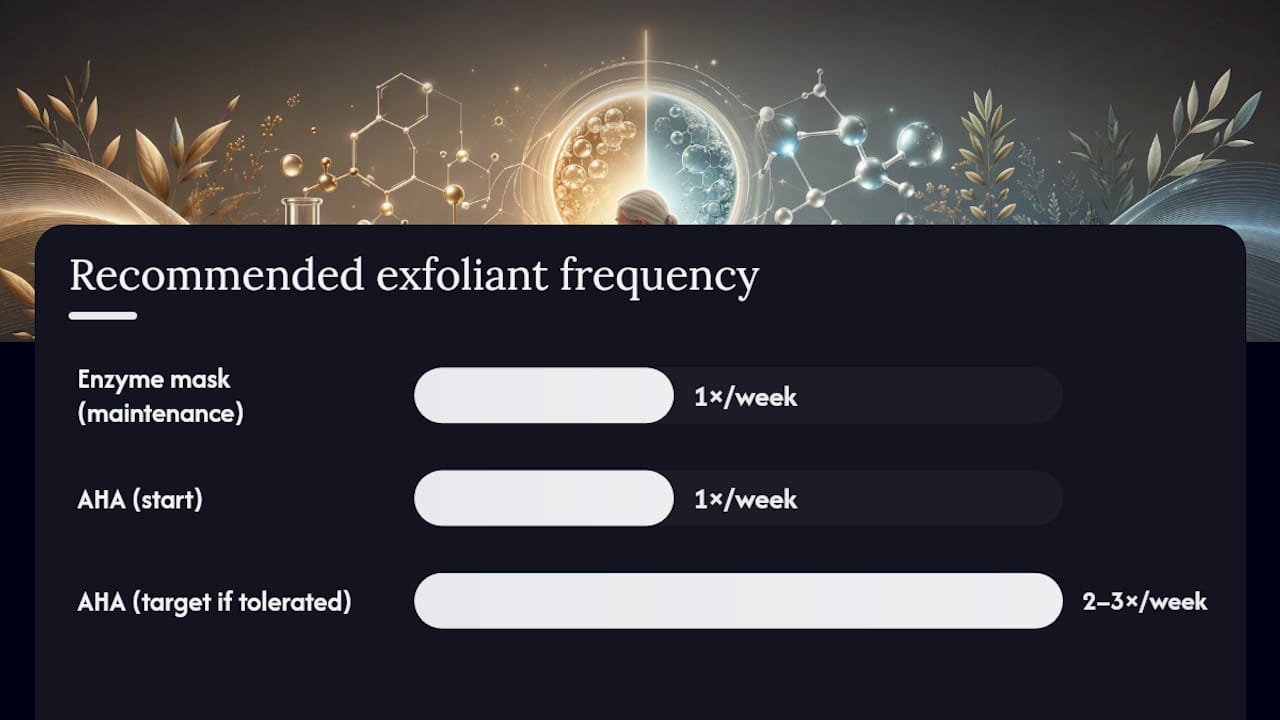
- Start low and slow. For AHAs, begin once a week and build toward two to three times weekly only if your skin tolerates it without persistent redness.
- Use enzymes as your steady baseline. A weekly enzyme mask works well as ongoing maintenance between more targeted acid treatments.
- Watch for over-exfoliation signs. Persistent redness, a stinging sensation from products that never used to sting, visible flaking, or a shiny, tight look all signal it’s time to pull back.
- Pause and repair when needed. Drop all actives, simplify to a gentle cleanser and moisturizer, and wait until your skin feels calm before restarting.
Combining both approaches often works better than picking one forever. Many people use an enzyme mask weekly for upkeep and bring in an AHA treatment only when addressing a specific flare of dullness or pigmentation, never stacking the two in the same session.
Pro Tip: Keep a simple log for the first month of any new exfoliant, noting redness, tightness, or peeling after each use. Patterns show up faster on paper than in memory, and that log makes it obvious when to scale back before a real reaction develops.
For a full walk-through of sequencing products correctly, the step-by-step exfoliation process breaks down order of application in more detail.
Why Miraclegelnaturalskincare’s Approach Fits the Gentle Camp
Miraclegelnaturalskincare was built around the idea that effective results shouldn’t require harsh acids, grains, or abrasive scrubs to get there. Founder Shelly Maguire, a recognized figure in the skincare industry, developed the brand’s formulas around gentler mechanisms rather than aggressive resurfacing, which lines up directly with the barrier-first approach this article recommends for sensitive and mature skin.
The brand’s flagship products lean on ingredient complexes like the Tri-Moisture Cryo Complex™, designed to work with skin rather than strip it. A few points worth knowing if you’re weighing this against a standard acid product:
- The formulas avoid harsh acids, grains, and physical abrasives entirely.
- The approach favors quick, visible results without the redness and downtime associated with stronger acid treatments.
- Products are built for consistent use rather than occasional, higher-risk treatments.
If your skin fits the sensitive, mature, or barrier-compromised profile covered earlier, the brand’s gentle exfoliant alternatives page and its guidance on exfoliating mature skin once weekly go into more specific routine detail than a general comparison article can.
Why the Enzyme vs. AHA Debate Misses the Real Question
Most articles on this topic treat enzymes and AHAs as competitors, as if picking one means rejecting the other forever. That framing doesn’t hold up against how skin actually behaves over time. Your tolerance shifts with season, hormones, stress, and even how much sun exposure you’ve had that month.
The bigger mistake I see in conventional advice is treating “gentle” and “effective” as opposites. They’re not. AHAs are effective because of their acid chemistry, not because irritation is required for results.
What actually matters is sequencing and expectation. If you want a maintenance glow with essentially no risk, enzymes deliver it reliably. If you’re correcting years of sun damage or pigmentation, you need the deeper mechanism AHAs offer, and some temporary irritation is a reasonable trade for that. The reader who wins here isn’t the one who picks a side. It’s the one who matches the tool to the specific problem in front of them this month, not the one they had last year.
— Barbara
A Gentler Option That Still Delivers Results
Miraclegelnaturalskincare’s 2-Minute Miracle Gel was formulated for exactly the reader caught between “I want real results” and “I can’t handle acid irritation.” It skips harsh acids and abrasives entirely, relying instead on gentler active complexes designed to support surface renewal without the sting or downtime that comes with stronger AHA formulas.
If your decision checklist from earlier points toward the sensitive or maintenance category, this fits naturally into a weekly routine rather than a once-a-month treatment you have to plan recovery time around. Use it as your steady baseline, the way you’d use a weekly enzyme mask, and save any dedicated acid product for the occasions when you’re specifically targeting pigment or deeper texture. At $50.00 for the 2-Minute Miracle Gel, it slots into the same maintenance role enzymes play in this article, minus the enzyme stability concerns formulators still work around.
Browse the full range of gentle formulas to see which product matches your specific goal, whether that’s hydration, brightening, or targeted eye care.
Sources
The PubMed review of proteolytic enzymes covers the current state of enzyme clinical evidence. The MDPI keratinase study details a promising thermostable enzyme option. The Vivify Beauty Care formulator’s guide explains manufacturing constraints behind both ingredient types in more technical depth.
- An overview of the use of proteolytic enzymes as exfoliating agents — PubMed
- Thermostable keratinolytic protease from Momordica charantia as a cosmetic ingredient — MDPI
- Choosing between chemical peels and enzyme peels: which is safer? — OTS Dermatology
- Enzyme exfoliants: papain, bromelain & zero sting — DermApproved
FAQ
Are Enzyme Exfoliants Good for the Face?
Yes, enzyme exfoliants are generally well tolerated on the face because they work near your skin’s natural pH rather than requiring the low pH acids need. They’re particularly suited to sensitive, reactive, or barrier-compromised skin, though clinical evidence for their effects remains limited compared to AHAs.
Which Is Better, AHA or BHA?
Neither is universally better since they target different concerns. AHAs work well on dry skin, texture, and pigmentation, while BHA (salicylic acid) is oil soluble and better suited to acne, blackheads, and clogged pores.
Which Is Better for Clogged Pores, AHA or BHA?
BHA is generally the better choice for clogged pores because salicylic acid is oil soluble and can penetrate into the follicle where AHAs and enzymes largely can’t reach. AHAs can still help with surface texture around clogged areas but won’t clear the pore itself as effectively.
Which Exfoliation Method Is Best Overall?
There’s no single best method. It depends on your skin’s sensitivity and your goal. Enzymes suit gentle, low-risk maintenance with minimal to no downtime, while AHAs suit deeper correction of pigmentation or texture when your skin can tolerate some irritation.
How Often Should I Use an Enzyme Exfoliant vs an AHA?
Enzyme masks are typically used weekly as a maintenance step, since their short contact time makes daily use unnecessary. AHAs usually start at once a week and frequency can vary depending on tolerance and concentration.