
TL;DR:
- Skin actives target skin concerns at a cellular level, providing lasting anti-aging and brightening results.
- Consistent use and proper introduction are essential for visible improvements over 4 to 12 weeks.
- Natural, synthetic, and hybrid actives each offer benefits, with hybrids often best for sensitive mature skin.
Most moisturizers promise a lot and deliver very little. They sit on the surface, plump things up temporarily, and fade by morning. If you have noticed that your skin still looks dull, uneven, or lined despite a consistent routine, the missing piece is almost certainly skin actives. These are the ingredients that actually change your skin at a biological level, not just coat it. For women over 40, when collagen production slows and cell turnover drops, actives are not optional extras. They are the difference between skincare that maintains and skincare that genuinely transforms. This guide breaks down exactly what actives are, how they work, and how to use them safely for real, lasting results.
Table of Contents
- What are skin actives and why do they matter?
- How do skin actives work for anti-aging and brightening?
- Natural actives vs. synthetic actives: What’s best for mature skin?
- Building your skincare routine with actives: Tips for women 40+
- Our take: Why actives are the real turning point for women’s skin after 40
- Enhance your results with trusted natural actives
- Frequently asked questions
Key Takeaways
| Point | Details |
|---|---|
| Actives drive visible change | Only bioactive ingredients can significantly improve wrinkles and brightness. |
| Efficacy proven by research | Clinical studies show actives like niacinamide and Skinbright Active reduce fine lines and spots within months. |
| Hybrid actives are best | Blending natural and synthetic actives often yields the best results for women over 40. |
| Routine matters most | Consistent, gradual introduction of actives leads to long-lasting, visible improvements. |
What are skin actives and why do they matter?
Skin actives are bioactive ingredients that target specific skin concerns like wrinkles, dullness, and discoloration at a cellular level. They are not the same as the base ingredients in your moisturizer, such as glycerin or shea butter, which hydrate and protect but do not trigger biological change. Actives go deeper. They signal your skin cells to behave differently, whether that means producing more collagen, fading a dark spot, or speeding up how quickly dead cells shed.
Think of it this way: a regular moisturizer is like watering a plant. A skin active is like adding fertilizer. Both matter, but only one drives real growth.
Common skin actives include:
- Retinol: Accelerates cell turnover and stimulates collagen and firmness
- Niacinamide: Fades discoloration and strengthens the skin barrier
- Vitamin C: A powerful antioxidant that brightens and protects
- Peptides: Short chains of amino acids that signal collagen production
- Bakuchiol: A plant-based alternative to retinol, gentler but effective
What makes actives so powerful for mature skin specifically is that your body actually recognizes and responds to them. They are not foreign chemicals forcing a reaction. They work with your skin’s existing biology. Actives penetrate the skin barrier to stimulate collagen production, inhibit tyrosinase (the enzyme behind dark spots), boost antioxidants, enhance cell turnover, and repair the barrier via ceramide synthesis.
For women over 40, this matters enormously. After 40, collagen production drops by roughly 1% per year. Cell turnover slows. The skin’s ability to repair itself weakens. Basic hydrators cannot address these changes. Only actives can.
“The real shift in a skincare routine happens when you move from maintaining skin to actively improving it. That shift requires actives.”
Pro Tip: If you are new to actives, start with fine line solutions that combine peptides and niacinamide. These are effective and far less likely to cause irritation than starting with high-strength retinol.
How do skin actives work for anti-aging and brightening?
Now that you know what skin actives are, let’s see exactly how they deliver impressive results for mature skin.
Actives work below the skin’s surface, which is what separates them from cosmetic products. A tinted moisturizer changes how your skin looks. An active changes how your skin behaves. That distinction is everything when you are trying to address real aging concerns.
Here is how the main categories of actives deliver results:
- Collagen stimulators (retinol, peptides): These signal fibroblast cells to produce more collagen and elastin. Over weeks, this reduces the depth of fine lines and improves skin firmness.
- Brightening actives (niacinamide, vitamin C): These interrupt the process that creates dark spots by blocking tyrosinase. The result is a more even, radiant tone.
- Cell turnover accelerators (retinol, AHAs): These speed up the natural shedding of dead skin cells, revealing fresher, smoother skin underneath.
- Antioxidant actives (vitamin C, green tea extract): These neutralize free radicals from UV exposure and pollution, slowing the breakdown of collagen.
The research behind these mechanisms is solid. 5% niacinamide used twice daily for 12 weeks improves fine lines by 23%, and brightening formulas at this concentration show significant results in 30 to 60 days. These are not marketing claims. They are measured outcomes from controlled studies.

| Active | Primary benefit | Visible results timeline |
|---|---|---|
| Retinol | Reduces wrinkles, firms skin | 8 to 12 weeks |
| Niacinamide | Brightens, evens tone | 4 to 8 weeks |
| Vitamin C | Antioxidant, glow boost | 4 to 6 weeks |
| Bakuchiol | Gentle firming, anti-aging | 8 to 12 weeks |
| Peptides | Collagen support, plumping | 6 to 10 weeks |
For women exploring brightening options or targeted wrinkle care, understanding this timeline is critical. Actives require consistency. Skipping applications or switching products too quickly is the most common reason women do not see the results they expect.
The key insight: actives work cumulatively. Each application builds on the last. The longer you use them correctly, the more pronounced and lasting the improvement becomes.
Natural actives vs. synthetic actives: What’s best for mature skin?
Understanding the mechanics leads us to a key question: should you choose natural, synthetic, or hybrid actives to optimize your skincare routine?
This is where personal values and skin biology both come into play. Neither category is universally superior. Each has real strengths and genuine limitations.
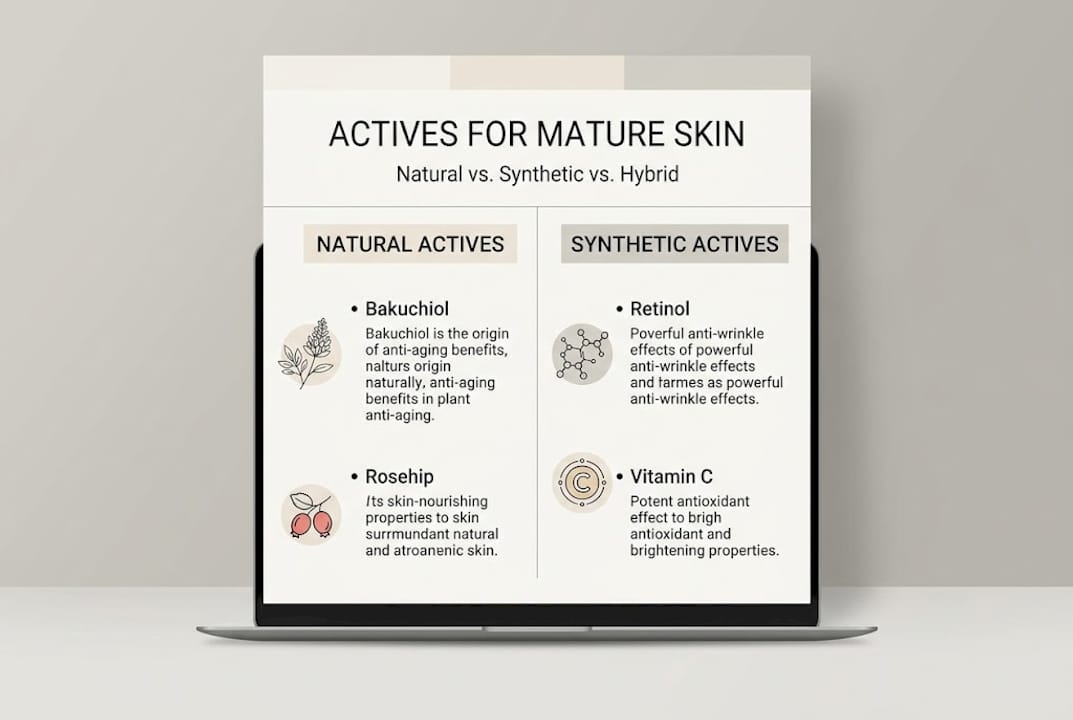
Natural actives like bakuchiol, sea kelp, rosehip, and botanical extracts are biocompatible, meaning your skin tends to tolerate them well. They are often rich in antioxidants and work gently over time. The downside is variability. The potency of a plant extract depends on the source, harvest conditions, and formulation. Results can be slower and less predictable.
Synthetic actives like retinol and certain vitamin C derivatives are manufactured to a precise standard. You know exactly what concentration you are getting, and the research behind them is extensive. However, they can cause irritation, redness, and peeling, particularly for sensitive or mature skin that has a thinner barrier.
Hybrid formulas combine the best of both worlds. They use natural actives like bakuchiol alongside stabilized synthetics to balance efficacy with tolerability. For women over 40 with sensitive or reactive skin, hybrids are often the smartest starting point.
Here is a quick comparison:
| Feature | Natural actives | Synthetic actives | Hybrid actives |
|---|---|---|---|
| Skin tolerance | High | Variable | High |
| Potency consistency | Variable | High | High |
| Irritation risk | Low | Moderate to high | Low to moderate |
| Research backing | Growing | Extensive | Growing |
| Best for | Sensitive, holistic | Fast results | Balanced approach |
If you are drawn to retinol alternatives or want to understand more about natural ingredients for glowing skin, the good news is that the natural active space has grown significantly. Bakuchiol in particular has strong clinical support as a gentler option for mature skin. For a broader look at understanding natural ingredients, the science is increasingly validating what holistic skincare advocates have argued for years.
Pro Tip: If your skin is reactive, start with a natural or hybrid active and give it a full 8 weeks before evaluating results. Switching too soon is the number one mistake that prevents women from finding what actually works for them.
Building your skincare routine with actives: Tips for women 40+
Once you know your options, it is time to build a smart routine that truly addresses the unique needs of skin over 40.
The biggest mistake most women make is adding too many actives at once. Your skin needs time to adjust. Overloading it leads to irritation, barrier damage, and frustration, none of which help you look or feel better.
Here is a practical approach to building your routine:
- Start with one active: Choose your primary concern, whether that is fine lines, dark spots, or dullness, and introduce a single active targeting that issue.
- Use lower concentrations first: A 2% niacinamide is a better starting point than jumping straight to 10%. Build up as your skin adapts.
- Alternate actives on different days: Retinol and niacinamide work beautifully together, but using them on alternate evenings reduces the risk of sensitivity.
- Always follow with barrier support: After applying an active, use a moisturizer that contains ceramides or hyaluronic acid to protect and seal the skin.
- Apply SPF every morning: Many actives, especially retinol and vitamin C, increase photosensitivity. SPF is non-negotiable.
For women new to actives, barrier-safe actives are a smart entry point. These are formulated to deliver results without stripping or weakening the skin’s protective layer.
The results from hybrid and phyto active formulas are genuinely encouraging. Hybrid phyto actives lift skin in as little as one week for 72 to 81% of users, and targeted brightening formulas at 5% concentration reduce melasma by 72% and lentigines (age spots) by 67% after 60 days. These numbers reflect what is possible with the right formula and consistent use.
Key things to watch for as you build your routine:
- Mild tingling in the first week is normal. Burning or persistent redness is not.
- Results are gradual. Photograph your skin monthly to track real progress.
- Seasonal adjustments matter. Skin is often more sensitive in winter, so reduce frequency if needed.
For a deeper look at how to structure everything, organic skincare for mature skin covers the broader principles that support an active-based routine.
Our take: Why actives are the real turning point for women’s skin after 40
Beyond the science and routines, here is our candid perspective on what truly works.
We have seen thousands of women invest in beautiful packaging, luxurious textures, and well-marketed moisturizers, only to feel disappointed months later. The honest truth is that hydrators alone rarely address deep wrinkles or stubborn spots. They are not designed to. That is not a failure of the product. It is a mismatch of expectation and function.
The shift that actually changes skin after 40 is adding actives with intention. Not a dozen at once, but the right ones, used consistently. We have watched women go from frustrated with their skin to genuinely confident, not because they found a miracle, but because they finally gave their skin the targeted support it needed.
Mainstream skincare advice often glosses over this transition. It treats actives as advanced or risky, when in reality they are simply specific. The clinical results for women after 40 consistently show that targeted active use outperforms even the most expensive passive moisturizers. Every woman over 40 deserves to know that. Actives are not intimidating once you understand them. They are the most logical next step.
Enhance your results with trusted natural actives
You now have the knowledge to make smarter choices about your skincare. The next step is finding products that actually deliver on the science.

At Miracle Gel Natural Skincare, we have built our range around clinically supported actives that work gently and effectively for mature skin. Whether you are starting with brightening or focusing on firmness, our brightening actives collection gives you targeted options without the guesswork. If you want to see how everything fits together, our organic skincare workflow walks you through a complete routine designed for real results. Your skin is ready for more than maintenance. Let’s give it what it actually needs.
Frequently asked questions
What is the difference between active and inactive skincare ingredients?
Active ingredients directly target specific skin concerns like wrinkles or discoloration, while inactive ingredients mainly support or carry the formula. Only actives drive biological change in the skin.
Are natural actives as effective as synthetic actives?
Natural actives can be highly effective but may work more gently. Natural actives like bakuchiol are antioxidant-rich with variable potency, while synthetics like retinol are more stable but can cause irritation for some skin types.
How long does it take to see results from skin actives?
Visible improvements like smoother skin or reduced spots typically appear within 4 to 12 weeks. 5% niacinamide twice daily shows measurable fine line improvement at 12 weeks, while brightening results can appear in 30 to 60 days.
How can I minimize irritation when starting actives?
Begin with lower concentrations, introduce one new active at a time, and always follow with moisturizing and SPF. Introducing actives gradually gives your skin barrier time to adapt without becoming reactive.