

TL;DR:
- Naturally derived ingredients originate from natural sources but may undergo permitted processing before use. The ISO 16128 standard quantifies their naturalness with an index from 0 to 1, providing objective measurement. Combining natural and synthetic ingredients often yields the best skincare results, guided by clinical data rather than marketing claims.
Naturally derived ingredients are substances that originate from natural sources, such as plants, minerals, or animals, but may undergo chemical or biological processing before reaching your skin. The industry term for measuring this is the Natural Origin Index (NOI), a scale from 0 to 1 that quantifies how much of an ingredient’s composition traces back to nature. Standards like ISO 16128 and FDA classifications give brands and consumers a shared language for evaluating these claims. If you have ever stared at an ingredient list wondering whether “coco-glucoside” counts as natural, this guide answers that question with specifics, not marketing language.
What are naturally derived ingredients and how are they classified?
ISO 16128 divides cosmetic ingredients into three categories: natural, naturally derived, and synthetic. Natural ingredients come directly from plant, mineral, or animal sources with no chemical modification. Naturally derived ingredients start from those same sources but go through permitted processing steps, such as fermentation, esterification, or hydrolysis. Synthetic ingredients have no natural starting material at all.
The NOI score makes this concrete. An ingredient scores 1.0 if it is entirely natural in origin and 0 if it is fully synthetic. A product with a 96.5% naturality rating means 96.5% of its ingredients carry an NOI greater than 0. That number gives you a real benchmark instead of a vague “natural” claim on the front of the box.
The FDA adds another layer through color additive regulation. The FDA classifies color additives as either certified (synthetic) or exempt from certification (natural or naturally derived). The agency actively encourages naturally derived alternatives, such as butterfly pea flower extract or Galdieria blue, to replace synthetic dyes like FD&C Yellow No. 5. This regulatory push matters because it signals that “naturally derived” is not just a marketing phrase. It is a category with real oversight.
Here is how the three categories compare at a glance:
| Category | Starting material | Processing allowed | Example |
|---|---|---|---|
| Natural | Plant, mineral, animal | Minimal (washing, drying) | Raw shea butter |
| Naturally derived | Plant, mineral, animal | Chemical or biological | Coco-glucoside from coconut |
| Synthetic | Lab-created | Full synthesis | Synthetic preservatives |
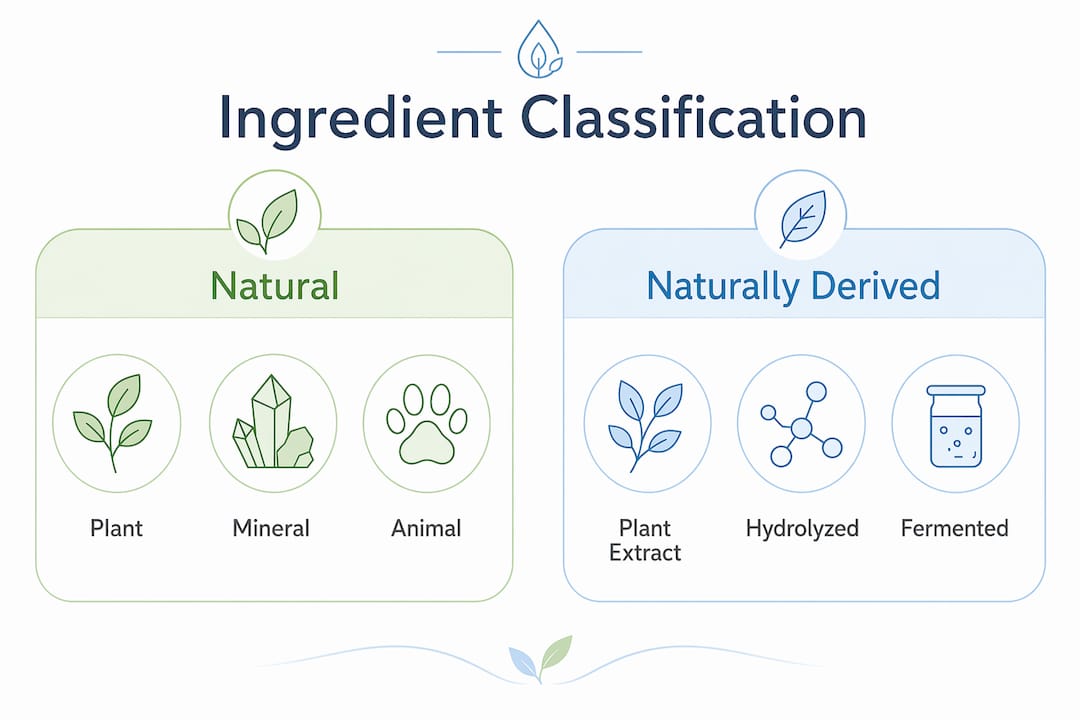
Pro Tip: When a brand lists an NOI score or references ISO 16128 compliance, that transparency is a stronger signal of quality than any “100% natural” claim on the front label.
How do naturally derived ingredients differ from natural and synthetic?
The most common misconception is that “naturally derived” and “natural” mean the same thing. They do not. A naturally derived ingredient has been chemically modified from its source material. Coco-glucoside, for example, starts as coconut oil and glucose but goes through a glycosidation reaction. The result is a gentle surfactant that would not exist in nature without that processing step.
Natural labeling is not legally defined in most markets. A brand can call an ingredient “natural” if it simply started from a plant, regardless of how many processing steps followed. Scrutinizing the full ingredient list is more reliable than trusting the front-of-pack claim. This gap between marketing and regulation is where greenwashing lives.
Synthetic ingredients get an unfair reputation. Many synthetics are safer, more stable, and more consistent than their natural counterparts. Lab-designed ceramides, for instance, deliver predictable skin barrier support in every batch. Plant-based ingredients like green tea polyphenols and vitamin E have demonstrated real skin benefits but show more batch-to-batch variability than synthetics. That variability matters when you are paying for a specific concentration of an active ingredient.
The naturalness bias is real and worth naming. Consumers frequently assume that natural equals safer or better, but safety and efficacy depend on clinical data, not source alone. Poison ivy is natural. Arsenic is natural. The source of an ingredient tells you where it came from, not whether it will help or harm your skin.
Pro Tip: Search for the ingredient’s INCI (International Nomenclature of Cosmetic Ingredients) name online alongside “NOI score” or “natural origin index.” That search gives you objective data instead of brand claims.
What are the benefits of naturally derived ingredients in skincare?
Naturally derived ingredients offer three practical advantages: antioxidant protection, reduced irritation potential, and a lower environmental footprint compared to fully synthetic alternatives. These benefits are real, but they come with conditions worth understanding.

Antioxidant protection from plant polyphenols
Plant polyphenols, including those found in green tea, resveratrol sources, and pomegranate extract, neutralize free radicals that accelerate skin aging. These compounds work because their molecular structure donates electrons to unstable free radical molecules, stopping the chain reaction that breaks down collagen. The antioxidant and skin-protective advantages of botanical ingredients are well documented in dermatology literature. The catch is that polyphenol concentration varies by harvest season, geography, and extraction method.
Reduced irritation with bio-based actives
Bio-based niacinamide with ultra-low residual nicotinic acid (under 100 ppm) reduces skin irritation while maintaining full efficacy at 5–10% concentrations. That purity level makes it suitable for people with sensitive skin who react to the flushing effect sometimes caused by lower-grade niacinamide. This is a strong example of how naturally derived processing, in this case fermentation-based production, improves on the raw natural starting material.
Sustainability and skin microbiome support
Naturally sourced components often biodegrade more readily than petroleum-derived synthetics. Beyond environmental impact, certain plant-derived compounds actively support the skin microbiome, the community of microorganisms that keep your skin barrier balanced and resilient. Prebiotic plant extracts, for example, feed beneficial bacteria on the skin’s surface rather than stripping them away.
The hybrid formula advantage
Effective skincare often combines naturally derived and synthetic ingredients for the best results. Plant-based bakuchiol pairs with lab-designed ceramides. Vegetable-derived squalane works alongside synthetic peptides. Neither category alone delivers what a well-formulated hybrid can. The goal is a formula that performs, not one that wins a purity contest.
Pro Tip: Look for formulas that list both the common name and the INCI name for key actives. Brands that do this are showing you exactly what you are getting and at what stage of processing.
How to identify skincare products with genuinely beneficial naturally derived ingredients
Reading an ingredient list is a skill, and it is one worth developing. The INCI system lists ingredients in descending order of concentration. An ingredient appearing in the top five positions is present in a meaningful amount. One appearing near the bottom, after the preservatives, is likely there in trace quantities for marketing purposes.
Here is a practical process for evaluating any product:
- Check for an NOI or naturality score. Brands that calculate and publish their natural origin index using ISO 16128 methodology are giving you objective data. A product with a 93% natural content score, calculated from ingredients like jojoba oil, coco-glucoside, water, and a synthetic preservative, is being transparent about its formulation.
- Look for specific ingredient names, not vague claims. “Plant-derived” tells you nothing. “Coco-glucoside (from coconut)” tells you the source and the ingredient. Specificity signals honesty.
- Cross-reference clinical data. A naturally derived ingredient backed by a peer-reviewed study carries more weight than one backed only by a brand’s marketing copy. Niacinamide, bakuchiol, and green tea polyphenols all have published clinical evidence.
- Watch for greenwashing signals. Phrases like “infused with nature,” “inspired by botanicals,” or “nature-identical” without further explanation are red flags. Ingredient list scrutiny is always more reliable than front-label claims.
- Prioritize purity benchmarks for sensitive skin. If you have reactive skin, look for products that specify residual limits for potential irritants, such as the sub-100 ppm nicotinic acid threshold in high-grade niacinamide.
Pro Tip: The EWG Skin Deep database and the CosDNA tool both let you look up individual INCI ingredients and see their safety ratings and known functions. Use them before committing to a new product.
Key Takeaways
Naturally derived ingredients are defined by their natural starting material and permitted processing, not by marketing language, and ISO 16128 provides the only objective framework for measuring that claim.
| Point | Details |
|---|---|
| ISO 16128 is the standard | It scores ingredient naturalness from 0 to 1 and calculates a product’s overall natural content percentage. |
| “Natural” is not a legal term | Front-label claims are unreliable; the INCI ingredient list and NOI scores give you real data. |
| Naturally derived allows processing | Ingredients like coco-glucoside start natural but are chemically modified, which is permitted under ISO 16128. |
| Hybrid formulas outperform pure natural | Combining naturally derived actives with synthetics delivers better efficacy and stability than either alone. |
| Clinical data beats source claims | Safety and skin benefit depend on concentration and evidence, not whether an ingredient came from a plant. |
Why I think the “natural is better” rule is holding your skincare back
I have spent years watching people make skincare decisions based on the word “natural” on a label, and I understand the instinct. There is something reassuring about the idea that what you put on your skin came from a plant rather than a lab. But that instinct, left unchecked, leads to real mistakes.
The naturalness bias is one of the most well-documented cognitive shortcuts in consumer behavior. It feels logical. It is not. The question that actually matters is: does this ingredient do what the brand claims, at the concentration listed, without causing harm? That question has nothing to do with whether the starting material grew in a field.
What I have found works is a both-and approach. Naturally derived ingredients like plant-based actives for youthful skin bring genuine antioxidant and skin-soothing benefits. Synthetics bring consistency, stability, and precision. The best formulas use both. Refusing synthetics entirely is like refusing to use a seatbelt because it is not made of wood.
Regulatory progress is real but slow. ISO 16128 is a meaningful step toward transparency, and the FDA’s push toward naturally derived color alternatives shows institutional momentum. Still, the burden of interpretation falls on you as a consumer. Read the list. Check the score. Demand specifics. A brand that cannot tell you its NOI or name its actives by their INCI names is not being transparent enough to earn your trust.
— Barbara
Naturally derived skincare from Miraclegelnaturalskincare
Miraclegelnaturalskincare builds its formulas around naturally derived actives that are backed by clinical results, not just ingredient origin stories.

The age-defying skincare range at Miraclegelnaturalskincare pairs plant-derived antioxidants and bio-based actives with clinically supported compounds, including the Tri-Moisture Cryo Complex™, to deliver visible results without relying on harsh chemicals. Every product is formulated with the kind of ingredient transparency this article describes: specific actives, clear purposes, and performance you can see. If you want skincare that respects both your skin and your intelligence, the anti-aging serums and moisturizers at Miraclegelnaturalskincare are a strong place to start.
FAQ
What are naturally derived ingredients in skincare?
Naturally derived ingredients start from plant, mineral, or animal sources but undergo permitted chemical or biological processing. ISO 16128 defines and scores them on a Natural Origin Index from 0 to 1.
Are naturally derived ingredients safe for sensitive skin?
Safety depends on the specific ingredient, its concentration, and its purity, not its origin. Bio-based niacinamide with under 100 ppm residual nicotinic acid, for example, is well-tolerated by most sensitive skin types.
What is the difference between natural and naturally derived?
Natural ingredients come from nature with minimal processing. Naturally derived ingredients also come from nature but go through chemical or biological transformation, such as fermentation or esterification, before use.
How do I know if a product is truly naturally derived?
Look for an ISO 16128 naturality score or published NOI value. Brands that list specific INCI names and disclose processing methods are more transparent than those using vague “plant-based” or “natural” claims.
Are naturally derived ingredients better than synthetic ones?
Not automatically. Clinical evidence and formulation quality determine efficacy. The most effective skincare products typically combine naturally derived and synthetic ingredients to balance performance, stability, and skin tolerance.