

For volume loss, fillers or fat grafting rebuild the padding your hands lost. For brown spots, lasers, IPL, or a peel clear pigment faster than any cream. For crepey, thin skin, resurfacing paired with a nightly retinoid rebuilds texture over months. None of it holds without daily sunscreen, and most people need more than one approach at once.
TL;DR:
- Fillers and fat grafting effectively restore volume loss caused by collagen depletion, with fat grafting offering the longest-lasting results but requiring surgery.
- Light-based treatments like lasers, IPL, and chemical peels are most effective for clearing age spots, with lasers often needing two to four sessions for visible improvement.
- Daily sunscreen with SPF 30 or higher is crucial to prevent new damage, especially since most sun exposure occurs during brief, unnoticed moments.
- Topical products with vitamin C and lightening formulas can significantly fade brown spots over several months, but consistency is essential.
- Combining clinical procedures with strict daily protection yields the best long-term results for hand rejuvenation.
Table of Contents
- What Causes Hand Aging Treatment to Matter So Much?
- Which In-Office Procedures Actually Fix Aging Hands?
- How Do You Build a Daily Hand Rejuvenation Routine?
- How Do You Combine Treatments and Set Realistic Expectations?
- Why a Product-First Maintenance Plan Can Work
- What Is the Anatomy Behind Aging Hands?
- What Safety Rules Apply to Hand Aging Treatments?
- An Honest Read on What Actually Moves the Needle
- Your Next Step: A Simple Daily Hand Routine
- Sources
What Causes Hand Aging Treatment to Matter So Much?
Hands age on a different timeline than the face. The skin on the back of your hand has almost no fat layer to begin with, and what little padding exists thins out steadily after your 40s, leaving veins and tendons more visible with every passing year. Add decades of sun exposure most people never think to block, and you get the classic aged-hand look: bony ridges, brown patches, and skin that looks papery when you pinch it.
Each visible sign points to a different underlying cause:
- Bony, veiny hands signal volume loss from fat and collagen depletion under the skin.
- Flat brown patches are usually solar lentigines, better known as age or sun spots, caused by years of UV exposure.
- Thin, wrinkled, “cellophane” skin reflects collagen breakdown and chronic photodamage rather than volume loss alone.
- Raised, rough, or irregular spots, especially ones that bleed, itch, or change shape, need a dermatologist’s eyes before any cosmetic plan.
This isn’t vanity. Plastic surgery clinical guidance confirms that hands age faster than the face precisely because they carry less fat and take more unprotected sun over a lifetime. That combination is why a hand age spots treatment plan almost never looks identical to a facial one, even when the underlying skin damage is similar.
Which In-Office Procedures Actually Fix Aging Hands?
The clinic-based options split cleanly along the three problems above, and picking the right category matters more than picking a specific brand of filler or laser.
For volume loss, hyaluronic acid fillers are the most common starting point because they’re reversible and require no downtime beyond mild bruising. Calcium hydroxylapatite (CaHA) fillers last longer, often over a year, and some formulations are specifically approved for hand volume restoration. Fat grafting, which transfers a patient’s own fat from another area, gives the longest-lasting result of the three but is a surgical procedure with real recovery time and higher cost. A 2025 clinical synthesis found fillers and fat grafting both restore visible volume effectively, with the tradeoff being durability versus invasiveness.
For pigment, the evidence favors light-based treatments. Clinical guidance from the American Society of Plastic Surgeons notes that lasers and IPL generally outperform peels and topical creams for clearing age spots, though all three have a place depending on how many spots you’re treating and your skin type. Q-switched and picosecond lasers target pigment directly and typically need two to four sessions. Cryotherapy freezes individual spots off in a single visit but carries a higher chance of leaving a pale mark behind on darker skin tones. Chemical peels are a middle ground: a prospective split-hand study found that three sessions of a 15% TCA plus 3% glycolic acid peel produced a statistically significant improvement in hand lentigines at 12 weeks, with a low complication rate at that lower TCA strength.
A 2024 clinical update found that two topical treatments, human platelet extract and vitamin C formulations, reduced the area covered by brown spots by roughly 23% to 26% after 26 weeks of consistent daily use. That’s meaningful clearance from creams alone, without a single office visit.
For texture, fractional CO2 resurfacing delivers the strongest collagen rebuild but comes with several days of redness and peeling. Radiofrequency devices work more gently with far less downtime, though results build gradually across sessions. Microneedling, sometimes paired with platelet-rich plasma, sits in between: modest downtime, moderate but real improvement in crepiness.
For prominent veins, sclerotherapy (an injected solution that collapses the vein) and laser vein ablation both reduce visibility, usually in one or two sessions, with mild bruising as the main side effect.
How Do You Build a Daily Hand Rejuvenation Routine?
A clinic visit fixes what’s already there. A daily routine is what keeps it fixed, and it’s also the only tool available to readers who aren’t ready for a procedure yet.
- Apply broad-spectrum SPF 30 or higher every morning, and reapply after washing dishes or driving, since UV passes straight through a car window and hits the backs of your hands on every commute. Keep a small tube by the sink; hands get washed more than any other body part, which strips sunscreen faster than people expect.
- Use a vitamin C serum in the morning before sunscreen. Randomized trial data supports topical antioxidants as part of a photoaging routine, and vitamin C specifically helps brighten existing pigment while sunscreen prevents new spots from forming.
- Switch to a nightly retinoid or a gentler retinol alternative if your skin is sensitive. Topical tretinoin has trial-backed support for improving photoaging texture, though the peptide-based alternatives are a reasonable substitute for anyone who finds retinoids irritating on thin hand skin.
- Treat stubborn dark spots with a studied lightening product. A randomized controlled trial found a dermocosmetic lightening formula measurably improved solar lentigo lesions on the hand over months of use, without hydroquinone. If you do use a hydroquinone product, limit it to short courses under a dermatologist’s guidance, since prolonged use carries its own pigmentation risks.
- Moisturize immediately after washing and again before bed, layering a humectant (look for hyaluronic acid or glycerin) under an emollient cream to lock in water. Some people sleep in thin cotton gloves over a heavier night cream for extra occlusion.
Pro Tip: Keep sunscreen in your car’s cup holder, not just your bathroom cabinet. Most sun damage on hands happens in ten-minute bursts, gripping a steering wheel, that nobody thinks to protect against.
Expect visible change from topicals in weeks for texture and softness, but months, typically 12 to 26 weeks, for actual pigment fading. Consistency matters more than potency here.
How Do You Combine Treatments and Set Realistic Expectations?
Most people don’t have just one problem, and for those considering adjunct systemic therapies, clinics often offer Longevity & Vitality Treatments to support overall skin health. Clinicians commonly sequence treatment by starting with pigment correction, since clearer skin makes volume and texture work look better, then move to volume restoration, then finish with texture refinement or maintain it entirely with topicals.
Typical sequence: topical prep for a few weeks, then laser or peel for pigment, then filler for volume if needed, spaced roughly a month apart to let inflammation settle between sessions.
Maintenance rhythm: HA filler touch-ups every 6 to 12 months, daily sunscreen without exception, and a topical retinoid or peptide routine to preserve laser and peel results.
Cost and downtime brackets vary widely by provider and region, but broadly: fillers run from a single office visit with days of mild swelling, laser/IPL sessions involve a few days of redness, and fractional CO2 resurfacing can mean a week or more of visible peeling.
Red flags to stop and call your provider: blistering, unusual pain, or a spot that looks different after treatment than before it.
When choosing a clinician, confirm board certification in dermatology or plastic surgery, ask specifically about hand experience (not just facial work), request before-and-after photos of hand cases, and expect a thorough informed consent conversation before anything is injected or lasered.
Why a Product-First Maintenance Plan Can Work
Not every hand needs a laser. Cleveland Clinic’s consumer guidance lists moisturizing, sunscreen, and daily protection as the primary steps for most people, reserving procedures for more advanced volume or pigment loss. That’s the gap Miraclegelnaturalskincare’s approach is built around: consistent, natural topical care as the realistic first-line plan for mild to moderate changes, not a replacement for medical treatment when it’s genuinely needed.
Miraclegelnaturalskincare’s internal moisturizer data suggests consistent moisturizing can help prevent a large share of visible photoaging over time, a brand-reported figure worth noting as motivation, not clinical proof.
One product is positioned around a fast-absorbing, multi-active formulation designed to be gentler than harsh chemical exfoliants, suitable for thinner, more reactive hand skin.
The founder’s formulation background supports the brand’s focus on natural ingredients within the skincare industry.
Daily topical maintenance doesn’t erase a decade of sun damage overnight, but it slows the accumulation of new damage while supporting whatever clinical work you’ve already had done.
What Is the Anatomy Behind Aging Hands?
The back of the hand, the dorsum, is where nearly all visible aging happens, and it’s built differently from most of the skin you see in the mirror. The epidermis there is thinner than facial skin, with less natural oil production to begin with. Beneath it sits a thin layer of subcutaneous fat, far less than the cheeks or jawline carry, which is exactly why hands look bony as that fat depletes with age.
Under the fat sits a network of tendons, veins, and small joints with almost nothing cushioning them from view once volume drops. The extensor tendons running to each finger become visible ridges; the dorsal veins, always present, simply become more prominent as the tissue covering them thins. This is also why injectable volume treatments target that subcutaneous layer specifically, restoring the cushion rather than the skin itself.
The palm side ages differently and rarely needs cosmetic treatment. It has thicker skin, no hair follicles, and far more sweat glands, built for grip and friction rather than visible protection, so treatment plans almost always focus exclusively on the dorsal surface. Dermatologists at ASDS also point out that skin tone and texture on the hands should ideally match the forearms and neckline; treating hands in isolation can leave a visible line of contrast against untreated skin nearby.
What Safety Rules Apply to Hand Aging Treatments?
Any spot that’s new, changing shape, bleeding, or asymmetrical needs a dermatologist’s evaluation before you treat it cosmetically. Age spots and early skin cancers can look deceptively similar on sun-damaged hands, and no cosmetic peel or laser should go anywhere near a lesion that hasn’t been checked.
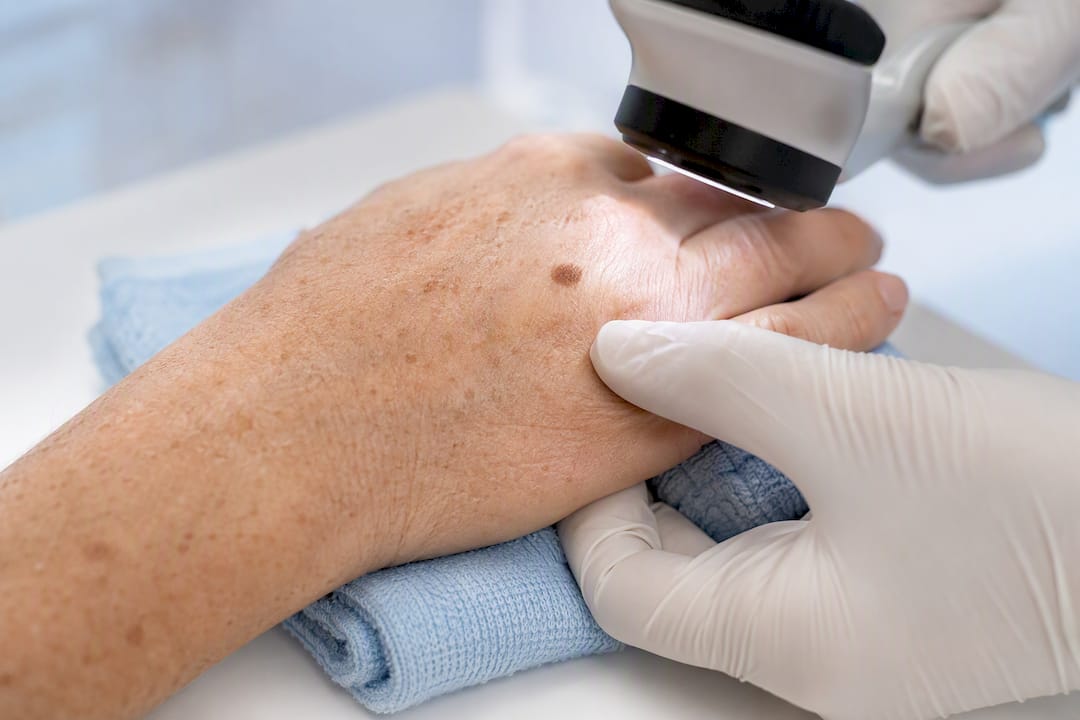
Blood thinners, a history of keloid scarring, active skin infections, and certain autoimmune conditions are common reasons a clinician may delay or modify filler and laser treatments on the hands. Pregnant or breastfeeding patients are typically advised to avoid most injectables, retinoids, and hydroquinone until afterward. Hydroquinone in particular should be used only in short, supervised courses, since long-term unsupervised use carries a risk of its own pigmentation problems.
Mayo Clinic’s guidance also stresses sunscreen use after any age spot procedure, since freshly treated skin is more vulnerable to new pigmentation forming in the same spot. That single step, more than any treatment, strongly influences whether results last or fade quickly.
An Honest Read on What Actually Moves the Needle
Most hand aging content treats every option as equally valid, as if a $40 cream and a $2,000 filler session solve the same problem. They don’t, and pretending otherwise wastes readers’ time and money. Volume loss is structural; no serum rebuilds fat under the skin. Pigment and early texture loss are a different story entirely, and the trial data on topical vitamin C, platelet extract formulas, and dermocosmetic lighteners is genuinely stronger than most people assume.
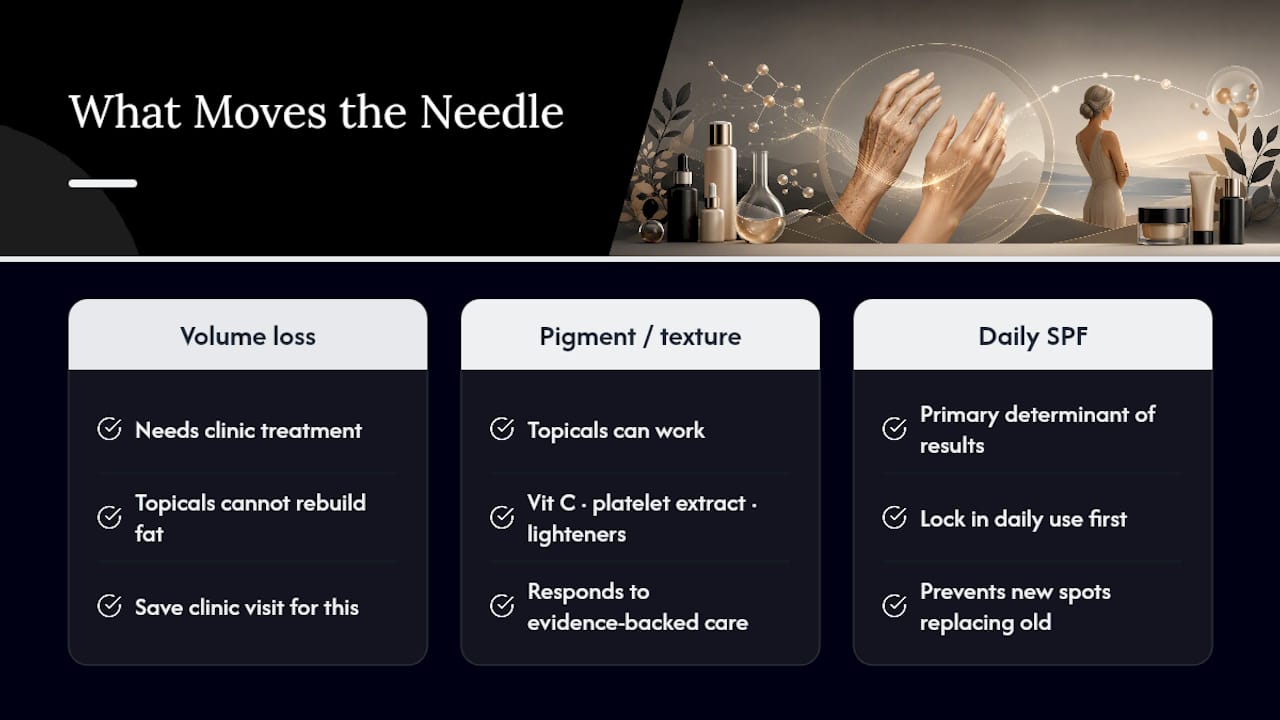
Where conventional advice falls short is in treating sunscreen as an afterthought tacked onto the end of a routine, rather than the single variable that determines whether any other treatment holds. Fix pigment with the right tool, sure, but if daily SPF isn’t already locked in, new spots will simply replace the old ones within a year or two.
My honest read: start with consistent, evidence-backed topical care for anything short of visible volume loss or a suspicious lesion. Save the clinic visit for structural problems a jar of cream genuinely cannot fix.
— Barbara
Your Next Step: A Simple Daily Hand Routine
If your main concern is mild pigment, early crepiness, or you just want to stop new damage before it starts, a product-first routine handles most of that without a single appointment. Miraclegelnaturalskincare built its regimen around exactly that gap: gentle daily steps that work on skin too thin and reactive for harsh exfoliants, at a fraction of what a single laser session costs.

The routine is simple: cleanse gently, apply an antioxidant serum in the morning, follow with broad-spectrum sunscreen, then use a peptide or retinoid-alternative treatment at night, sealed under an occlusive moisturizer while you sleep. If your hands show only mild spotting or you’re aiming for prevention, this is where to start. If you’re seeing deep volume loss, prominent veins, or any lesion that looks unusual, see a dermatologist first and layer topical maintenance in afterward.
Browse the full natural skincare regimen built around this exact sequence, or check the clinically proven results page to see what consistent use looks like over time. Either page gets you started today.
Sources
- A prospective split-hand study of 15% TCA + 3% glycolic acid for hand lentigines
- Tackling sun damage and signs of aging on the hands and arms
- Age spots diagnosis and treatment — Mayo Clinic