

Retinol wins on raw evidence and speed if your skin tolerates it and you’re not pregnant or breastfeeding. Bakuchiol is the better call if you have sensitive skin, you’re expecting, or you’ve tried retinol and your face rebelled. A 2018 randomized trial found both produced similar improvements in wrinkles and pigmentation over 12 weeks, so the real decision comes down to tolerability, not power.
TL;DR:
- Bakuchiol has shown similar short-term effectiveness to retinol in reducing wrinkles and pigmentation over 12 weeks, with fewer side effects like scaling and stinging.
- Retinol provides a deeper, long-term evidence base due to decades of clinical use, while bakuchiol’s research remains smaller and shorter in duration.
- Bakuchiol is safer for sensitive skin, pregnant, or nursing individuals, but its safety during pregnancy is not as extensively studied as retinol.
- For quick results, retinol is preferable for those who tolerate actives well, whereas bakuchiol is better suited for sensitive or reactive skin types.
- Proper introduction and patch testing are essential to avoid irritation with either ingredient, and daily sunscreen remains a must.
Table of Contents
- Bakuchiol vs Retinol: What Retinol Actually Does to Your Skin
- What Is Bakuchiol and Why Is It Called Gentler?
- Does Bakuchiol Work as Well as Retinol in Clinical Trials?
- Who Should Use Retinol, and Who Should Choose Bakuchiol?
- How to Introduce Retinol or Bakuchiol Without Wrecking Your Skin
- Is Bakuchiol Safe During Pregnancy, and What Do Dermatologists Say?
- Why I Think the Bakuchiol Hype Gets One Thing Right and One Thing Wrong
- Where Miraclegelnaturalskincare Fits Into Your Routine
- Sources
Bakuchiol vs Retinol: What Retinol Actually Does to Your Skin
Retinol is a vitamin A derivative. Once absorbed, it converts to retinoic acid, which binds to receptors in skin cells and tells them to speed up turnover and ramp up collagen production. That’s the mechanism behind smoother texture and softer lines, and it’s why retinol accelerates cell turnover while commonly causing dryness and peeling as skin adjusts.
Most over-the-counter formulas are available in varying concentrations, with lower amounts generally recommended for beginners and sensitive skin types, whereas higher amounts may produce faster results but with greater irritation risk. The adjustment period, often called “retinization” or the purge, typically brings:
- Dryness and flaking, especially around the nose and mouth
- Stinging or a warm, tight sensation after application
- Increased sun sensitivity, making daily sunscreen non negotiable
- Occasional breakouts in the first few weeks as cell turnover shifts
None of this is new territory for dermatology. Retinol has decades of clinical use behind it, more than almost any other over-the-counter anti-aging ingredient, which is part of why it remains the default recommendation for photoaging and acne.
What Is Bakuchiol and Why Is It Called Gentler?
Bakuchiol comes from the seeds and leaves of the Psoralea corylifolia plant, long used in Ayurvedic and Chinese medicine. Chemically, it’s a meroterpene with antioxidant and anti-inflammatory properties, and review-level research describes it as generally better tolerated than retinol, which is the main reason it gets marketed as a natural retinol substitute.
Here’s the part most articles skip: bakuchiol doesn’t work through the same receptor pathway as retinol at all. Researchers have found that bakuchiol and retinoids trigger overlapping gene expression tied to collagen production but through distinct upstream signaling. Different route, comparable destination, at least in the short term.
Practical points worth knowing before you shop:
- Products typically range from 0.5% to 2% bakuchiol, often blended with peptides or antioxidants
- It’s less photosensitizing than retinol, giving more flexibility for daytime use (sunscreen still matters)
- Formulation quality affects performance, since encapsulation and delivery systems can meaningfully change bakuchiol’s efficacy and tolerability
- It layers easily with sensitive-skin staples like vitamin C and hyaluronic acid
If your skin has ever revolted against a retinoid, bakuchiol is the ingredient dermatologists tend to suggest first as a swap.
Does Bakuchiol Work as Well as Retinol in Clinical Trials?
The most cited head-to-head comparison is a 12-week randomized, double-blind trial with 44 participants, splitting them between bakuchiol 0.5% cream twice daily and retinol 0.5% cream once daily. Both groups showed significant reductions in wrinkle surface area and hyperpigmentation, and the difference in clinical efficacy between the two groups did not reach statistical significance.
The 12-week numbers: Bakuchiol and retinol produced comparable improvements in wrinkles and pigmentation, but the bakuchiol group reported fewer instances of scaling and stinging.
That’s a genuinely useful data point, and also a limited one. Forty-four participants over 12 weeks tells you something about short-term parity. It tells you nothing about what either ingredient does to skin over two years, five years, or a decade, which is the kind of horizon retinol has actually been tested across for far longer.
Broader clinical reviews caution that retinoids still carry a deeper, longer evidence base than bakuchiol, whose trials remain smaller and shorter. Harvard Health’s clinical summary lands in the same place: bakuchiol shows real promise and can reduce fine lines and pigmentation with better tolerability, but the research volume behind it is nowhere near what retinoids have accumulated.
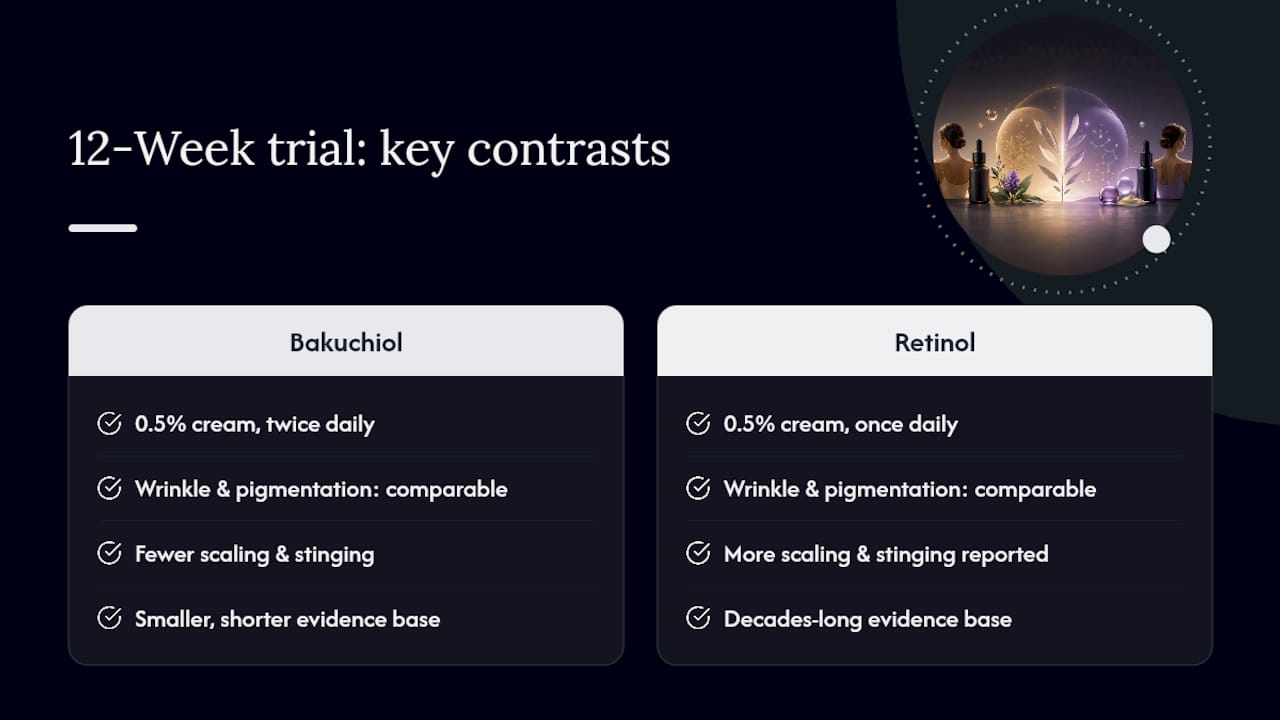
So the honest read is this: for a 12-week stretch, bakuchiol performs in the same range as retinol on wrinkles and tone. For anything longer, or for conditions where retinol has decades of dermatology-backed use behind it (like moderate acne), retinol still holds the deeper track record.
Who Should Use Retinol, and Who Should Choose Bakuchiol?
Match the ingredient to your skin’s actual behavior, not to whichever one is trending.
- Choose retinol if: your skin has handled actives before, you want the fastest documented results, and you’re not pregnant, breastfeeding, or trying to conceive.
- Choose bakuchiol if: you have reactive or sensitive skin, you’re pregnant or nursing, or you’ve already tried retinol and it left you red and flaking.
- Consider alternating or layering if: you tolerate retinol fine but want a gentler option on nights your skin feels reactive, using bakuchiol as the “off night” active.
Dermatologist guidance also points toward pairing bakuchiol with peptides or vitamin C when retinol isn’t an option, building a routine that still targets fine lines without the irritation risk.
Run through this before buying either one:
- Goal: wrinkle reduction, acne control, or general prevention?
- Sensitivity: does your skin flare with new actives, or has it handled strong ingredients before?
- Pregnancy status: pregnant, nursing, or trying to conceive changes the answer immediately.
- Purge tolerance: can you handle a few weeks of flaking and redness for faster results?
- Budget and access: bakuchiol formulations often sit in a similar price range to retinol serums, so cost rarely decides this for you.
Pro Tip: If you’re unsure which camp you fall into, start with bakuchiol for four weeks. If your skin tolerates it well and you want more intensity, you can introduce a low-strength retinol afterward rather than the reverse.
How to Introduce Retinol or Bakuchiol Without Wrecking Your Skin
Rushing either ingredient is the single most common mistake people make, and it’s almost always avoidable.
- Patch test first. Apply a small amount to your inner forearm for two nights before putting either ingredient on your face.
- Start low with retinol. Use a 0.25% to 0.3% formula two to three nights a week for the first two weeks, then build toward nightly use as tolerance improves.
- Use bakuchiol more freely. Because it’s less irritating, many people apply it nightly from the start, and some tolerate it well enough for twice-daily use.
- Separate conflicting actives. Don’t stack retinol the same night as strong AHAs, BHAs, or benzoyl peroxide. Alternate nights instead. Bakuchiol is more forgiving here but still benefits from spacing out from strong exfoliants.
- Sunscreen, every morning, no exceptions. Retinol increases sun sensitivity directly. Bakuchiol is less photosensitizing but sunscreen still remains essential for both.
- Give it time. Most people see initial texture changes around 6 to 12 weeks in, with pigmentation improvements often trailing behind wrinkle softening.
Watch for irritation that doesn’t calm down after a week or two. That’s your signal to cut back frequency, not push through it.
Is Bakuchiol Safe During Pregnancy, and What Do Dermatologists Say?
Retinoids are generally advised against during pregnancy, and topical retinol specifically is a category most obstetricians and dermatologists recommend avoiding altogether. Bakuchiol is widely treated as the pregnancy-friendlier alternative, but the safety data behind it in pregnancy specifically remains limited compared to how thoroughly retinol’s risks have been studied.
Dermatologists still frame bakuchiol as functioning similarly to retinol for texture and wrinkles while being the gentler pick overall, and that gentleness is exactly why it gets recommended during pregnancy. But “widely considered safer” isn’t the same as “extensively proven safe.” If you’re pregnant, nursing, managing a skin condition, or combining several active ingredients already, talk to a dermatologist or your GP before adding either one.
Why I Think the Bakuchiol Hype Gets One Thing Right and One Thing Wrong
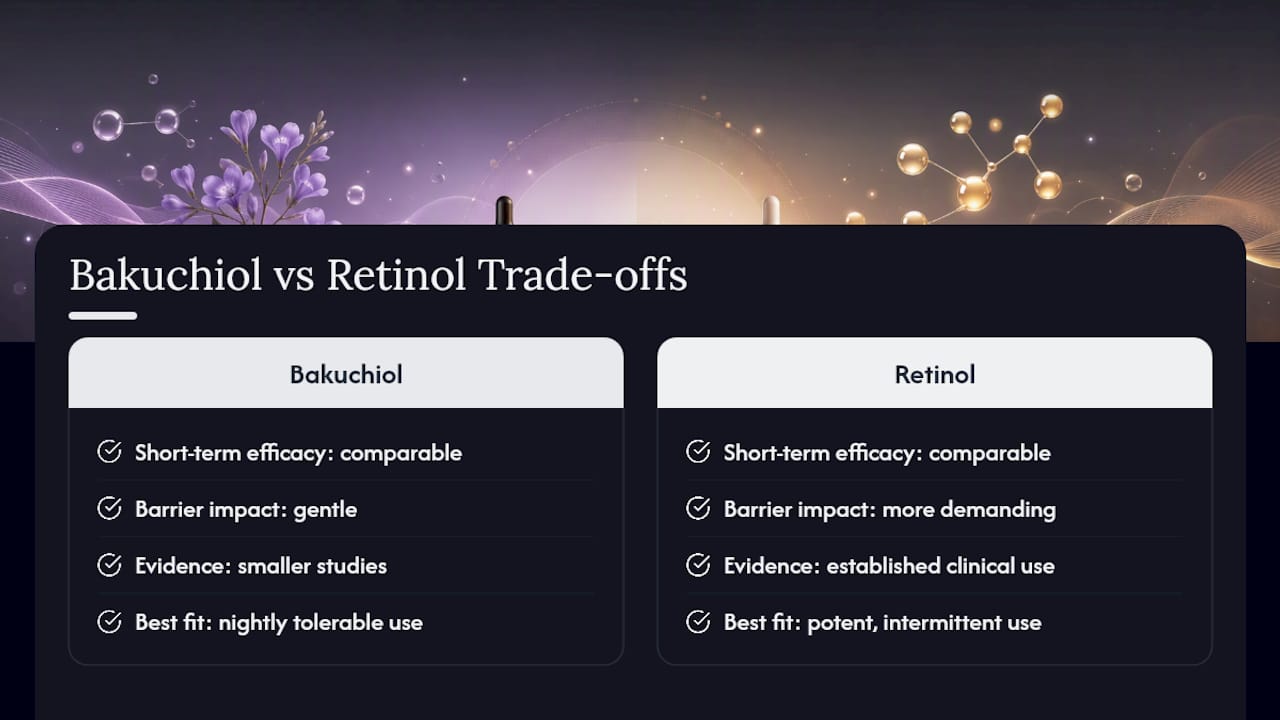
The skincare industry loves a clean narrative, and “bakuchiol replaces retinol” is a clean narrative. It’s also only half true. What the research actually supports is that bakuchiol matches retinol on short-term cosmetic outcomes, wrinkle depth, pigmentation, texture, while asking far less of your skin barrier. That’s not a marketing spin. That’s what a randomized trial with real measurements found.
Where the hype overreaches is treating “gentler and comparably effective at 12 weeks” as “equivalent, full stop.” Retinol has a body of clinical use that spans generations. Bakuchiol has promising, smaller studies. Our approach leans toward gentle, plant-derived actives because many people managing sensitive or mature skin get more consistent long-term results from an ingredient they can tolerate nightly than from a powerhouse used infrequently out of caution. If that’s you, our bakuchiol collection and retinol alternative guides are built around exactly that reasoning.
— Barbara
Where Miraclegelnaturalskincare Fits Into Your Routine
If you’ve read this far, you probably already know which camp you’re in: someone who wants visible anti-aging results without gambling on a week of flaking, redness, and sun sensitivity. That’s the premise behind these plant-forward formulas.

The range includes serums, moisturizers, and eye treatments built around gentle, multi-functional actives rather than harsh concentrations that force a slow, uncomfortable ramp-up. Those managing sensitive skin, and shoppers over 40 looking for consistent results without the purge, tend to benefit because the formulas are designed to be used nightly from day one, not eased into over months. If bakuchiol-forward skincare sounds like the right direction after everything above, take a look at our natural anti-aging range for women 40 and older and find the formula that matches your skin’s actual tolerance, not just its goals.
Sources
- Randomized double-blind trial comparing bakuchiol and retinol (2018)
- Review article on bakuchiol’s properties and tolerability (Journal of Cosmetic Dermatology DOI)
- Bakuchiol: Does it make skin look younger? (Harvard Health)