
Yes, hyperpigmentation after menopause is real, common, and directly tied to hormones. Falling estrogen and progesterone disrupt how your melanocytes distribute pigment, and decades of sun exposure finally show up on skin that’s thinner and slower to heal than it used to be. The result: new dark patches, deepening age spots, or old marks that suddenly refuse to fade.
The immediate priority isn’t a serum. It’s protection and a professional look:
- Wear broad-spectrum sunscreen every single day, rain or shine.
- Get any new, changing, or oddly-shaped spot checked by a dermatologist before treating it yourself.
- Expect visible fading from a consistent topical routine in roughly three to six months. Melasma tends to need ongoing maintenance rather than a onetime fix.
Key Takeaways
Hyperpigmentation after menopause stems from hormonal shifts and cumulative sun damage, and it responds best to daily sunscreen plus gentle, consistent topical care rather than aggressive bleaching.
| Point | Details |
|---|---|
| Hormones drive the change | Declining estrogen disrupts melanocyte regulation, making existing and new pigment more visible. |
| Sunscreen is non-negotiable | Daily broad-spectrum SPF 30+ prevents new spots and protects results from any treatment. |
| Timelines run three to six months | Most topical regimens show measurable fading in this window; melasma needs ongoing maintenance. |
| Irritation causes setbacks | Harsh scrubs, strong peels, and overused bleaching agents often trigger the PIH they’re meant to fix. |
| Get new spots checked first | A dermatologist exam before home treatment rules out skin cancer mimicking benign pigmentation. |
| Miraclegelnaturalskincare offers a gentler path | Peptide-rich, barrier-first formulas support brightening without the irritation risk of aggressive at-home treatments. |
Table of Contents
- What Kind of Hyperpigmentation Shows Up After Menopause?
- Why Menopause Changes the Way Your Skin Holds Pigment
- Building a Daily Routine That Prevents New Spots
- Which Topical Ingredients Actually Fade Dark Spots?
- In-Clinic Treatments: What Peels, Lasers, and Microneedling Can and Can’t Fix
- When a Spot Needs a Dermatologist, Not a Serum
- How Miraclegelnaturalskincare Approaches Menopausal Pigmentation
- Lifestyle and Diet: The Factors You Can Actually Control
- The Emotional Weight of Visible Pigmentation Changes
- Building a Routine Your Menopausal Skin Can Actually Tolerate
- Managing Pigmentation Across Different Skin Tones and Ethnicities
- Hyperpigmentation After Menopause: Causes, Safe Treatments, and What Really Works
- Start With a Gentle, Barrier-First Routine
- Frequently Asked Questions
- Sources
What Kind of Hyperpigmentation Shows Up After Menopause?
Not all dark spots are the same, and figuring out which one you’re dealing with changes your entire treatment plan.
- Melasma appears as symmetrical, blotchy brown patches, usually on the cheeks, forehead, or upper lip. It often predates menopause (many women first notice it during pregnancy or on birth control) and tends to flare with heat, sun, and hormonal shifts, including starting HRT.
- Solar lentigines, better known as age spots or sun spots, are flat, well-defined brown marks on the hands, chest, and face. These are the cumulative bill for decades of UV exposure and they respond fairly predictably to topical treatment and photoprotection.
- Post-inflammatory hyperpigmentation (PIH) develops after any irritation: a popped pimple, a wax burn, an aggressive facial, even eczema. In menopausal skin, PIH lingers longer than it would in your 20s because cell turnover slows down and the barrier takes longer to recover.
Age spots and PIH generally fade faster with consistent topical care. Melasma is the stubborn one. It often improves, then relapses with sun or hormonal triggers, which is why dermatologists frame it as something you manage rather than cure.
Why Menopause Changes the Way Your Skin Holds Pigment
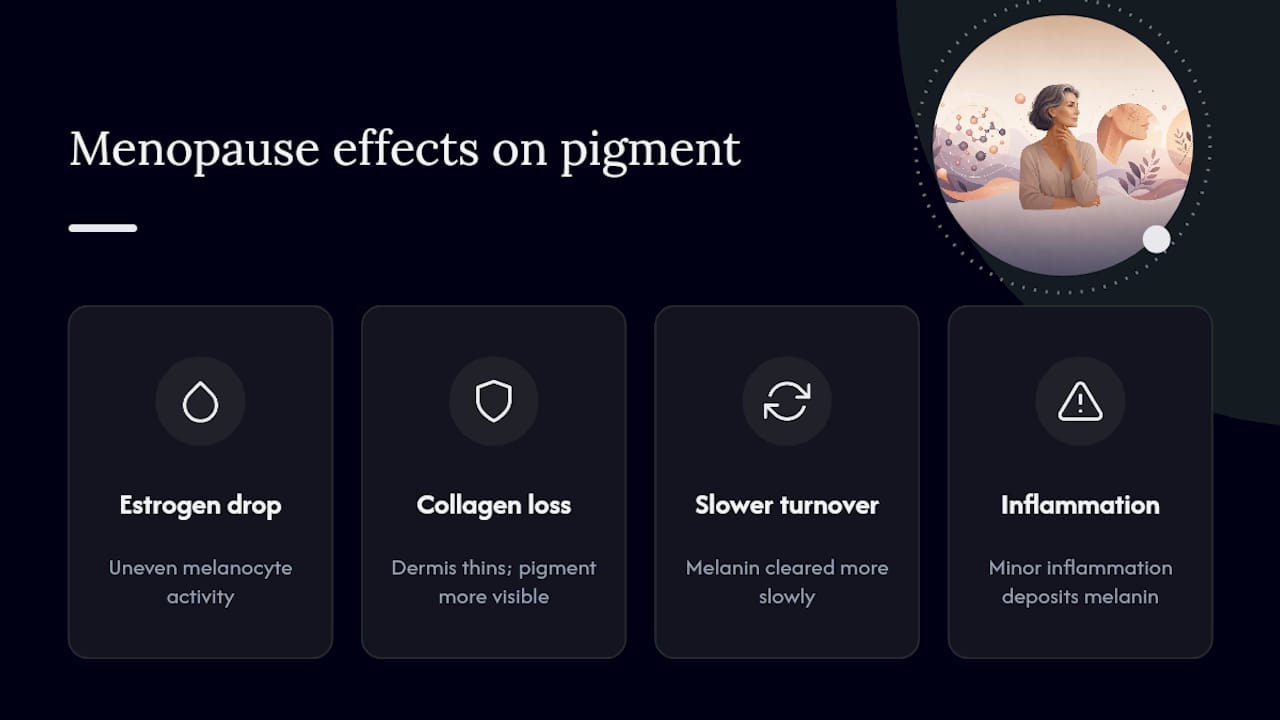
Estrogen isn’t just a reproductive hormone. It plays a direct role in regulating melanocyte activity, and when levels drop during menopause, that regulation gets sloppy. Pigment production becomes uneven instead of consistent, which is why spots that were once faint suddenly look darker or more defined against surrounding skin, according to a review of menopausal skin changes.
At the same time, your skin is getting structurally thinner. Collagen loss accelerates in the years around menopause, and a thinner dermis makes existing pigment more visible rather than less. Add slower cell turnover, and any new inflammation, even a minor one, has more time to deposit melanin before it clears.
Hormone replacement therapy complicates the picture further. The same PMC review notes that HRT can sometimes trigger or worsen melasma in susceptible women, though the evidence is mixed and not every woman on HRT sees this effect. If you started HRT around the same time your pigmentation changed, that timing is worth mentioning to whoever prescribed it.
Building a Daily Routine That Prevents New Spots
Prevention does more heavy lifting than any treatment you’ll buy, and it costs less.
- Apply a broad-spectrum SPF 30+ every morning, mineral formulas (zinc oxide or titanium dioxide) if your skin runs sensitive or reactive, and reapply every two hours if you’re outdoors. This single habit is the foundation the American Academy of Dermatology points to for preventing new age spots.
- Support your barrier with ceramide- and hyaluronic acid-based moisturizers, and skip anything with harsh sulfates or drying alcohol.
- Drop the physical scrubs and at-home high-strength peels. On slower-healing menopausal skin, that kind of friction is a common trigger for PIH rather than a shortcut to brighter skin.
- Choose gentler hair removal methods. Waxing burns and aggressive threading are frequent, avoidable causes of new dark marks.
- Introduce any new active ingredient one at a time, patch-tested on your inner arm for a few days before it touches your face.
Pro Tip: If a product stings, tingles, or turns your skin pink for more than a few minutes, that’s not “working.” It’s irritation, and irritation is exactly what triggers the pigmentation you’re trying to treat. Stop and let your skin recover before trying again at a lower frequency.
Which Topical Ingredients Actually Fade Dark Spots?
Most women want to know what to put on their skin, and the honest answer depends on how aggressive you want to be.
- Hydroquinone, often in triple-combination formulas with tretinoin and a mild steroid, remains one of the most effective short-term prescription options for stubborn spots, but it’s meant for limited courses, not indefinite daily use.
- Azelaic acid, cysteamine, arbutin, and kojic acid are gentler maintenance options that work well for ongoing use without the rebound risk that comes with long-term bleaching agents.
- Tretinoin and other retinoids speed cell turnover, which helps pigment clear faster, but they need a slow introduction (two or three nights a week to start) and non-negotiable daily sunscreen, since they increase sun sensitivity.
- Vitamin C and peptides don’t erase dark spots on their own, but they support collagen and barrier health, which matters more in menopausal skin than in younger skin, and they pair well underneath brightening actives.
Overusing bleaching agents is one of the more common mistakes: uneven or blotchy results, sometimes worse than the original spot, tend to follow when hydroquinone is applied more often or longer than recommended. Most people using a consistent regimen see measurable fading within three to six months; melasma specifically tends to need continued maintenance to hold results, a pattern echoed in guidance on managing melasma long term. For ingredient pairings suited to this stage of life, a deeper look at brightening mature skin covers how to layer these actives without overwhelming your barrier.
In-Clinic Treatments: What Peels, Lasers, and Microneedling Can and Can’t Fix
When topicals plateau, clinic treatments can push further, but they carry more risk in menopausal skin, especially skin with more melanin.
- Superficial chemical peels need multiple sessions with minimal downtime and are generally the safer entry point.
- Medium-depth peels work faster but come with real downtime and a higher chance of triggering the exact PIH you’re trying to fix, particularly in darker skin tones.
- Lasers and IPL can be genuinely effective on stubborn spots, but they also carry a documented risk of rebound hyperpigmentation, which is why a pigmentation review specifically recommends dermatologist-led, staged protocols rather than one aggressive session.
- Microneedling shows promise combined with topical agents, though again, conservative protocols beat aggressive ones on mature skin.
Pro Tip: Before any laser or medium peel, ask your provider about pre-conditioning your skin with topical brightening agents beforehand and strict sun avoidance afterward. Specialists who treat pigmentation regularly build in test patches for exactly this reason, since rebound pigmentation is easier to prevent than to treat.
When a Spot Needs a Dermatologist, Not a Serum
Some pigmentation changes are urgent, not cosmetic, and knowing the difference matters more than any product choice.
- Watch for the ABCDE signs: Asymmetry, irregular Borders, multiple Colors, a Diameter larger than a pencil eraser, or Evolving size, shape, or texture.
- Any spot that bleeds, itches persistently, or changes rapidly needs an exam, not a wait-and-see approach.
- Any new dark spot in someone over 40 deserves a professional look before home treatment starts, since skin cancer can closely mimic benign pigmentation.
Skin cancer risk climbs with age, and a mark that looks like an ordinary age spot can occasionally be something else entirely. Dermatologist exams before starting treatment are the standard safety recommendation from the AAD, not an overcautious extra step.
If you’re on HRT and pigmentation appeared or worsened after starting it, mention that timeline to your prescribing clinician. It doesn’t necessarily mean stopping treatment, but it’s a factor worth discussing openly rather than managing quietly on your own.
How Miraclegelnaturalskincare Approaches Menopausal Pigmentation
This section reflects the editorial view of Barbara, drawing on the clinical guidance above.
Miraclegelnaturalskincare, founded by Shelly Maguire, builds formulas around peptide-rich, barrier-supporting complexes like the Tri-Moisture Cryo Complex™ rather than aggressive bleaching agents. That choice isn’t arbitrary. Menopausal skin heals slowly, and British Skin Foundation guidance specifically warns that harsh at-home peels tend to create the very post-inflammatory marks women are trying to avoid.
- Formulas prioritize barrier repair alongside brightening, rather than stripping pigment through irritation.
- Patch testing and gradual introduction are recommended before layering any new active.
- Dermatologist collaboration is encouraged for anyone using prescription-strength treatments alongside daily skincare.
- Understanding perimenopausal skin changes first helps explain why gentler, consistent care outperforms aggressive one-off treatments.
Lifestyle and Diet: The Factors You Can Actually Control
Skincare gets most of the attention, but what happens away from your bathroom counter shapes pigmentation just as much.
Chronic stress raises cortisol, and elevated cortisol has a documented relationship with inflammatory skin responses, the same inflammatory pathway that drives PIH after any irritation. Poor sleep compounds this, since skin repair and turnover happen disproportionately overnight. If you’re not sleeping well through menopause, and many women aren’t, that’s not just fatigue; it’s slower pigment clearance too.
Diet plays a smaller but real role. Diets heavy in refined sugar and processed carbohydrates promote glycation, a process that stiffens collagen and accelerates visible aging, including making existing pigment more prominent against duller, less elastic skin. Antioxidant-rich foods (berries, leafy greens, colorful vegetables) support your skin’s own defense against UV-driven oxidative stress, the same stress that worsens sun spots over time.

Smoking deserves a direct mention: it thins skin, impairs circulation, and slows the healing process that clears PIH. If you smoke and you’re frustrated that spots aren’t fading, that habit is working against every topical you’re using.
Thyroid function is worth checking too. Hypothyroidism, more common around menopause, is linked with skin changes including altered pigmentation patterns, and it’s often overlooked because fatigue and weight changes get blamed on menopause alone. If your dermatologist rules out other causes for stubborn pigmentation, ask your doctor whether a thyroid panel makes sense.
None of this replaces sunscreen or the right topical. But treating your skin from the inside, sleep, stress management, and steady blood sugar, gives every product you apply a better chance of working.
The Emotional Weight of Visible Pigmentation Changes
Skin changes during menopause rarely arrive alone. They land alongside hot flashes, sleep disruption, mood shifts, and a body that already feels unfamiliar, and for many women, visible dark spots become a focal point for a broader sense of losing control over their appearance.
That reaction is worth naming rather than dismissing. Feeling frustrated or self-conscious about new pigmentation isn’t vanity, it’s a reasonable response to a visible, persistent change that conventional advice often treats as purely cosmetic. Clinical commentary on menopausal skin increasingly acknowledges this emotional dimension directly, recommending that dermatology visits address the psychological weight of these changes and not just the treatment plan.
A few things help. First, get a professional diagnosis early. Uncertainty about whether a spot is dangerous is often more distressing than the spot itself, and a clear answer from a dermatologist resolves that specific anxiety fast. Second, set a realistic timeline. Expecting overnight results from any topical sets you up for disappointment; knowing that three to six months is a normal window changes how you experience the wait. Third, talk to other women going through the same shift. Menopause support communities, whether through your doctor’s office or online, normalize skin changes that can otherwise feel isolating.
Makeup isn’t a failure or a shortcut around “real” treatment. Color-correcting concealers and mineral-tinted SPF let you manage how visible pigmentation feels day to day while your topical routine does its slower work underneath. There’s no rule that says you have to wait for spots to fade before you feel comfortable in your own skin.
Building a Routine Your Menopausal Skin Can Actually Tolerate
The mistake most women make isn’t choosing the wrong ingredient. It’s introducing too many active ingredients at once on skin that’s already more reactive than it used to be.
Start with the basics done consistently rather than a shelf full of serums. A gentle, non-foaming cleanser twice daily protects a barrier that’s already thinner and slower to repair itself. Follow with a hydrating moisturizer containing ceramides or hyaluronic acid before layering anything else, since a compromised barrier makes every active ingredient, brightening or otherwise, more likely to irritate.

Morning routines should center on antioxidant protection (vitamin C or a peptide serum) followed by mineral sunscreen, non-negotiable, applied as the last step. Evening routines are where brightening actives belong, introduced one at a time and spaced a few nights apart from each other rather than stacked together on the same night.
Weekly, not daily, exfoliation is usually enough for menopausal skin. Chemical exfoliants at low concentrations (a mild lactic acid, for instance) tend to be gentler than physical scrubs, which cause the micro-tears that trigger PIH in slower-healing skin.
Reassess every few months rather than switching products at the first sign of impatience. Skin barrier repair and visible pigment fading both operate on a timeline measured in months, not days, and constantly changing products resets that clock every time. A multitasking approach that combines hydration, brightening, and protection in fewer steps tends to outperform a complicated ten-step routine that irritates skin before it has a chance to improve.
Managing Pigmentation Across Different Skin Tones and Ethnicities
Melanin-rich skin, including Black, South Asian, Latina, and Mediterranean skin, faces a distinct set of trade-offs after menopause that lighter skin doesn’t share to the same degree.
The core issue is PIH risk. Any inflammation, from a laser treatment to an aggressive peel to a popped blemish, tends to trigger more pronounced and longer-lasting dark marks in higher-melanin skin, because those melanocytes are more reactive to inflammatory signals. That’s why guidance for women of color and menopausal skin explicitly recommends gentler, more conservative treatment protocols over the more aggressive options sometimes marketed for “fast results.”

This changes practical decisions. Lasers and medium-depth peels carry meaningfully higher risk for darker skin tones and should only be performed by a provider experienced specifically in treating pigmentation on melanin-rich skin, not a general aesthetics practice. Ingredient choice shifts too: azelaic acid and cysteamine are often better tolerated long-term than hydroquinone in darker skin, since they carry a lower risk of the blotchy rebound discoloration that can follow prolonged bleaching agent use.
Lighter skin tones face a different but equally real challenge: solar lentigines and general sun damage tend to dominate over PIH risk, meaning UV protection carries even more weight in prevention, since existing damage is often more extensive from cumulative unprotected exposure over decades.
Whatever your skin tone, the same underlying principle holds: irritation is the enemy of clear skin during menopause, and the gentler your approach, the better your odds of steady, lasting improvement rather than a new mark replacing the old one.
Hyperpigmentation After Menopause: Causes, Safe Treatments, and What Really Works
The conventional advice on menopausal pigmentation gets one thing badly wrong: it treats bleaching agents as the default answer instead of the last resort. Hydroquinone and aggressive peels have their place, but reaching for them first, on skin that heals slower and irritates faster than it used to, is how women end up trading one pigmentation problem for another.
What the evidence actually supports is sequencing. Sunscreen and barrier repair first, gentler maintenance actives second, prescription-strength or in-clinic options only when needed and only under professional guidance. That order isn’t cautious for caution’s sake. It’s the order least likely to backfire on skin where a single irritated blemish can leave a mark for months.
If you take away one priority from all of this, make it sunscreen consistency over any serum. No brightening ingredient outruns daily unprotected sun exposure, and no clinic treatment holds its results without it. Everything else, ingredients, procedures, timelines, works better once that foundation is in place.
Start With a Gentle, Barrier-First Routine
If you’re navigating hyperpigmentation after menopause and want a starting point that won’t add irritation to an already sensitive complexion, begin with fewer products done consistently rather than an aggressive multi-step regimen. Miraclegelnaturalskincare’s approach centers on peptide-rich, barrier-supporting formulas, an evidence-aligned middle ground between doing nothing and reaching for prescription-strength bleaching agents before your skin is ready for them.

A practical starter stack looks like this: a gentle daily cleanser, a peptide or hydrating moisturizer to rebuild barrier resilience, a mineral SPF 30+ applied every morning without exception, and a targeted brightening serum layered in once your skin tolerates the basics. The brand’s natural skincare collection for women 40 and up is built around exactly this kind of layered, gentle approach, with formulas designed to work alongside dermatologist-recommended sun protection rather than instead of it.
Orders over €85 ship free within Ireland and the UK, and the customer service team can help you sequence products if you’re unsure where to start. Browse the anti-aging and brightening lineup and build your starter routine around the products your skin can actually tolerate.
Frequently Asked Questions
Is hyperpigmentation normal after menopause?
Yes. Hormonal decline combined with decades of sun exposure makes new or worsening dark spots common during and after menopause, though the severity varies widely between individuals.
Can hormone replacement therapy cause dark spots?
It can in some women, particularly those prone to melasma. The relationship is inconsistent, so mention any new pigmentation to the clinician managing your HRT.
How long does it take for menopausal hyperpigmentation to fade?
Most consistent topical routines show visible fading within three to six months. Melasma typically requires ongoing maintenance rather than a single treatment course.
Are chemical peels safe for menopausal skin?
Superficial peels are generally low risk when done conservatively. Medium-depth peels and lasers carry higher rebound pigmentation risk and work best under a dermatologist experienced in treating pigmentation.
When should I see a dermatologist about a dark spot?
See one before treating any new, rapidly changing, asymmetrical, or bleeding spot, since these can signal skin cancer rather than benign pigmentation.
This article is general information, not a substitute for advice from a qualified doctor. Consult a qualified healthcare professional about your own circumstances before acting on anything here.
Sources
- Clinical review on pigmentation treatments (2026 DOI)
- Caring for your skin in menopause — AAD
- Menopausal skin changes review (PMC)
- Navigating melasma — British Skin Foundation (2024)
- Dark spots during menopause — SANE MD