
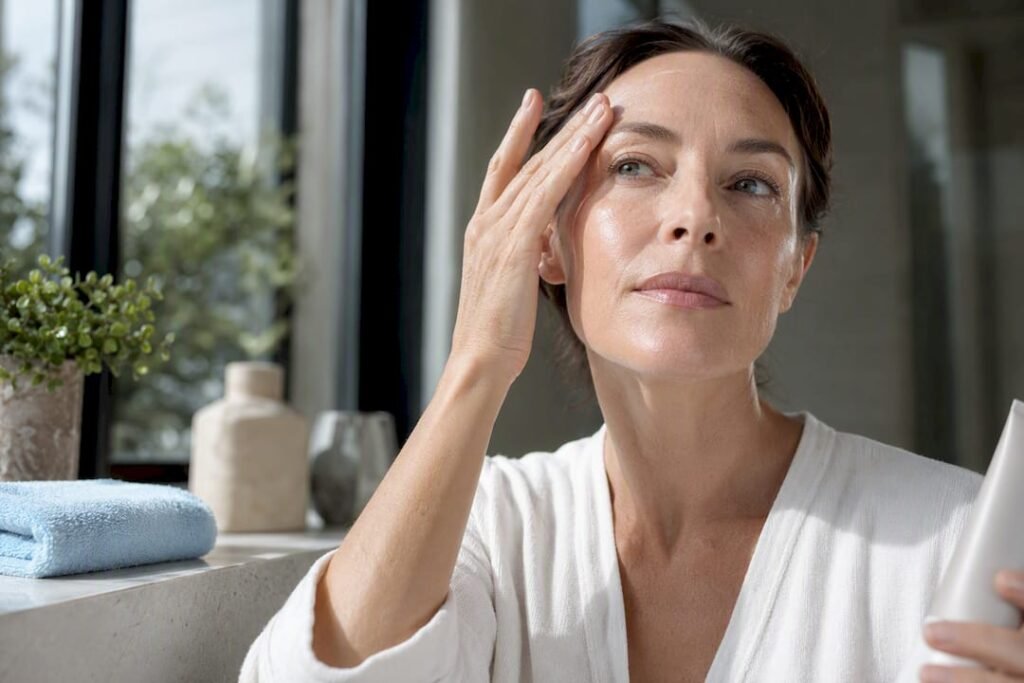
For most people, a barrier-first, multimodal routine controls melasma best: daily tinted broad-spectrum sunscreen, gentle cleansing, a barrier-repair moisturizer, and targeted actives added slowly under guidance. Melasma responds to a structured plan, not a single product, and it needs an 8 to 12 week induction period followed by ongoing maintenance to keep pigment from creeping back.
TL;DR:
- A barrier-first, multimodal routine with consistent photoprotection and slow, guided introduction of actives is key to controlling melasma effectively.
- Use tinted mineral sunscreen with iron oxides daily, reapply every two to three hours, and incorporate physical barriers like hats and shade during peak sunlight.
- Expect initial visible improvement after eight to twelve weeks of proper skincare, with ongoing maintenance crucial to prevent relapse.
- Avoid common triggers such as hot water, high-strength AHAs, and unsupervised hydroquinone use, which can worsen pigmentation or cause irritation.
- Supporting the skin barrier with ceramides, niacinamide, hyaluronic acid, and squalane helps reduce irritation and sustain treatment results.
Table of Contents
- What Does a Daily Melasma Skincare Routine Look Like in the Morning?
- How Should the Evening Routine Remove Sunscreen and Add Actives?
- What Ingredients Actually Support a Damaged Skin Barrier?
- What Should You Avoid If You Have Melasma?
- When Does Melasma Need a Prescription or Procedure?
- How Do You Keep Melasma From Coming Back?
- Does Miraclegelnaturalskincare Align With Clinical Melasma Guidance?
- The Part of Melasma Care Everyone Skips Past
- Where Miraclegelnaturalskincare Fits Into Your Maintenance Routine
- Where This Routine’s Guidance Comes From
- Sources
- FAQ
What Does a Daily Melasma Skincare Routine Look Like in the Morning?
Mornings are about protection, not correction. Start with a lukewarm water cleanse using a mild, non-foaming formula. Hot water strips lipids from already-compromised skin and tends to trigger the inflammation that feeds melasma. Double-cleansing isn’t necessary in the morning unless you woke up with visible product buildup from an overnight treatment.
After cleansing, an antioxidant step can help. Low-irritation vitamin C derivatives (ascorbyl glucoside or sodium ascorbyl phosphate rather than pure L-ascorbic acid) or niacinamide both work well here, applied before sunscreen. Vitamin C and melasma have a complicated relationship: the vitamin helps limit oxidative damage, but high-strength L-ascorbic acid can sting and provoke the exact irritation that worsens pigmentation.
Sunscreen is the step that actually decides whether the rest of the routine works. A tinted mineral sunscreen built on zinc oxide or titanium dioxide, blended with iron oxides, is what dermatology guidelines point to for melasma specifically, because standard clear sunscreens block UV but do almost nothing against visible light, which is a documented trigger for melasma pigmentation. Aim for SPF 30 to 50 or higher, and treat reapplication as non-negotiable.
- Reapply every 2 to 3 hours during direct sun exposure, per photoprotection guidelines for melasma.
- Add a wide-brim hat or seek shade between 10 a.m. and 3 p.m., when UV and visible light both peak.
- Consider UV-filtering window film for cars and home offices, since glass doesn’t block visible light.
Pro Tip: Keep a compact pressed mineral powder with iron oxides in your bag for midday reapplication over makeup. Rubbing in liquid sunscreen at your desk is messy; tapping on a tinted powder takes ten seconds.
How Should the Evening Routine Remove Sunscreen and Add Actives?
Tinted mineral sunscreens don’t dissolve with a splash of water. An oil-based cleanser or micellar water first, followed by a gentle water-based cleanser, gets pigment and mineral filters off without scrubbing. Scrubbing is exactly what you’re trying to avoid, since friction and irritation are known drivers of post-inflammatory pigment.
Actives get introduced one at a time, slowly, in this order:
- Tranexamic acid or azelaic acid first. Azelaic acid at 15 to 20 percent is one of the better-tolerated melanin-inhibiting options and pairs well with topical tranexamic acid. Start three nights a week for two weeks before assessing tolerance.
- Niacinamide can run alongside either agent most nights, since it calms inflammation rather than adding exfoliation.
- Retinoids come last, and only once your barrier feels stable. Begin with a low concentration twice a week, buffered under moisturizer, and increase frequency only if skin shows no redness or flaking after a week.
Never stack tranexamic acid, azelaic acid, and a retinoid on the same night when you’re still in the early weeks. Give your skin one active to adapt to before layering another; melasma-prone skin flares easily, and a flare undoes weeks of progress.
Expect a real response window of 8 to 12 weeks before you see meaningful fading. Some patients notice partial improvement earlier, but the visible shift most people are chasing tends to show up closer to the three-month mark, with continued gains over the following months.
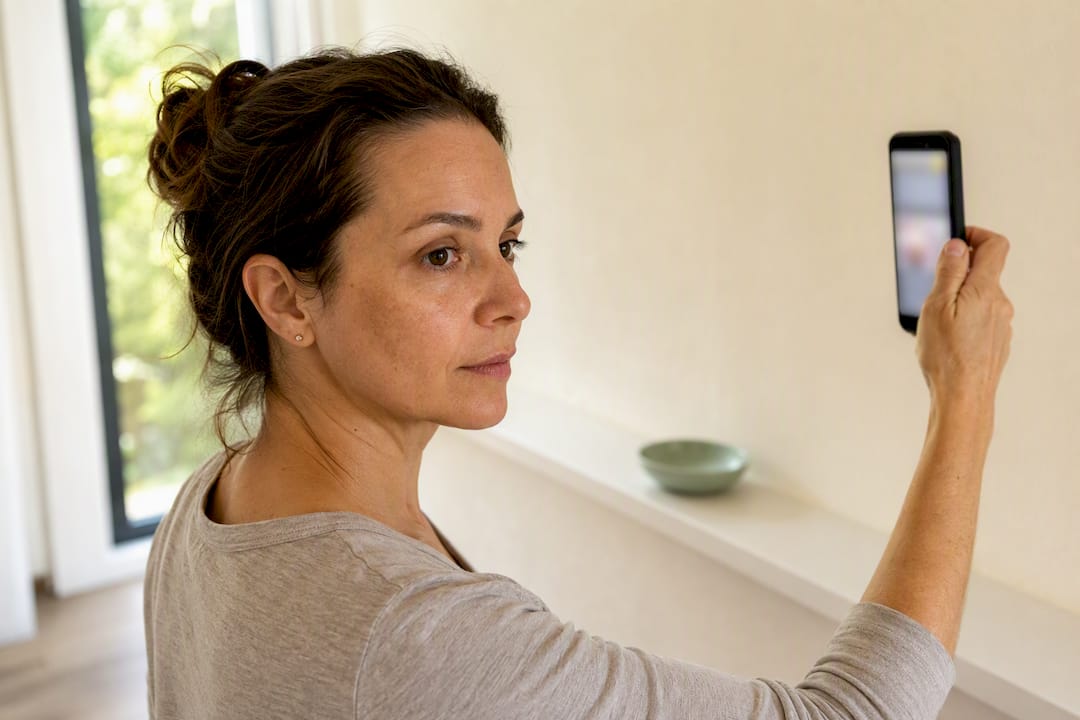
Pro Tip: Take a plain, well-lit photo of your face every two weeks in the same spot and lighting. Day-to-day changes are nearly invisible, but a two-week comparison photo will show you real progress your mirror can’t.
What Ingredients Actually Support a Damaged Skin Barrier?
Melasma-prone skin usually has a weaker barrier than it looks like on the surface, and that weakness is part of why irritation so easily turns into new pigment. A barrier-first approach isn’t optional padding around the “real” treatment. It’s what lets the real treatment work without blowing up in your face.
Look for moisturizers built around:
- Ceramides, which restore the lipid matrix that holds moisture in and irritants out.
- Niacinamide, doing double duty as both a barrier ingredient and a mild pigment-calming agent.
- Hyaluronic acid, for water-based hydration under heavier creams.
- Squalane, a lightweight occlusive that seals without feeling greasy.
Climate and season change what texture you want. Humid or hot conditions call for a lighter emulsion so pores don’t clog under sweat; dry winter air often needs a richer, more occlusive cream layered over a hydrating serum. Either way, moisturizer isn’t just a finishing step. Applying it before or immediately after an active (the “buffering” technique) slows absorption just enough to cut irritation without meaningfully reducing the active’s benefit.
Skip anything with denatured alcohol high on the ingredient list, physical scrubs with jagged particles, or added fragrance. All three are common irritants that melasma-prone skin tolerates poorly, and irritation is often the fastest route to a flare.
What Should You Avoid If You Have Melasma?
A few habits undo months of careful treatment faster than any product can fix. Heat is one of the least talked-about triggers: hot showers, saunas, steam facials, and applying actives right after a sweaty workout all raise skin temperature enough to stimulate pigment-producing cells.
- Skip daily high-strength AHAs. Glycolic acid above 5 percent used every day is a common cause of irritation-driven flares in melasma-prone skin.
- Drop L-ascorbic acid if it stings on application. Discomfort is a signal, not something to push through.
- Treat hydroquinone with real caution. It’s effective, but prolonged unsupervised use carries risks, including a rare condition called exogenous ochronosis, so prescription-strength use belongs under a clinician’s supervision, not indefinite self-treatment.
- Review hormonal triggers honestly: pregnancy, hormonal contraception, and certain medications can all worsen melasma regardless of how disciplined your topical routine is.
When Does Melasma Need a Prescription or Procedure?
Topical care handles most cases, but a subset of patients need more, and knowing the escalation path keeps you from either giving up too early or over-treating at home. The standard framework splits treatment into an induction phase of roughly 8 to 12 weeks, where the goal is measurable pigment reduction, followed by maintenance, where the goal shifts to holding the gains and preventing relapse.
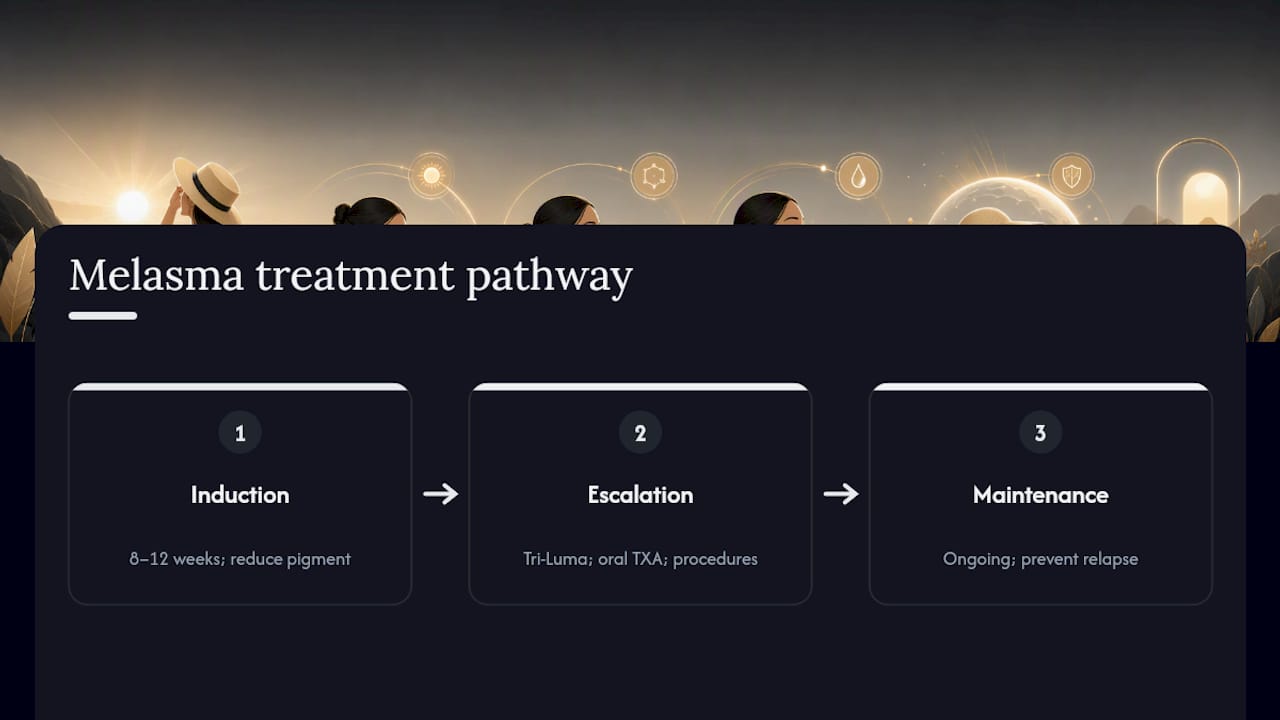
For moderate to severe cases that don’t respond to standard topicals, dermatologists sometimes prescribe Tri-Luma, a triple-combination cream pairing fluocinolone acetonide, hydroquinone, and tretinoin. Clinical data show significant clearing typically by around two months of use. It’s approved for short-term use only. It isn’t appropriate during pregnancy, and ongoing use needs monitoring for steroid-related skin thinning, which is exactly why it’s a supervised induction tool rather than a long-term staple.
Oral tranexamic acid is another option some clinicians consider for stubborn cases, but it requires screening for clotting risk before prescribing, since tranexamic acid affects blood clotting pathways. This is a specialist decision, never a self-directed one.
Procedural options, superficial chemical peels, microneedling, and low-fluence laser devices, can help as adjuncts, but every one of them carries a real risk of triggering worse pigmentation if performed too aggressively or by an inexperienced provider. These belong squarely in specialist hands, not DIY territory.
How Do You Keep Melasma From Coming Back?
Maintenance is where most people quietly fail, not because the routine gets harder, but because it gets boring right when results start showing. Relapse without ongoing photoprotection is common, which makes the daily habits below the real long game.
- Wear tinted SPF every single day, reapplying through sun exposure, indefinitely, not just during flare season.
- Drop actives to a maintenance frequency (two to three nights weekly) once pigment stabilizes, and only ramp back up to induction-level frequency if you notice regression.
- Pack a travel-sized tinted SPF and a single active serum for trips. Simplicity beats a full nine-step routine you’ll skip on vacation.
- Snap that same benchmark photo monthly and check in with a dermatologist if pigment darkens despite consistent sunscreen use.
Does Miraclegelnaturalskincare Align With Clinical Melasma Guidance?
Dermatology guidance is consistent on the hierarchy that matters most: photoprotection first, then multimodal topical care, then specialist intervention when needed. The product focus on gentle, barrier-supportive formulations fits squarely into the maintenance side of that hierarchy. Prescription-strength hydroquinone, triple-combination creams, and oral tranexamic acid remain firmly in clinician territory. A well-formulated maintenance product set doesn’t replace that; it supports what happens between appointments.
The Part of Melasma Care Everyone Skips Past
The uncomfortable truth about melasma treatment is that most people fixate on the active ingredient and treat sunscreen as an afterthought, when the research points the opposite direction. Iron-oxide tinted sunscreen isn’t a nice add-on to your “real” treatment. It’s arguably the single highest-leverage product in the entire routine, because visible light keeps triggering pigment regardless of how good your serum is.
The conventional advice to “just find the right brightening ingredient” undersells how much melasma is a barrier problem wearing a pigment costume. Skin that’s inflamed, dehydrated, or irritated produces more pigment, not less, no matter how many actives you throw at it. That’s why a slow, patient introduction of actives beats an aggressive multi-step regimen almost every time.
If you take one thing from this: prioritize tinted SPF and barrier repair for the first month before adding anything else. Everything else in the routine works better once that foundation holds, and most of the frustration people report with melasma treatment traces back to skipping that step in favor of something that felt more “active.”
— Barbara
Where Miraclegelnaturalskincare Fits Into Your Maintenance Routine
Once your skin is past active irritation and into the maintenance phase, the products doing the daily work matter more than any single serum breakthrough. Miraclegelnaturalskincare’s gentle cleansers, barrier moisturizers, and low-irritation brightening serums are formulated for exactly this stage, sitting on either side of your photoprotection step without disrupting a barrier you’ve worked hard to stabilize.

A gentle cleanser removes the day’s tinted sunscreen without stripping lipids. A barrier moisturizer layered morning and night keeps skin resilient enough to tolerate whatever active you’re rotating in. And a low-irritation brightening serum can support pigment maintenance between induction courses, without the sting that sends people back to square one. None of this replaces prescription-strength treatment or oral therapy when a clinician determines you need it; those decisions stay with your dermatologist. For the daily maintenance work that keeps results from slipping, explore the Miraclegelnaturalskincare natural skincare range for radiant, age-defying results and build the routine around what your skin actually needs to hold steady.
Where This Routine’s Guidance Comes From
- Photoprotection and melasma (PMC 2022): the core evidence behind tinted, iron-oxide sunscreen recommendations.
- Contemporary topical agents for melasma (PMC 2024): concentration guidance for azelaic acid and tranexamic acid.
- Melasma – StatPearls: the chronic-disease framing behind induction and maintenance phases.
- TRI-LUMA® product information: official data on triple-combination induction therapy.
This article is general information, not a substitute for advice from a qualified doctor. Consult a qualified healthcare professional about your own circumstances before acting on anything here.
Sources
- Photoprotection and melasma (PMC 2022)
- Contemporary topical agents for melasma (PMC 2024)
- TRI-LUMA® product information
- Melasma – StatPearls – NCBI Bookshelf
FAQ
What is the best skincare routine for melasma?
The best routine combines daily tinted mineral sunscreen with iron oxides, gentle cleansing, a barrier-repair moisturizer, and slowly introduced actives like azelaic acid or tranexamic acid, built around an 8 to 12 week induction phase followed by maintenance.
What do Koreans use for melasma?
Korean skincare approaches to melasma typically emphasize layered hydration, gentle multi-step cleansing, and daily mineral sunscreen reapplication, principles that align closely with the barrier-first, photoprotection-heavy routine outlined above.
What should I avoid if I have melasma?
Avoid hot water, saunas, and steam, daily high-strength AHAs above 5 percent glycolic acid, stinging L-ascorbic acid formulas, and unsupervised long-term hydroquinone use, since each can trigger irritation-driven pigment flares.
What is the best moisturizer for melasma?
Look for a moisturizer built around ceramides, niacinamide, hyaluronic acid, or squalane, free of alcohol, fragrance, and harsh exfoliating particles, in a texture matched to your climate and season.
Can melasma be treated at home without a dermatologist?
Mild to moderate melasma often responds well to a consistent home routine of tinted sunscreen, gentle actives, and barrier care, but persistent or worsening pigmentation, or interest in prescription-strength or oral treatment, needs a dermatologist’s evaluation.