
Short answer: retinal (retinaldehyde) is generally faster and more efficient than retinol, converting to active retinoic acid in one step instead of two. But faster is not automatically better. Dermatologist guidance and clinical imaging studies both point to the same catch: whichever retinoid you can tolerate and apply consistently, night after night, wins over the one that just sounds stronger on paper.
TL;DR:
- Retinal converts to retinoic acid faster than retinol because it requires only one enzymatic step, leading to quicker visible results but increased irritation risks.
- Proper formulation and packaging are crucial, as poorly stabilized retinal products lose potency faster and may underperform compared to well-made retinol options.
- Sensitive skin types should start with retinol at low concentrations to avoid irritation, while acne-prone skin can benefit from retinal’s antibacterial properties despite its higher irritation potential.
- Consistent use over 12 weeks is necessary for noticeable improvements, with retinal showing earlier changes in skin texture and wrinkle depth than retinol.
- Combining retinoids with supportive, barrier-boosting products and daily SPF is vital to maximize benefits and minimize irritation during the adjustment period.
Table of Contents
- Retinal vs Retinol: The Head-to-Head Comparison
- How Retinol and Retinal Actually Work in Your Skin
- How Fast Do Retinol and Retinal Actually Work?
- Which Skin Types Tolerate Retinal and Retinol Best?
- How to Start, Ramp Up, and Switch Between Retinol and Retinal
- What Pairs Safely With Retinoids, and Why SPF Isn’t Optional
- What the Research Actually Shows About Retinal vs. Retinol
- Why I Tell People to Stop Chasing the “Stronger” Retinoid
- How Miracle Gel Supports Your Retinoid Routine
- Sources
Retinal vs Retinol: The Head-to-Head Comparison
The gap between these two ingredients comes down to chemistry, not marketing. Retinol needs two enzymatic conversions before your skin can use it. Retinal needs one. That single missing step is why retinal converts to retinoic acid faster and hits harder gram-for-gram than retinol, and it’s the entire reason this comparison exists.
Concentration labels can be misleading if you compare them like-for-like. Retinol has more forgiving margins because your skin does more of the conversion work gradually. Retinal skips ahead, which is exactly why it can be both more effective and more irritating in the same week.
Fast fact: Systematic reviews of topical retinoids rank tretinoin (prescription retinoic acid) at the top of the potency scale, retinal next, then retinol and retinyl esters at the bottom, with tolerability running roughly inverse to potency.
Formulation matters just as much as the molecule itself. Retinaldehyde oxidizes more readily than retinol once exposed to air and light, so poorly stabilized retinal products lose potency faster on the shelf than their retinol counterparts. That’s a manufacturing problem, not a chemistry flaw, but it means the brand and packaging you choose actually change the outcome you get.
Here’s how the two stack up across the factors that matter in practice:
- Conversion steps: Retinol needs two enzymatic conversions to become retinoic acid; retinal needs one.
- Speed: Retinal generally shows visible changes sooner, though “sooner” still means weeks, not days.
- Potency per concentration: A lower percentage of retinal can rival a higher percentage of retinol.
- Stability: Retinol is more shelf-stable; retinal requires airtight, light-blocking packaging to stay effective.
- Best for: Retinol suits beginners, sensitive skin, and anyone easing into a routine; retinal suits people with established tolerance, acne-plus-aging concerns, or impatience for results.
- Cost and availability: Retinol dominates drugstore and mid-range shelves; retinal is pricier and less widely stocked.
None of this means retinal is the “advanced” version and retinol is the “starter kit” in some hierarchy you’re supposed to climb. Plenty of people do beautifully on retinol indefinitely. The comparison only matters once you know what you’re optimizing for: speed, tolerance, or a specific skin concern like acne.
How Retinol and Retinal Actually Work in Your Skin
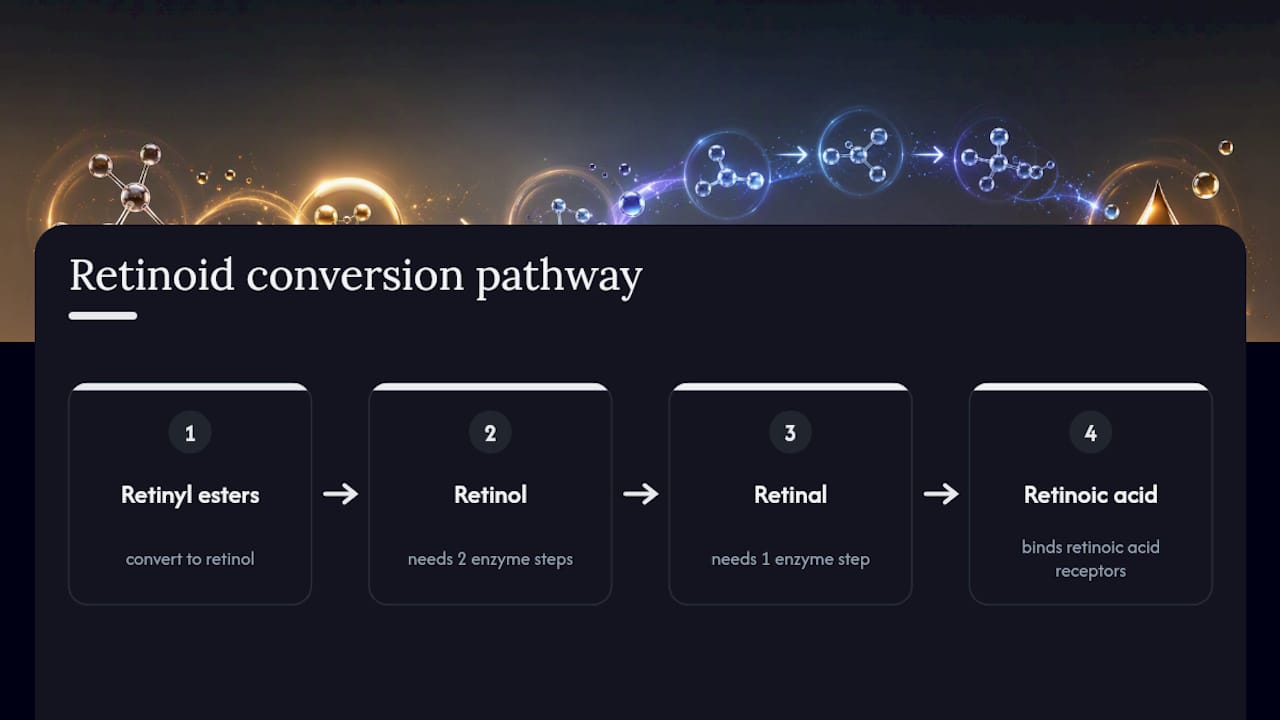
Every retinoid you put on your face is a step on the same staircase, and where an ingredient sits on that staircase determines how much work your skin has to do before anything happens. The full sequence runs like this: retinyl esters convert to retinol, retinol converts to retinal, and retinal converts to retinoic acid, the only form that actually binds to retinoic acid receptors in skin cells.
Retinyl esters sit at the bottom of that ladder, which is why they’re the gentlest and slowest of the bunch, common in lower-cost anti-aging creams aimed at first-time users. Retinol needs two enzymatic conversions, first to retinal, then to retinoic acid, before it can bind anywhere. Retinal is already one conversion away from the active form. It only needs a single enzyme step, which is the entire mechanistic reason it tends to act faster and stronger than retinol at an equivalent dose.
Retinoic acid, once formed, binds to nuclear retinoic acid receptors inside skin cells. That binding event triggers gene expression changes that speed up cell turnover, boost collagen production, and regulate oil gland activity. Every benefit associated with retinoids, smoother texture, faded discoloration, fewer breakouts, traces back to this one receptor interaction. The only question is how much of each product actually reaches that receptor in usable form, and how quickly.
Fewer conversion steps generally mean higher bioavailability, meaning more of what you apply actually becomes active retinoic acid instead of getting broken down or excreted along the way. That’s the practical translation of the chemistry: retinal wastes less of itself in transit. It also means retinal reaches deeper skin layers faster, which shows up in comparative imaging as quicker changes in fine lines and texture, but the same efficiency is what makes it more likely to overwhelm an unprepared skin barrier.
Think of it less like two different products and more like the same delivery truck taking two different routes to the same warehouse. Retinol’s route has an extra stop. Retinal’s is more direct. Same destination, same cargo, different travel time, and different odds of something falling off the truck along the way.
How Fast Do Retinol and Retinal Actually Work?
Most people see nothing dramatic in the first month, and that’s normal. Cell turnover cycles take time, and the visible changes people chase, smoother texture, fewer fine lines, more even tone, typically start showing between four and twelve weeks of consistent nightly use. Meaningful improvement in deeper wrinkles or long-standing discoloration usually needs twelve weeks or more, regardless of which retinoid you’re using.
Where retinal pulls ahead is in how much happens inside that window. A comparative imaging trial of topical retinoids found higher skin penetration and greater improvements in wrinkle depth for retinal versus retinol within the study cohort, alongside lower reported irritation than tretinoin. That’s a meaningful data point, but it’s also worth reading with the right amount of caution: it’s one trial, not a decade of head-to-head research, and formulation differences between the products tested could account for part of the gap.
Retinal vs. retinol timeline snapshot:
| Stage | Retinol | Retinal |
|---|---|---|
| First visible texture change | 6 weeks | 4 weeks |
| Noticeable fine line softening | 12 weeks | 8 weeks |
| Peak collagen remodeling effects | 6+ months | 4 to 6 months |
The timeline you actually experience depends heavily on formulation choices that have nothing to do with the ingredient’s name on the label. A retinal serum in an unstable, poorly packaged base can underperform a well-formulated encapsulated retinol. Vehicle matters: oil-based serums, gel textures, and encapsulation technology all change how much active ingredient survives contact with your skin and how gradually it’s released. Concentration on a label tells you almost nothing about real-world delivery unless you also know how the product was built.
This is why two 0.3% retinol products from different brands can produce noticeably different results. One might use encapsulation to slow-release the active over hours, minimizing irritation while maintaining efficacy. The other might dump the full dose on contact. The ingredient name is a starting point for research, not a guarantee of outcome.
Which Skin Types Tolerate Retinal and Retinol Best?
Every retinoid, regardless of strength, tends to trigger a break-in period dermatologists call “retinization.” Expect some combination of dryness, flaking, mild redness, and a tight or sensitive feeling for the first two to six weeks. This is your skin adjusting its turnover rate, not a sign that something is wrong, though it’s also your skin telling you exactly how much it can handle.
Common side effects across both ingredients include:
- Peeling or flaking, especially around the nose and mouth
- Redness or a warm, sunburned feeling
- Increased sun sensitivity
- Temporary breakouts as skin cell turnover speeds up (“purging”)
- Dryness that worsens if paired with other actives too soon
Retinal tends to provoke this response faster and sometimes more intensely because it skips straight past the slower conversion step that gives retinol its gentler on-ramp. That single-step efficiency is a double-edged sword: it’s why results show up sooner, and it’s why your face might protest sooner too. The only real way to judge your personal tolerance is a patch test on your jawline for a few nights before committing your whole face to either ingredient.
Skin type should drive the decision more than ambition:
- Sensitive, rosacea-prone, or eczema-prone skin: Start with retinol, and at a low concentration. Board-certified dermatologists note that stronger OTC retinal products can trigger flares in people with these conditions, and some should consult a dermatologist before using any retinoid.
- Oily or acne-prone skin: Retinal has a practical edge here. Retinal shows antibacterial activity against acne-related bacteria, giving it a dual benefit that plain retinol doesn’t offer.
- Dry or mature skin focused on aging: Either works, but pace matters more than potency; buffering with a rich moisturizer protects against over-drying.
- Combination skin: Start with retinol on alternating nights and reassess after four weeks before considering retinal.
Pro Tip: If your skin flares within the first two applications of any retinoid, don’t assume you need a weaker version. Try reducing frequency to twice a week before switching products entirely. Frequency is often the real lever, not concentration.
If irritation persists past six weeks, or you notice swelling, blistering, or intense burning, that’s beyond normal retinization and worth a conversation with a dermatologist rather than more trial and error on your own.
How to Start, Ramp Up, and Switch Between Retinol and Retinal
Jumping into nightly use of either ingredient is the single most common reason people quit retinoids altogether. A slow build gives your skin time to adjust its turnover rate without the flaking and redness that make people give up in week two.
- Weeks 1 to 2: Apply a pea-sized amount two nights per week, only to fully dry skin. Damp skin increases penetration and irritation risk.
- Weeks 3 to 4: Increase to every other night if skin tolerates it without persistent redness or flaking.
- Weeks 5 to 6: Move to nightly use if comfortable, still buffering with moisturizer underneath or on top as needed.
- Ongoing: Once retinization has fully settled, usually six to eight weeks in, you can consider increasing concentration or switching to a faster-acting formula.
Buffering is the single most useful trick most people never try. Applying moisturizer before your retinoid dilutes the initial contact, while sandwiching it between two moisturizer layers, moisturize, retinoid, moisturize again, slows delivery further without meaningfully reducing long-term results. This works for both ingredients, but it matters more with retinal given its faster conversion.
If you’re switching from retinol to retinal, don’t just swap products on the same schedule. Drop back to two nights a week for the first two weeks of retinal, even if you were using retinol nightly beforehand, since retinal’s single-step conversion means your skin is suddenly getting a stronger, faster signal than it’s used to. Choose a starting concentration on the lower end, generally 0.05% to 0.1% retinal, and treat the first month as a new retinization period, not a continuation of your old routine.
Pro Tip: Keep a plain, fragrance-free moisturizer on your nightstand specifically for retinoid nights. Reaching for a different product every night makes it harder to isolate what’s actually causing irritation if something goes wrong.
If irritation ever outpaces the benefit, pause the retinoid entirely for three to five nights, focus on barrier repair with a simple moisturizer, and resume at a lower frequency. A gentler retinol option is often the smarter long-term move for skin that keeps reacting, rather than pushing through with something stronger out of impatience.
What Pairs Safely With Retinoids, and Why SPF Isn’t Optional
Retinoids don’t work in isolation, and what you layer around them determines whether your routine builds skin resilience or just stacks irritation on top of irritation. The safest structure separates your actives by time of day: vitamin C and antioxidants in the morning, retinoid at night. This isn’t arbitrary, it keeps two potent actives from competing for absorption in the same application.
Good pairing partners include:
- Hyaluronic acid: Layers underneath a retinoid to support hydration without interfering with absorption.
- Niacinamide: Helps calm redness and supports barrier function alongside retinoid use.
- Ceramide-rich moisturizers: Reinforce the skin barrier that retinoids can temporarily weaken during retinization.
What to avoid stacking with retinoids, especially early on:
- Strong AHAs or BHAs (glycolic acid, salicylic acid, lactic acid) on the same night as a retinoid until tolerance is fully established.
- High-percentage vitamin C serums applied right before a retinoid, which can increase irritation risk.
- Physical scrubs or harsh exfoliants during the first several weeks of any new retinoid.
The glycolic acid vs lactic acid question comes up constantly among people building a retinoid routine, and the short version is that both are AHAs, but lactic acid is gentler and better suited to sensitive or retinoid-adjusted skin, while glycolic acid penetrates deeper and pairs less comfortably with an active retinoid schedule. Mandelic acid sits even gentler than both, making mandelic vs glycolic acid a common substitution for anyone whose skin is already busy adjusting to a retinoid at night.
Sun protection isn’t optional once you introduce a retinoid, it’s a structural requirement of the routine. Topical retinoids increase photosensitivity, and clinical guidance recommends daily broad-spectrum SPF30 at minimum, with SPF50 advisable for extended outdoor exposure. Skipping sunscreen while using a retinoid doesn’t just risk sunburn, it actively works against the collagen and tone improvements you’re using the retinoid to achieve in the first place.
What the Research Actually Shows About Retinal vs. Retinol
The clinical picture here is more settled than most skincare debates, but it still has real gaps worth naming honestly. The mechanistic case for retinal’s speed advantage is well established: one conversion step instead of two translates directly into faster receptor activation, which is why retinal-based products generally act faster and hit harder than retinol at comparable concentrations.
Imaging evidence backs this up at the tissue level. A comparative trial using non-invasive imaging found retinal achieved higher skin penetration and greater wrinkle-depth improvement than retinol in its study cohort, with less reported irritation than prescription tretinoin. That’s a meaningful signal, not a verdict. Long-duration, well-powered head-to-head trials comparing retinal and retinol directly remain limited in number, which means a lot of the practical guidance in this space still leans on smaller studies and clinical consensus rather than decades of large-scale data.
What that consensus consistently comes back to:
- Potency and speed matter far less than whether you actually keep using the product.
- Retinal’s antibacterial properties give it a genuine, practical advantage for anyone managing acne alongside aging concerns.
- Retinol remains the safer starting point for sensitive skin, and a perfectly legitimate long-term choice, not just a training-wheels version of retinal.
Clinician guidance consistently frames the choice this way: a gentler retinoid used consistently outperforms a stronger one used sporadically because you kept reacting to it. Harvard Health’s review of retinoid evidence makes exactly this point when weighing real-world results against lab potency.
The honest takeaway is that neither ingredient wins outright. Formulation quality, concentration, frequency, and how well you manage your skin barrier through the adjustment period all shape the outcome more than the name on the bottle.
Why I Tell People to Stop Chasing the “Stronger” Retinoid
Most people ask me whether they should skip retinol and go straight to retinal, as if potency were the only variable that mattered. It isn’t. The customers who get the best long-term results are the ones who found a retinoid their skin barrier could handle consistently, not the ones who pushed for the strongest formula they could find and then quit six weeks later when their face rebelled.
At Miracle Gel, that’s exactly why our formulation philosophy for skin over 40 starts with barrier support first, not potency chasing. Retinization is real, and it’s uncomfortable enough that it derails good routines before they have a chance to work. If you’re introducing any retinoid and your skin needs backup while it adjusts, our gentler supporting moisturizers and barrier-focused products are built for exactly that transition period, not as a replacement for your retinoid, but as the buffer that lets you actually stay consistent with it.
— Barbara
How Miracle Gel Supports Your Retinoid Routine
Whichever side of the retinal vs retinol decision you land on, your skin barrier is doing extra work during the adjustment period, and that’s where a lot of retinoid routines quietly fall apart. Miracle Gel’s approach centers on gentle, natural formulations that support your skin while a retinoid does its job, rather than adding another aggressive active into an already-adjusting routine.

Our natural anti-aging skincare range for women 40 and older includes moisturizers, barrier serums, and brightening formulas designed to work alongside a retinoid rather than compete with it. If flaking or tightness is making your nightly retinoid feel like a chore, our gentle moisturizer guide for sensitive skin walks through exactly which textures and ingredients buffer irritation without diluting your results. Browse the range, find the barrier support your routine is missing, and give your retinoid the consistent conditions it needs to actually work.
Sources
- What’s the Difference Between Retinol and Retinal? Experts Explain (Today)
- Comparative imaging study of topical retinoids (DOI trial)
- Review of topical retinoids and skin effects (NCBI PMC)
- Tretinoin topical route precautions (Mayo Clinic)