

TL;DR:
- Patch testing skincare products helps prevent delayed allergic reactions, which can appear up to 96 hours after application. At-home tests screen for irritation, but professional patch testing by a dermatologist provides definitive allergen identification. Consistently testing new products individually and tracking reactions improves skin health and routine safety.
You find a moisturizer that sounds perfect, apply it generously on day one, and wake up three days later with a red, itchy patch that won’t quit. Sound familiar? Knowing why patch test skincare products is one of the most practical skills any adult with a skincare routine can have. Most people assume a quick swipe on the wrist tells them everything they need to know. It doesn’t. Skin reactions, especially allergic ones, are far more unpredictable than that. This article breaks down the science, the correct method, and exactly when to take things further.
Table of Contents
- Key takeaways
- Why patch test skincare products before using them fully
- What patch testing actually means
- The real benefits of patch testing for your skin
- How to patch test skincare products correctly
- Ingredients that most commonly trigger reactions
- When to see a professional instead
- My honest take on patch testing as a non-negotiable
- Try skincare built for sensitive and reactive skin
- FAQ
Key takeaways
| Point | Details |
|---|---|
| Delayed reactions are real | Allergic skin reactions can appear 24 to 96 hours after exposure, not immediately after application. |
| At-home tests are screens, not diagnoses | Self patch testing catches irritation but cannot replace clinical allergy diagnosis. |
| Test one product at a time | Testing multiple products together makes it impossible to identify which ingredient caused a reaction. |
| Fragrance is the top trigger | Fragrances, preservatives, and strong actives are the most common causes of skincare reactions. |
| Know when to see a dermatologist | Persistent or severe rashes that don’t resolve with avoidance need professional patch testing. |
Why patch test skincare products before using them fully
The core reason is simple: your skin may react to an ingredient you have never encountered before, and that reaction might not show up for days. Delayed skin reactions fall into a category called Type IV hypersensitivity, which means your immune system mounts a response that builds over 24 to 96 hours rather than instantly. A rash that appears on day three was not caused by your lunch or the weather. It traces directly back to the product you tested days earlier.
The importance of patch testing goes beyond avoiding one bad reaction. If you skip this step and apply a new serum to your full face, you risk spreading an allergen across a large surface area, making the resulting irritation harder to treat and longer to resolve. A controlled test on a small area limits both exposure and damage.
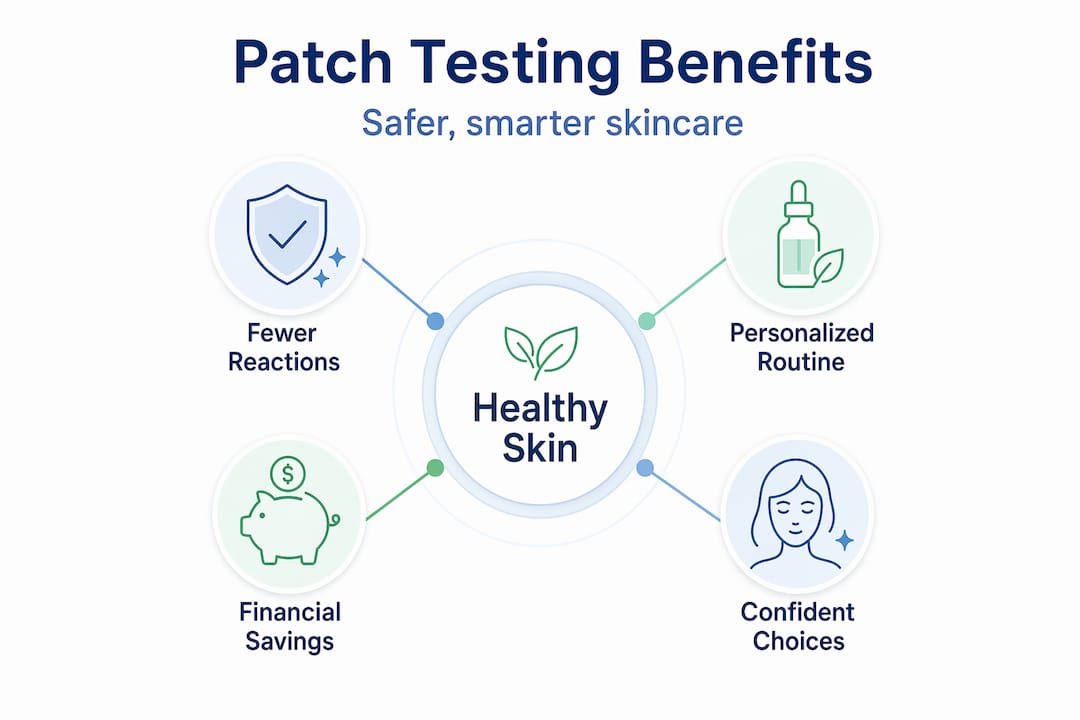
There is also a financial argument. Investing in a premium skincare product and then abandoning it after a full-face reaction wastes money. A seven to ten day patch test costs you nothing except a small square of skin on your inner forearm and a little patience.
The patch testing benefits extend to people building more complex routines. Once you know which ingredients your skin handles well, you can layer products with confidence. That clarity does not come from guessing.
What patch testing actually means
Not all patch tests are the same. There are two distinct types, and confusing them is one of the most common mistakes people make.
Clinical patch testing is a medical procedure performed by a dermatologist. Medical patch testing applies around 80 allergens to your upper back under adhesive patches, with readings taken at 48 and 96 hours. The results identify specific allergens causing allergic contact dermatitis. This is a diagnostic tool, not a product preview.
At-home patch testing is what most people mean when they talk about testing a new moisturizer or serum. It is a tolerance screen. Home patch tests catch irritation and obvious reactions but cannot tell you whether you have a true allergy or just sensitive skin. The distinction matters because treatment and avoidance strategies differ significantly.
Here is what separates the two approaches in practical terms:
- Clinical tests use standardized concentrations of known allergens for consistent, comparable results
- At-home tests apply actual products, which contain multiple ingredients simultaneously
- Clinical readings are graded on a scale by a trained professional
- At-home tests rely on your own observation of visible changes
- Distinguishing irritant from allergic dermatitis via proper testing directly shapes what treatment works
Knowing which category applies to your situation helps you use the right tool for the right job.
The real benefits of patch testing for your skin
Skipping patch tests creates a frustrating loop. You try a new product, develop a rash, stop using it, recover, then try another product and repeat the cycle. Patch testing breaks this cycle by identifying specific allergens so you can make informed choices about what to put on your face.
Beyond avoiding rashes, the skincare allergy testing process teaches you something genuinely useful about your own biology. You might discover you react to a specific preservative found across dozens of products. Once you know that, scanning an ingredient label takes thirty seconds and saves you weeks of skin trouble.
There is also a subtler benefit. When your skin stays consistently calm because you have identified your triggers, it becomes easier to notice when something else is causing a reaction. You are not chasing multiple variables at once. That kind of clarity is hard to put a price on.
Pro Tip: Keep a simple notes app log when patch testing. Record the product name, the ingredients list, the start date, and any observations each day. If a reaction appears, you have a clear record to bring to a dermatologist or to reference when checking future products.
Patch testing also becomes more relevant as you age. Skin changes after 40, and ingredients that caused no issues at 25 can become problematic as your barrier function shifts. Regular patch testing when introducing new products keeps you ahead of those changes. Check out this guide on visible skincare results after 40 to understand how mature skin responds differently to active ingredients.
How to patch test skincare products correctly
This is where most people get it wrong. The process is straightforward but only works if you follow the timing correctly.
- Choose one product to test at a time. Testing multiple products simultaneously makes it impossible to determine which specific ingredient triggered a reaction. Start with the newest addition to your routine.
- Select your test site. Apply a small amount of the product to your inner forearm or behind your ear. These areas are non-sun-exposed, have relatively thin skin, and are easy to observe.
- Apply twice daily for 7 to 10 days. Repeated application for up to 10 days is what catches delayed reactions that a single application would miss entirely.
- Observe carefully each day. Look for redness, swelling, itching, flaking, or any change in texture at the test site.
- Do not judge too early. A clean result on day two means nothing if a reaction appears on day five. The full window matters.
- If no reaction occurs, introduce the product to your face gradually. Start with every other day application to a small facial area before committing to full routine use.
Pro Tip: Avoid patch testing on skin that is already compromised, sunburned, or freshly exfoliated. Damaged skin produces unreliable results and may react to things it would ordinarily tolerate.
The patch test procedure sounds slow. But seven to ten days of testing is far shorter than the weeks of recovery a full-face allergic reaction can require.
Ingredients that most commonly trigger reactions
Not every product carries the same risk. Understanding which categories of ingredients are most likely to cause problems lets you prioritize what to test first.
| Ingredient Category | Reaction Type | Common Examples |
|---|---|---|
| Fragrances | Allergic | Synthetic fragrance, parfum, essential oil blends |
| Preservatives | Allergic or irritant | Methylisothiazolinone, parabens, formaldehyde releasers |
| Strong actives | Irritant | Retinoids, AHAs, BHAs, benzoyl peroxide |
| Hair dye chemicals | Allergic | PPD (paraphenylenediamine) |
| Botanical extracts | Allergic | Tea tree oil, lavender, citrus-derived ingredients |
Fragrance blends, preservatives, and strong actives account for the largest share of adverse reactions in skincare. What makes fragrances particularly tricky is that “natural” does not mean hypoallergenic. Essential oils like lavender and tea tree are among the most documented contact allergens in cosmetic products.
A few points worth knowing:
- Products labeled “unscented” may still contain masking fragrances
- Preservatives trigger both allergic and irritant reactions depending on the individual
- Strong actives like retinoids almost always cause some initial irritation, which is different from a true allergy
- Hair dyes containing PPD require their own specific patch test and carry a higher allergy risk than most face products
Understanding this landscape helps you decide which products need the full ten-day protocol versus which ones carry lower inherent risk. For specific ingredient guidance, this resource on natural ingredients for mature skin is worth bookmarking.
When to see a professional instead
At-home testing has real limits. If you experience any of the following, why patch test products at home becomes the wrong question. The right question becomes why you haven’t already seen a dermatologist.
- Rashes that keep returning despite stopping suspected products
- Reactions spreading beyond the test area without explanation
- Severe swelling, blistering, or weeping skin
- Reactions affecting your eyelids, lips, or hands that don’t resolve within two weeks
- No identifiable trigger despite repeated attempts to isolate the cause
Professional patch testing is the gold standard for diagnosing allergic contact dermatitis. Dermatologists use comprehensive allergen series that test up to 80 individual allergens with standardized concentrations and controlled timing. This level of precision is not replicable at home.
The outcome of clinical testing is also more actionable. You walk away with a specific list of allergens to avoid, which you can cross-reference against product ingredient lists. That information follows you for life. Continuing trial-and-error with new products when you have persistent skin issues just prolongs the problem.
My honest take on patch testing as a non-negotiable
I have talked to hundreds of people who describe the same frustrating pattern. They buy a new product, love the texture, and ignore the urge to patch test because they are excited to start. Three days later, their cheeks are inflamed and they are back to square one.
What I have learned is that the problem isn’t just impatience. It’s a genuine misunderstanding of how delayed allergic reactions work. Most people assume that if their skin tolerates a product on day one, it will keep tolerating it. That’s not how Type IV hypersensitivity operates. The immune system needs time to mount a response, and that response can absolutely show up on day four when you’ve already applied the product to your entire face twice a day.
In my experience, the people who invest in proper patch testing end up with more stable, effective routines. They spend less time troubleshooting and more time actually benefiting from the products they use. There is something genuinely satisfying about knowing your routine is built on tested, confirmed compatibility rather than hope.
My honest advice: treat the patch test window like you would treat a prescription label. You wouldn’t stop taking antibiotics on day three because you feel better. Don’t stop the patch test protocol on day two because nothing looks wrong yet.
The patience required is real. So is the payoff.
— Barbara
Try skincare built for sensitive and reactive skin

Once you have completed a patch test and know what your skin can handle, the next step is finding products formulated with that sensitivity in mind. Miraclegelnaturalskincare specializes in natural and organic formulations designed specifically to be gentle on reactive and mature skin. Their age-defying skincare collection is built around fragrance-conscious, nourishing ingredients that work with skin over 40 rather than against it. For a focused selection of products that consistently pass the sensitive skin standard, browse the sensitive skin safe range to find formulas you can introduce with confidence.
FAQ
What is patch testing in skincare?
Patch testing in skincare is the practice of applying a new product to a small skin area and monitoring for reactions over 7 to 10 days. It screens for irritation and sensitivity before you apply a product to larger or more delicate areas.
How long should a patch test take?
A proper at-home patch test should run for 7 to 10 days with twice-daily application. Delayed allergic reactions can appear anywhere from 24 to 96 hours after exposure, so testing for less than a week risks missing a real reaction.
Can natural or organic products still cause reactions?
Yes. Natural ingredients including essential oils, botanical extracts, and plant-based fragrances are among the most common skincare allergens. “Natural” does not mean reaction-proof, which is why patch testing benefits apply equally to organic formulas.
When should I see a dermatologist instead of patch testing at home?
See a dermatologist if you have recurring, unexplained rashes, reactions that don’t resolve when you stop using a product, or skin issues severe enough to affect daily life. Professional testing uses comprehensive allergen panels that at-home tests cannot replicate.
Do I need to patch test every new product?
Yes, especially when adding products with new active ingredients, fragrances, or preservatives you haven’t used before. Testing one product at a time gives you clear, reliable information about what your skin accepts and what it doesn’t.