

TL;DR:
- A clean skincare routine involves daily use of non-toxic, natural products for cleansing, moisturizing, and SPF protection, delivering visible results in 6 to 12 weeks with consistent use. Choosing products that match your skin type and transitioning gradually while patch testing helps prevent irritation and skin reactions. Focus on simplicity and patience, as real improvements depend on routine, not product complexity.
A clean skincare routine is defined as a daily regimen using non-toxic, naturally derived products to cleanse, moisturize, and protect your skin without synthetic fragrances, parabens, or hormone-disrupting chemicals. Knowing how to build a clean skincare routine matters because the products you use daily absorb into your skin barrier, and what you leave out is just as important as what you put in. The good news: a three-step daily routine covering cleansing, moisturizing, and SPF protection takes under five minutes and delivers visible results within 6 to 12 weeks of consistent use. This guide walks you through every step, from identifying your skin type to choosing clean ingredients and avoiding the mistakes that derail most beginners.
How to build a clean skincare routine: start with your skin type
Your skin type is the single most important variable when selecting clean skincare products. Using the wrong formula, even a natural one, can trigger breakouts, dryness, or redness that has nothing to do with the ingredient quality and everything to do with the match.

The four main skin types are oily, dry, combination, and sensitive. Oily skin produces excess sebum, looks shiny by midday, and is prone to enlarged pores. Dry skin feels tight after cleansing, may flake, and absorbs moisturizer quickly. Combination skin is oily in the T-zone (forehead, nose, chin) but normal or dry on the cheeks. Sensitive skin reacts to fragrance, alcohol, and many active ingredients with redness, stinging, or itching.
The simplest way to identify your type is the bare-face test. Wash your face with a gentle, fragrance-free cleanser, pat dry, and wait 30 minutes without applying anything. If your skin looks shiny all over, it is oily. If it feels tight or looks flaky, it is dry. If only your T-zone shines, it is combination. If it stings or turns red during or after cleansing, it is sensitive.
Product selection follows directly from this. Dry skin benefits from creamy, oil-rich cleansers that preserve the skin barrier. Oily skin responds better to foaming or gel cleansers that remove excess sebum without over-stripping. Sensitive skin needs fragrance-free, minimal-ingredient formulas. Patch testing new products on your jawline or forearm for 48 hours before full application reduces the risk of allergic reactions significantly.
- Oily skin: Gel or foaming cleanser, lightweight water-based moisturizer, non-comedogenic mineral SPF
- Dry skin: Creamy or milk cleanser, rich moisturizer with hyaluronic acid or ceramides, hydrating SPF
- Combination skin: Gentle gel cleanser, lightweight moisturizer, oil-free SPF
- Sensitive skin: Fragrance-free milk or micellar cleanser, barrier-repair moisturizer, mineral SPF with zinc oxide
Pro Tip: If your skin changes with the seasons, reassess your skin type in January and July. Many people shift between dry and combination depending on humidity and indoor heating.
What are the core steps to a clean skincare routine?
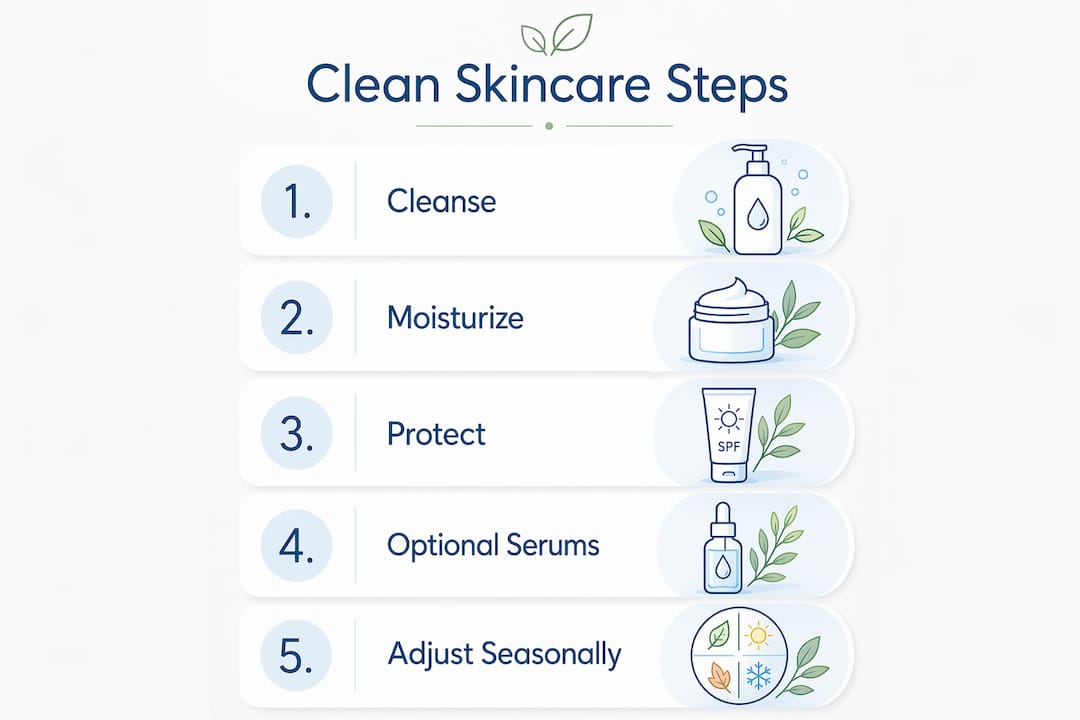
A clean daily skincare regimen has three non-negotiable steps: cleanse, moisturize, and protect. Everything else, toners, serums, exfoliants, is optional and should only be added once you have mastered the foundation.
Step 1: Cleanse
Cleansing removes dirt, pollution, and overnight skin secretions that accumulate on the surface. For morning routines, a gentle rinse or light cleanser is enough since your skin has not been exposed to environmental stressors overnight. For evening routines, a more thorough cleanse is needed, especially if you wear sunscreen or makeup. Double cleansing solves this: first use an oil-based cleanser to dissolve sunscreen and makeup, then follow with a water-based cleanser to remove remaining impurities. This method cleans thoroughly without stripping the skin barrier. Look for cleansers with ingredients like aloe vera, chamomile, or oat extract rather than sodium lauryl sulfate or synthetic fragrance.
Step 2: Moisturize
Apply moisturizer while your skin is still slightly damp after cleansing. Damp skin absorbs humectants like hyaluronic acid and glycerin more effectively, locking in hydration before the surface dries. Clean moisturizers worth looking for contain ceramides, shea butter, squalane, or plant-based oils like rosehip or jojoba. Avoid formulas with PEGs, synthetic emulsifiers, or mineral oil, which are common in conventional products but unnecessary in a clean routine.
Step 3: Protect
Sunscreen is the most evidence-backed anti-aging product available, and it belongs in every morning routine regardless of skin type or age. For a clean routine, mineral SPF 30 or higher with non-nano zinc oxide or titanium dioxide is the standard. Chemical sunscreens containing oxybenzone are linked to hormone disruption and coral reef damage, making them a poor fit for clean beauty principles. Mineral options sit on top of the skin and physically deflect UV rays rather than absorbing them.
Proper layering order is cleanser first, moisturizer second, sunscreen last. This sequence preserves ingredient absorption and maintains the skin barrier’s protective function.
Pro Tip: Apply your moisturizer within 60 seconds of patting your face dry. This window is when your skin barrier is most receptive to hydration.
| Step | Product type | Key clean ingredients |
|---|---|---|
| Cleanse | Gel, cream, or oil cleanser | Aloe vera, chamomile, oat extract |
| Moisturize | Lotion, cream, or facial oil | Ceramides, squalane, hyaluronic acid |
| Protect | Mineral SPF 30+ | Non-nano zinc oxide, titanium dioxide |
Once you are consistent with these three steps for four to six weeks, you can add one optional step, such as a vitamin C serum in the morning or a gentle exfoliant two nights per week.
How to transition to clean skincare without irritating your skin
The most sustainable approach to switching to clean beauty is replacing products one by one as your current ones run out. This method, supported by gradual product replacement research, preserves your skin barrier’s stability and helps you identify which new product is responsible for any change, positive or negative.
A full overnight overhaul of your routine introduces too many variables at once. If your skin reacts, you will not know which product caused it. Replacing one item at a time gives you clear data on what works for your skin.
When reading ingredient labels during your transition, look for these markers of a clean formula:
- Look for: Zinc oxide, titanium dioxide, plant-based oils, aloe barbadensis leaf extract, ceramides, glycerin, vitamin E (tocopherol), green tea extract
- Avoid: Oxybenzone, parabens (methylparaben, propylparaben), sodium lauryl sulfate, synthetic fragrance (listed as “parfum”), formaldehyde-releasing preservatives like DMDM hydantoin, PEGs
Monitoring your skin during the transition is straightforward. Take a photo in natural light every two weeks from the same angle. Note any new dryness, breakouts, or redness in a simple notes app entry. This removes guesswork and gives you a record to reference if you need to adjust.
Pro Tip: Start your clean transition with the product you use most often, typically your cleanser. It contacts your skin twice daily and sets the tone for everything applied afterward.
Common mistakes that derail a clean skincare routine
Overcomplicating a routine with too many products at once is the most common reason people quit clean skincare within the first month. More products do not equal better results. They increase the risk of ingredient interactions, skin irritation, and decision fatigue that leads to inconsistency.
The second most frequent mistake is skipping patch tests. Introducing active ingredients like retinoids, vitamin C, or BHAs without a 48-hour patch test on a small area of the face is a reliable way to trigger a reaction that sets your routine back by weeks. This applies to clean products too. Natural does not automatically mean non-reactive.
Other mistakes worth avoiding:
- Skipping sunscreen on cloudy days or indoors. UVA rays penetrate glass and clouds. Daily SPF is non-negotiable for any anti-aging or brightening goal.
- Expecting results in days. Skin cell turnover takes roughly 28 days in younger adults and up to 45 days after 40. Visible improvements from a consistent routine appear within 6 to 12 weeks, not overnight.
- Switching products too frequently. Changing formulas every two to three weeks prevents any product from completing a full skin cycle. Commit to at least six weeks before evaluating.
“The skin is not a machine you can reset with a new product every week. It is a living organ that responds to consistency, not novelty.” This principle separates people who see real results from those who stay stuck in the cycle of buying and abandoning.
If irritation or breakouts occur after introducing a new product, stop using it for two weeks and return to your three-step baseline. Once your skin stabilizes, reintroduce the product at a lower frequency, such as every third day, before building up.
Key takeaways
A clean skincare routine built on cleansing, moisturizing, and mineral SPF protection delivers visible results within 6 to 12 weeks when applied consistently and matched to your skin type.
| Point | Details |
|---|---|
| Three steps are enough | Cleanser, moisturizer, and mineral SPF 30+ form a complete and effective daily routine. |
| Skin type drives product choice | Matching your formula to oily, dry, combination, or sensitive skin prevents irritation and wasted products. |
| Transition gradually | Replace one product at a time as items run out to protect your skin barrier and isolate reactions. |
| Patch test every new product | Apply to jawline or forearm for 48 hours before full use, including clean and natural formulas. |
| Consistency beats complexity | A simple three-step routine followed daily outperforms a ten-step routine used inconsistently. |
What I have learned from years of watching people build clean routines
The most common thing I see derail people is the belief that more is better. Someone spends three weeks researching the best clean skincare products, orders six new items, and applies all of them in the first week. Their skin reacts. They blame clean beauty and go back to what they know.
The truth is that patience is the actual active ingredient in any skincare routine. I have watched people with genuinely difficult skin, rosacea-prone, post-acne, perimenopausal, transform their complexion in three months by doing almost nothing. Cleanser, moisturizer, SPF. Every single day. No skipping.
What I find most underrated in clean beauty is ingredient transparency. When a brand lists every ingredient and explains why it is there, that is a signal of confidence in the formula. Brands that hide behind “proprietary blends” or vague “natural fragrance” claims are not playing by clean beauty rules, regardless of how their marketing reads. Checking resources like clean beauty principles before committing to a new product takes five minutes and saves weeks of skin recovery.
The other thing worth saying plainly: your skin is not your neighbor’s skin. A product that transformed someone else’s complexion may do nothing for yours, or worse. Personalization is not a luxury in clean skincare. It is the whole point.
— Barbara
Start your clean routine with Miraclegelnaturalskincare
Miraclegelnaturalskincare was built specifically for people who want effective, natural skincare without the guesswork. Every formula is designed around ingredient transparency, clinically tested results, and the kind of simplicity that actually gets used daily.

The natural skincare range for 40+ covers every core step, from gentle natural cleansers to deep-hydration moisturizers and targeted serums. If you are ready to add an active step, the 2-Minute Miracle Gel delivers visible brightening and exfoliation using the Tri-Moisture Cryo Complex™ without harsh chemicals. For a complete starting point, the Dynamic Duo set pairs the Miracle Gel with the 2-Minute Miracle Moisturizer, giving you two core steps in one purchase. Free shipping applies on orders over €85.
FAQ
What is clean skincare, exactly?
Clean skincare refers to products formulated without ingredients linked to toxicity, hormone disruption, or environmental harm, such as parabens, oxybenzone, and synthetic fragrance. The focus is on effective, naturally derived ingredients that deliver results without unnecessary risk.
How many steps does a clean skincare routine need?
A complete clean routine requires only three steps: cleanser, moisturizer, and mineral SPF. Additional steps like serums or toners are optional and should only be added after the core routine is consistent.
How long before I see results from a clean skincare routine?
Visible improvements typically appear within 6 to 12 weeks of daily consistency. Skin cell turnover takes several weeks, so results require patience rather than product switching.
Can I use clean skincare if I have sensitive skin?
Yes. Sensitive skin often responds better to clean formulas because they exclude common irritants like synthetic fragrance and sulfates. Choose fragrance-free, minimal-ingredient products and always patch test first before applying anything new to your full face.
What ingredients should I avoid in a clean skincare routine?
The primary ingredients to avoid are oxybenzone, parabens, sodium lauryl sulfate, synthetic fragrance (listed as “parfum”), and formaldehyde-releasing preservatives like DMDM hydantoin. A chemical-free body wash guide can also help you extend clean principles beyond your face.