
TL;DR:
- Avoiding harsh chemicals involves identifying common irritants like parabens, phthalates, and fragrance allergens that cause skin reactions. A gradual, informed approach—using trusted certifications, patch testing, and focused ingredient screening—builds a safe, effective skincare routine over time. Consistency and vigilant monitoring lead to healthier skin and long-term relief from irritation and sensitivity.
If you’ve ever developed a rash, redness, or persistent irritation from a product labeled “natural” or “gentle,” you already know how to avoid harsh chemicals in skincare matters more than most brands admit. The average person applies over a dozen personal care products daily, each one potentially carrying allergens, hormone-disrupting preservatives, or undisclosed fragrance chemicals. The marketing language is intentionally confusing. Words like “clean,” “pure,” and “botanical” have no legal definition. This guide cuts through that noise with a practical, science-grounded approach to identifying what’s actually in your products and building a routine that genuinely works for your skin.
Table of Contents
- Key Takeaways
- How to avoid harsh chemicals in skincare
- Preparing for a chemical-free beauty routine
- A step-by-step approach to skincare without harsh chemicals
- Common challenges and how to troubleshoot them
- What to expect after you commit to cleaner skincare
- My honest take on avoiding chemicals in skincare
- Clean skincare for 40+ from Miraclegelnaturalskincare
- FAQ
Key Takeaways
| Point | Details |
|---|---|
| Know the real offenders | Parabens, phthalates, fragrance allergens, and formaldehyde releasers are the most common causes of skin reactions. |
| Swap gradually, not all at once | Replacing one product at a time lets you identify what your skin tolerates and what triggers reactions. |
| “Natural” is not a safety guarantee | Some botanical extracts and essential oils sensitize skin just as much as synthetic chemicals. |
| Fragrance-free beats “unscented” | “Unscented” products can still contain masking fragrances. Choose products explicitly labeled fragrance-free. |
| Use certifications as shortcuts | Third-party certifications like EWG Verified and Made Safe help you screen products without reading every ingredient label from scratch. |
How to avoid harsh chemicals in skincare
Before you can avoid something, you need to know exactly what it is. “Harsh chemicals” is not a precise scientific category. It’s a practical label for ingredients that cause one of two types of skin reactions: irritant contact dermatitis (a direct damage response to a substance) or allergic contact dermatitis (an immune-mediated reaction triggered after prior sensitization).
The most frequently implicated ingredient groups include:
- Parabens (methylparaben, propylparaben): preservatives linked to endocrine disruption concerns, though debate continues on dose thresholds.
- Phthalates: plasticizing agents found in fragrances and nail products; associated with hormonal disruption.
- Formaldehyde releasers (DMDM hydantoin, quaternium-15, imidazolidinyl urea): preservatives that slowly release formaldehyde, a known sensitizer.
- Fragrance allergens: fragrance substances are among the most common triggers of allergic contact dermatitis, with reactions recurring on re-exposure.
- Sodium lauryl sulfate (SLS): a surfactant in cleansers that strips the skin barrier in sensitive individuals.
Here’s where the science gets interesting. Contact dermatitis is driven by barrier disruption or immune sensitization, not by whether a chemical is synthetic or natural. Poison ivy is natural. It’s also one of the most potent allergens known to dermatology. This distinction matters because the “natural equals safe” assumption leads people to swap parabens for essential oils and end up with worse reactions than they started with.
The labeling system makes this harder than it should be. The word “fragrance” on a label can legally represent hundreds of undisclosed chemicals, many of which act as sensitizers. The Modernization of Cosmetics Regulation Act (MoCRA, 2022) expanded FDA oversight and will require more fragrance allergen disclosure, but MoCRA regulations are still rolling out in 2026. Until full implementation, the burden of scrutiny sits with you as the consumer.
Preparing for a chemical-free beauty routine
Planning matters more than people expect. Most failed attempts at cleaner skincare happen because someone replaces every product in one weekend, gets a flare-up, and can’t tell which product caused it. A gradual, methodical approach changes that outcome completely.
Here’s how to set yourself up for success:
- Audit your current lineup. List every product you use, from cleanser to SPF. You’ll be surprised how many items you apply daily without thinking.
- Learn the ingredient label format. Ingredients are listed from highest to lowest concentration. The first five to seven ingredients make up the bulk of the formula. Focus your scrutiny there.
- Use third-party certifications as a filter. Look for EWG Verified, Made Safe, or NSF certification. Trusted certifications like these require brands to disclose and vet ingredients against safety databases. They’re not perfect, but they save you hours of solo research.
- Start a reaction journal. When you introduce a new product, note the date, product name, and any changes in your skin over the next one to two weeks. This is the fastest way to identify patterns.
- Set a realistic budget. Cleaner formulas can cost more, but you don’t need to replace everything at once. Prioritize the products you leave on your skin longest, such as moisturizers and serums, over rinse-off products like cleansers.
Pro Tip: Download the Think Dirty or EWG Healthy Living app before your next shopping trip. You can scan product barcodes in-store and get an instant ingredient safety rating, which removes guesswork at the point of purchase.
For deeper context on what certifications actually mean, the Miraclegelnaturalskincare organic certifications guide explains the differences between certification bodies and which ones carry the most weight for skincare specifically.
A step-by-step approach to skincare without harsh chemicals
Now for the practical work. This is where most guides go vague. Here’s a specific, sequenced process.
Identify your highest-risk products first
Leave-on products carry more risk than rinse-off products because the skin has sustained contact time. Start your ingredient audit with moisturizers, serums, eye creams, and SPF. Cleansers matter too, especially if you have a compromised barrier, but they’re lower priority in the initial audit.
Screen for these specific ingredients
When reading labels, flag these immediately:
- Any entry that says “fragrance” or “parfum”
- DMDM hydantoin, quaternium-15, or diazolidinyl urea (formaldehyde releasers)
- Methylisothiazolinone or methylchloroisothiazolinone (preservatives with high sensitization rates)
- Propylene glycol at high concentrations in sensitive formulas
- Oxybenzone in chemical sunscreens if you have reactive skin
Choose scientifically supported natural alternatives
Not every natural swap is a good one. Here’s a quick comparison:
| Ingredient to replace | Better alternative | Why it works |
|---|---|---|
| Synthetic fragrance | Fragrance-free formulas | Removes up to hundreds of potential allergens at once |
| Paraben preservatives | Phenoxyethanol, sodium benzoate | Effective preservation with lower sensitization rates |
| SLS cleanser | Coco-glucoside, decyl glucoside | Gentle surfactants derived from coconut and corn |
| Synthetic colorants | No colorant formulas | Reduces unnecessary ingredient load on skin |
| Alcohol-based toners | Rose water, hyaluronic acid | Hydrates without stripping the acid mantle |
Some natural alternatives come with their own risks. Tea tree oil, lavender oil, and citrus extracts are known skin sensitizers despite their botanical origins. The goal is evidence-based selection, not blanket avoidance of synthetics.
Follow this transition order
Start with your cleanser, because it’s the lowest barrier to switching and the product you interact with most. Then move to your moisturizer, then serums, then SPF last. SPF formulation is complex, and finding a clean formula that actually works requires the most trial time.
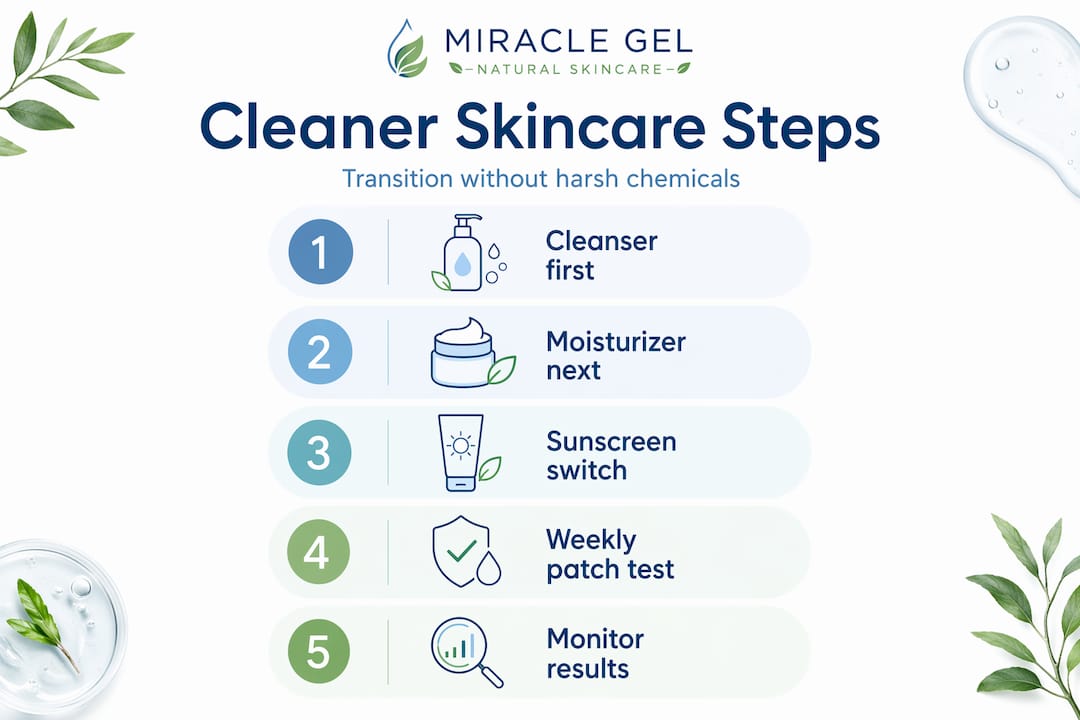
Pro Tip: Introduce one new product per week maximum. Your skin needs a stable period to show you whether something works or irritates. Rushing this process produces confusing data and frustrated skin.
Always patch test new products on your inner arm for 48 hours before applying to your face. This one habit catches a significant number of reactions before they reach a sensitive area.
Common challenges and how to troubleshoot them
Even with a careful approach, you’ll hit walls. Here are the most common ones and how to handle them.
Transitional flare-ups. When you remove a product your skin was adapted to, it sometimes overreacts before settling. Give a new product two full weeks before concluding it’s causing problems, unless you see an acute allergic reaction (hives, swelling, intense burning), in which case stop immediately.
The “natural means safe” trap. This is the single most dangerous misconception in the clean beauty space. Safety assessment requires science-based evaluation, not a “natural versus synthetic” label. An ingredient’s risk depends on dose, formulation, and your individual immune history.
Confusing label language. “Unscented” means no perceptible smell. It does not mean fragrance-free. Many unscented products contain masking fragrances that neutralize odor but still expose your skin to allergens. Look specifically for “fragrance-free” on the label.
Over-avoiding synthetics. Avoiding all synthetics unnecessarily can leave you with fewer effective options and formulas that don’t perform well enough to be worth the switch. The goal is to avoid confirmed sensitizers and irritants, not to refuse anything made in a lab.
“The core treatment for contact dermatitis is identifying and avoiding the offending allergen or irritant — not replacing one product category wholesale with another.”
Merck Manual, Contact Dermatitis clinical guidance
If you’re uncertain whether a reaction is allergic or irritant in nature, see a dermatologist for formal patch testing. This is a clinical procedure that tests your immune response to 30 to 80 individual chemicals simultaneously, and it produces far more reliable data than anything you can do at home.
What to expect after you commit to cleaner skincare
The benefits of avoiding harsh chemicals in skincare are real, but they aren’t instant. Here’s a realistic timeline of what happens when you stick with it.
- Weeks one to four: Initial adjustment. Some people experience dryness or minor breakouts as their skin recalibrates without heavy occlusives or sensitizers.
- Months one to three: Reduction in redness, irritation, and reactivity as your skin barrier begins to repair itself.
- Month three and beyond: Clearer baseline skin health, fewer reaction episodes, and a better understanding of what your skin actually tolerates.
Systematic replacement with careful monitoring is the most reliable way to build an effective chemical-free routine. It’s not fast, but it’s the only approach that gives you real answers.
Keep evaluating products even after your initial transition. Manufacturers reformulate frequently, sometimes without prominent disclosure. The EWG Healthy Living app lets you re-scan products periodically to catch formula changes. You can also cross-reference ingredients on your Miraclegelnaturalskincare blog for up-to-date guidance on emerging ingredient concerns.
For long-term results, consistency beats perfection. A routine you follow every day with moderately clean products outperforms a theoretically perfect routine you abandon because it’s too complex to maintain.
My honest take on avoiding chemicals in skincare
I spent years doing what most people do: reading “natural” on a label and assuming the job was done. It wasn’t until I developed a persistent perioral rash that I actually sat down and learned what was in my moisturizer. The culprit turned out to be a lavender essential oil that had been in a product I’d used for two years without issue. Sensitization builds over time. That was a revelation.
What I’ve learned from that experience, and from years of watching clients navigate the same confusion, is that this is not a problem you solve once. It’s an ongoing practice of paying attention. The people who succeed at skincare without harsh chemicals are not the ones with the most expensive products or the strictest “clean” philosophy. They’re the ones who treat their routine like a quiet experiment, keeping notes, staying curious, and not panicking when something doesn’t work.
I’m also genuinely skeptical of the all-or-nothing framing that dominates this space. Avoiding specific confirmed allergens and irritants is smart. Refusing all synthetics on principle is not science-based and often leads to worse outcomes, because some of the most effective skin-supporting ingredients (like synthetic hyaluronic acid and niacinamide) happen to be lab-made. The goal is informed skin, not ideologically pure skin.
Be patient with yourself. Most people take three to six months to build a routine that genuinely works. That timeline is normal. It’s worth it.
— Barbara
Clean skincare for 40+ from Miraclegelnaturalskincare

If you’re ready to move from reading labels to actually using products that meet the standard, Miraclegelnaturalskincare has built a curated range specifically for women over 40 who want results without the ingredient risk. Every formula prioritizes gentle efficacy: fragrance-free options, clinically tested actives, and none of the preservatives that show up most often on dermatologist-flagged ingredient lists. The natural skincare collection for 40+ is a strong starting point, especially for those transitioning from conventional products. For a structured daily approach, the natural skincare regimen guides you through cleanser to serum in the exact order recommended in this guide. Patch test everything first, and give each product two full weeks to show you what it can do.
FAQ
What are the most harmful ingredients to avoid in skincare?
The highest-priority ingredients to avoid include synthetic fragrance or parfum, parabens, formaldehyde-releasing preservatives like DMDM hydantoin, phthalates, and methylisothiazolinone. These are the most frequently linked to allergic and irritant skin reactions in clinical literature.
Does “natural” skincare mean it’s free from harsh chemicals?
No. Natural ingredients can cause allergic reactions just as readily as synthetic ones. Essential oils like lavender and tea tree are confirmed sensitizers for many people. Safety depends on the specific ingredient, concentration, and your individual skin history.
How do I know if a skincare product is truly fragrance-free?
Look for the explicit term “fragrance-free” on the label. “Unscented” products can still contain masking fragrance chemicals. When in doubt, check the full ingredient list for the words “fragrance,” “parfum,” or any essential oil listed by name.
How long does it take to see results from a cleaner skincare routine?
Most people see a meaningful reduction in irritation and reactivity within one to three months of consistently avoiding their trigger ingredients. Full skin barrier repair takes longer, often three to six months, depending on the extent of prior damage.
How do I patch test a new skincare product safely?
Apply a small amount of the product to your inner forearm and leave it for 48 hours without washing. If you see redness, swelling, itching, or bumps, discontinue use. This method catches many reactions before they affect your face. For more detail, the Miraclegelnaturalskincare patch testing guide walks through the process step by step.