
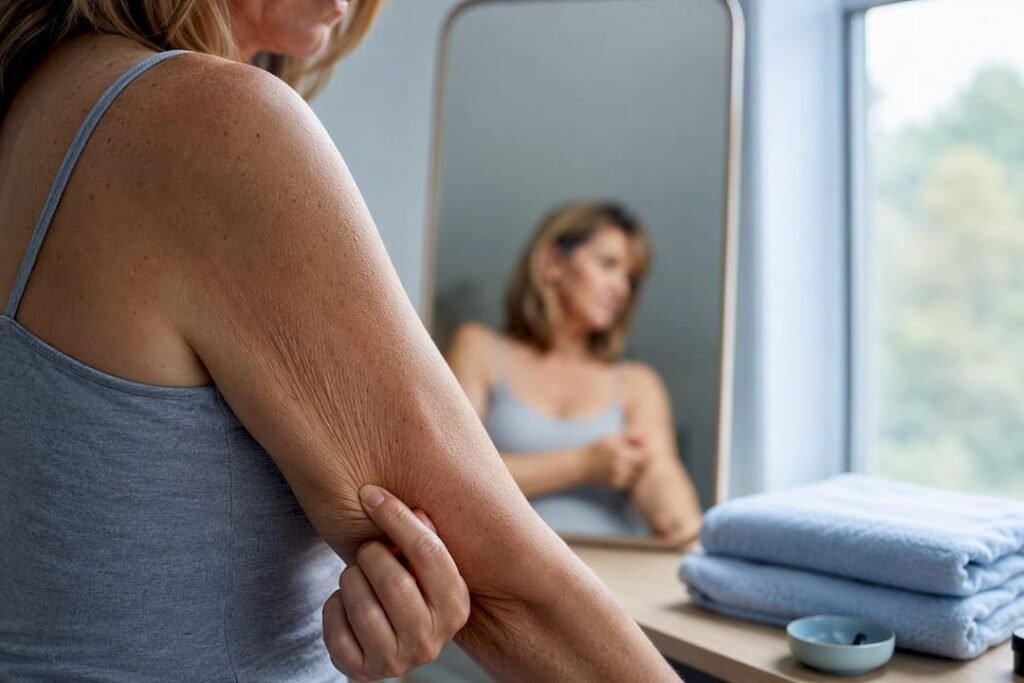
Yes, crepey arm skin usually responds to consistent care: daily sun protection paired with retinol, peptides, or lactic acid can visibly smooth texture within a couple of months. When the skin has real excess laxity, not just surface crepiness, topicals alone won’t cut it, and radiofrequency, microneedling, or a surgical consult become the more honest paths. Expect gradual change measured in weeks and months, not overnight results.
TL;DR:
- Crepey arm skin responds to consistent topical care, but significant laxity requires professional procedures or surgery for meaningful improvement.
- Sun damage accelerates collagen breakdown, especially on arms with habitual exposure, making daily SPF application crucial for prevention.
- Topical treatments like retinol, peptides, and lactic acid improve surface texture over 8 to 16 weeks with patience and proper layering.
- Energy-based treatments such as radiofrequency and microneedling build results gradually over multiple sessions, not instantly.
- Surgical options like arm lifts are typically necessary only when loose skin results from major weight loss or inelastic tissue, as topicals and noninvasive treatments cannot tighten severe laxity.
Table of Contents
- What Causes Crepey Skin on the Arms?
- How Do You Prevent and Treat Crepey Skin at Home?
- What Professional Treatments Work for Crepey Arm Skin?
- What Results Should You Realistically Expect?
- Where a Natural At-Home Formula Fits Into the Plan
- A Straight Answer From Someone Who’s Looked at the Research
- Ready to Start Your At-Home Routine?
- Sources
What Causes Crepey Skin on the Arms?
Crepey skin happens when collagen and elastin, the two proteins that keep skin thick and springy, break down faster than your body replaces them. The result is a thin, finely wrinkled texture that looks almost like crumpled paper, most noticeable on the upper arms, the tops of the knees, and around the eyes. It shows up more often in your 40s and 50s, when hormonal shifts and decades of cumulative sun exposure start compounding.
UV damage is the biggest driver by far. Every unprotected hour in the sun, even brief errands, degrades the collagen matrix a little more. Arms take an outsized hit because they’re rarely covered and rarely treated with the same sunscreen diligence as the face.
Several other factors accelerate the process:
- Chronological aging, which naturally slows collagen production after your mid-20s
- Significant weight fluctuation, which can leave skin stretched beyond its capacity to snap back
- Menopause and related hormonal changes, which reduce skin thickness and moisture retention
- Long-term steroid use and certain other medications that thin the skin
- Smoking, which restricts blood flow and accelerates elastin breakdown
Here’s the distinction that matters most: crepey texture and structural skin laxity are not the same problem. Crepiness is a surface-level thinning, fine wrinkling without significant sagging. Laxity is when the skin has lost enough structural support that it hangs or folds, often after substantial weight loss. Topicals can meaningfully improve the first. They rarely fix the second on their own.
Pro Tip: Pinch the skin on your upper arm and let go. If it springs back with fine lines still visible, you’re likely dealing with crepiness that topicals can help. If it stays folded or takes a while to settle, you’re looking at laxity, and that’s a conversation for a dermatologist or plastic surgeon.
How Do You Prevent and Treat Crepey Skin at Home?
Prevention costs less effort than treatment, and it works better over time. The single highest-leverage habit is daily sun protection: apply a broad-spectrum SPF 30 or higher, with SPF 50 preferred if your arms see regular sun, and reapply every two hours during extended outdoor exposure. Sun-protective sleeves or lightweight long shirts matter more than people assume. Incidental exposure, the fifteen minutes walking to the car or sitting near a window while driving, adds up over years and quietly undoes whatever your sunscreen routine is trying to accomplish.
Once sun protection is locked in, a simple three-step routine handles the active treatment side:
- Exfoliate gently with a lactic acid product one to three times a week to clear dead surface cells and let other actives absorb better.
- Apply a retinol or peptide serum on clean, dry skin, introducing it slowly, starting once or twice weekly and building up as tolerance allows.
- Seal it in with a hydrating moisturizer built around hyaluronic acid, adding a richer occlusive layer if your skin runs dry.
Retinol, peptides, lactic acid, and growth-factor products each work on a different piece of the puzzle. Retinoids speed cell turnover and stimulate collagen production. Peptides send signals that encourage the skin to rebuild its own structural proteins. Lactic acid resurfaces and smooths texture. Layering more than one class tends to outperform relying on any single ingredient.
The inner and upper arm skin is thinner and more reactive than most people expect, closer in sensitivity to the neck than to the forearm. Introduce anything new here at half strength and half frequency compared to what you’d use on your face. Patch-test on a small area first, and if you notice redness, flaking, or stinging that doesn’t settle within a day, back off to every third day until your skin adjusts.
Give it time before judging results. Most people notice incremental smoothing somewhere between 8 and 16 weeks of consistent use, sometimes longer. That timeline reflects how slowly skin cells cycle and collagen rebuilds. Skipping days or switching products every few weeks resets the clock. A structured evening routine helps most people stay consistent long enough to actually see the payoff.
What Professional Treatments Work for Crepey Arm Skin?
When at-home care plateaus, or the skin has more laxity than texture, clinical procedures pick up where topicals leave off. Every one of these works by triggering some form of controlled damage that forces the skin to rebuild collagen, and every one of them takes time and repetition rather than a single visit.
- Radiofrequency and RF microneedling heat the deeper skin layers to trigger collagen remodeling, typically over a course of three to six sessions spaced weeks apart, with modest downtime.
- Microfocused ultrasound reaches even deeper than RF, stimulating collagen at a structural level; results build gradually rather than showing up immediately.
- Fractionated lasers resurface skin in a controlled grid pattern, though on the upper inner arm they’re sometimes limited or adjusted because of higher nerve density and sensitivity in that area.
- Microneedling with PRF (platelet-rich fibrin) creates controlled micro-injuries that induce collagen production, offering modest but real textural improvement.
- Biostimulatory injectables, the category that includes products working similarly to Sculptra or Radiesse, gradually stimulate the skin’s own collagen rather than just filling space; they require a qualified injector and a series of treatments, not a one-time fix.
None of these deliver instant smoothing. Noninvasive energy-based treatments build results in stages, which is normal and expected, not a sign the treatment isn’t working.
For arms carrying substantial excess, inelastic skin, usually after major weight loss, surgical excision (brachioplasty, commonly called an arm lift) is often the only realistic route to a meaningfully tighter result. A surgical consult can tell you within one visit whether you’re a candidate, since surgeons assess skin quality and excess volume directly rather than guessing from photos.
What Results Should You Realistically Expect?
Timelines vary a lot by method, and setting the right expectation upfront saves you from quitting a treatment that was actually working.
- Topicals: expect visible texture improvement in 8 to 16 weeks or more, with continued gains the longer you stay consistent.
- Energy-based procedures (RF, ultrasound, laser): results build gradually over several months following a series of sessions, not after the first appointment.
- Biostimulatory injectables: improvement appears in stages across a treatment series, as the product prompts your own collagen to rebuild.
- Surgery: removes excess skin in a single procedure, with a defined recovery period, and is the most direct route when laxity is severe.
Costs for clinical options vary widely by clinic, geography, and how many sessions your skin needs. Rather than quoting a number here, get a written quote from two or three local providers, since regional pricing differences are often larger than differences between technologies.
Talk to a dermatologist or plastic surgeon if you notice sudden changes in skin texture, suspect a medication is contributing, or if there’s pronounced excess skin rather than surface crepiness. At a consult, ask about the practitioner’s credentials, the specific device or technique they’re proposing, how many sessions they expect you’ll need, before-and-after photos of real cases, how they handle complications, and what maintenance looks like afterward. Our skin renewal checklist is a useful companion for tracking your own progress alongside any clinical plan.
Where a Natural At-Home Formula Fits Into the Plan
The at-home layer of this plan, exfoliate, treat, hydrate, is exactly where a well-formulated body product earns its place. Firming gels and peptide serums are designed to sit in that middle step: applied after gentle exfoliation and before a richer occlusive moisturizer, on clean, dry skin.

Here’s how the product categories map onto the routine discussed above:
- Firming gels target the loose, thin-textured feel that comes with collagen loss on the upper arm.
- Peptide serums support the skin’s own collagen signaling, the same mechanism behind clinical peptide recommendations.
- Hydrating body lotions lock in moisture with humectants, the same role hyaluronic acid plays in a dermatologist-recommended routine.
| Routine step | What it does | Where it fits |
|---|---|---|
| Exfoliate | Clears dead cells, preps skin | Before actives, 1 to 3x weekly |
| Firming gel or peptide serum | Supports collagen signaling | After exfoliation, on clean skin |
| Hydrating body lotion | Seals in moisture | Final step, daily |
Explore the natural anti-aging skincare collection to see which formula matches where you are in the routine.
A Straight Answer From Someone Who’s Looked at the Research
Most advice on crepey skin oversells the timeline and undersells the patience required. Skin doesn’t rebuild collagen on a marketing schedule, it rebuilds on a biological one, and that’s usually somewhere past the two-month mark, not the two-week mark most product labels imply.
The honest priority order is sun protection first, consistent topicals second, and a clinical consult only when texture genuinely isn’t the issue anymore, laxity is. If you’re seeing real sagging rather than fine wrinkling, don’t spend another six months on serums. Get an in-person assessment. That’s not a failure of the at-home approach, it’s just recognizing what topicals were never built to fix.
— Barbara
Ready to Start Your At-Home Routine?
Most guides stop at “use retinol and sunscreen” and leave you to guess which product actually fits your skin. Some skincare brands build formulas around natural, multi-functional actives, peptides, firming complexes, and hydrating gels, so you may not need five separate products to cover what one well-designed product line can handle. That’s the practical difference for someone managing crepey arms alongside everything else on a daily routine.
The natural anti-aging skincare range is built for exactly the profile this article describes: adults over 40 dealing with thinning, crepey texture who want gentle, effective ingredients without harsh chemicals. Browse the collection, check which formula matches your current routine step, and place an order today to start seeing texture change within the timeline this article laid out.

This article is general information, not a substitute for advice from a qualified doctor. Consult a qualified healthcare professional about your own circumstances before acting on anything here.