
Sunscreen and one gentle active ingredient will do more for dark spots than any DIY treatment you find online. Wear a broad-spectrum SPF 30+ daily, ideally tinted with iron oxide, and add a stabilized vitamin C or niacinamide product to your routine. Patch test everything first. Give it 4 to 12 weeks of consistent use before judging results, since skin needs that long to turn over and reveal change.
TL;DR:
- Daily use of broad-spectrum SPF 30+ sunscreen containing iron oxide is crucial for preventing dark spots and ensuring other treatments work effectively.
- Natural ingredients like vitamin C, niacinamide, and azelaic acid show measurable depigmenting effects with fewer side effects than stronger agents, but require consistent application over 4 to 12 weeks.
- DIY treatments such as turmeric masks or lemon juice are ineffective or risky because natural compounds degrade quickly or can cause irritation and hyperpigmentation.
- Commercial products with stabilized, standardized formulas are more reliable than homemade extracts, especially for sensitive skin or darker skin tones prone to post-inflammatory hyperpigmentation.
- Building a routine with targeted actives, sun protection, and light exfoliation, and maintaining patience, is the best strategy for gradual, lasting dark spot fading.
Table of Contents
- Why Do Dark Spots Form in the First Place?
- Which Natural Ingredients Actually Fade Dark Spots?
- How Do You Use These Ingredients Safely at Home?
- What Should You Avoid When Treating Dark Spots?
- How Do You Build a Routine That Actually Fades Spots?
- Why Formulated Products Often Beat DIY Extracts
- A Quick Perspective on What Actually Moves the Needle
- Where MiracleGelnaturalskincare Fits Into This Routine
- Sources
- FAQ
Why Do Dark Spots Form in the First Place?
Dark spots show up when pigment cells go into overdrive. An enzyme called tyrosinase kicks off melanin production, and it gets triggered by three main things: ultraviolet light, inflammation, and hormonal shifts. Sun exposure is the most common trigger, but a pimple, a cut, or even a bad reaction to a skincare product can leave behind a mark called post-inflammatory hyperpigmentation, or PIH. Melasma, the hormonal type often tied to pregnancy or birth control, behaves differently and tends to be more stubborn.
Here’s the part most people miss: visible light, not just UV rays, can trigger pigmentation in melanin-rich skin. That’s why the American Academy of Dermatology recommends tinted sunscreens containing iron oxide for anyone dealing with dark spots or melasma.
A few things worth knowing before you treat anything:
- Melanin production ramps up in response to injury, sun, and hormones, not just one cause.
- PIH from acne or eczema fades faster than sun-triggered spots in most cases.
- Melasma often resists standard treatments and can worsen with heat, not just sun.
- No fading ingredient works well if you skip daily sun protection.
Sunscreen isn’t a side note here. It’s the foundation every other step depends on.
Which Natural Ingredients Actually Fade Dark Spots?
Several plant-derived and natural compounds have real clinical backing, not just anecdotal buzz. A 2018 systematic review in the Journal of Clinical and Aesthetic Dermatology evaluated 13 plant-derived and natural compounds across clinical studies and found that azelaic acid, licorice extract, niacinamide, arbutin, and ascorbic acid all show measurable depigmenting effects, often with fewer side effects than hydroquinone.
Statistic Callout: That 2018 review covering 13 natural compounds is one of the most cited pieces of evidence behind the shift toward gentler, plant-based alternatives to prescription bleaching agents.
Here’s how the strongest performers actually work:
- Vitamin C (L-ascorbic acid): Inhibits tyrosinase and acts as an antioxidant. Clinical evidence suggests effective concentrations vary, but the molecule is unstable and degrades quickly once exposed to light or air.
- Niacinamide: Doesn’t block melanin production so much as stop the transfer of pigment from melanocytes to skin cells. A PMC review of botanical depigmenting agents cites randomized trials showing measurable tone improvement with regular use.
- Azelaic acid: A slower-acting tyrosinase inhibitor with solid trial data, generally well tolerated even on sensitive skin.
- Licorice extract (glabridin): Blocks tyrosinase activity and has shown clinical results in the same 2018 review.
- Arbutin and kojic acid: Both interrupt melanin synthesis, with arbutin generally considered gentler.
- Ellagic acid: Shows antioxidant and pigment-inhibiting activity in trial data, though usually as a supporting ingredient rather than a standalone treatment.
Green tea’s EGCG and turmeric’s curcumin both show antioxidant and tyrosinase-inhibiting activity in lab studies, but the catch with DIY use is concentration. A cup of brewed green tea or a pinch of turmeric doesn’t deliver anywhere near the potency used in those studies. Lactic acid, found in yogurt, offers gentle exfoliation that helps surface pigment shed faster, with less irritation risk than stronger acids.
How Do You Use These Ingredients Safely at Home?
Three low-risk formulations give you a real shot at fading spots without irritating your skin. Each works differently, so pick based on what you already have and how your skin tolerates new products.
- Stabilized vitamin C serum. Buy a pre-formulated serum in an opaque, airtight bottle rather than mixing powdered L-ascorbic acid yourself, since it oxidizes fast and loses potency within days once exposed to air. Apply a pea-sized amount to clean, dry skin in the morning before sunscreen.
- Turmeric, yogurt, and honey mask. Mix a quarter teaspoon of turmeric with a tablespoon of plain yogurt and a teaspoon of raw honey. Apply for 10 to 15 minutes, 3 to 5 times a week. Turmeric can stain lighter skin temporarily, so avoid it right before events, and always patch test since it’s a known sensitizer for some people.
- Overnight aloe vera with a lactic acid boost. Apply pure aloe gel at night, or mix in a spoonful of buttermilk for gentle exfoliation. Cosmetic studies on lactic acid show it improves discoloration with less irritation than stronger AHAs, making it a reasonable nightly option for sensitive skin.
Before trying any of these, patch test on your inner arm for 48 hours. Redness, itching, burning, or swelling means stop immediately and rinse with cool water.
Pro Tip: Introduce one new active at a time, spaced a week apart. If your skin reacts, you’ll know exactly which ingredient caused it instead of guessing.
What Should You Avoid When Treating Dark Spots?
Undiluted lemon juice is the single most repeated piece of bad advice in natural skincare. Its acidity is strong enough to cause chemical burns and irritant dermatitis, and dermatology guidance on DIY acid use warns that this kind of irritation frequently triggers new post-inflammatory hyperpigmentation, the exact problem you’re trying to fix. Aggressive at-home peels and abrasive scrubs carry the same risk.
A few rules worth following:
- Skip undiluted citrus juice entirely. If you want vitamin C, use a formulated serum.
- Avoid harsh physical scrubs on already-discolored skin. Friction triggers more pigment, not less.
- If you have a darker skin tone, start with the gentlest actives first, niacinamide, aloe, or licorice, before trying anything with exfoliating acids.
- See a dermatologist if a spot changes shape, color, or size, or if PIH persists or worsens after 3 months of consistent gentle care.
Darker skin tones are more prone to PIH because melanocytes react more aggressively to any inflammation, so caution matters more here, not less.
How Do You Build a Routine That Actually Fades Spots?
Combining prevention with one inhibiting active and light exfoliation outperforms any single-ingredient approach for sustained fading. Structure matters more than intensity.
- Morning: Cleanse, apply your vitamin C or niacinamide product, moisturize, then finish with a tinted sunscreen containing iron oxide.
- Evening: Cleanse, apply your targeted active (azelaic acid, more niacinamide, or your DIY mask night), then moisturize.
- Two to three times weekly: Use a gentle lactic acid exfoliant, yogurt or a mild chemical exfoliant, never on the same night as a new active ingredient.
- Pause actives for a day or two if you notice tightness, redness, or flaking that lasts more than an hour after application.
| Checkpoint | What to expect | Action |
|---|---|---|
| Week 4 | Slight evenness, spots may look the same | Keep routine, don’t add new actives |
| 4 to 12 weeks | Noticeable fading in fresh PIH, melasma slower | Consider adding a second gentle active |
| Week 12 | Clear improvement expected for most PIH | If unchanged, consult a dermatologist |
Consistency drives results more than any single ingredient. Reputable patient-facing dermatology sources note that most natural treatments need 4 to 12 weeks of steady, twice-daily application before visible change shows up.
Why Formulated Products Often Beat DIY Extracts
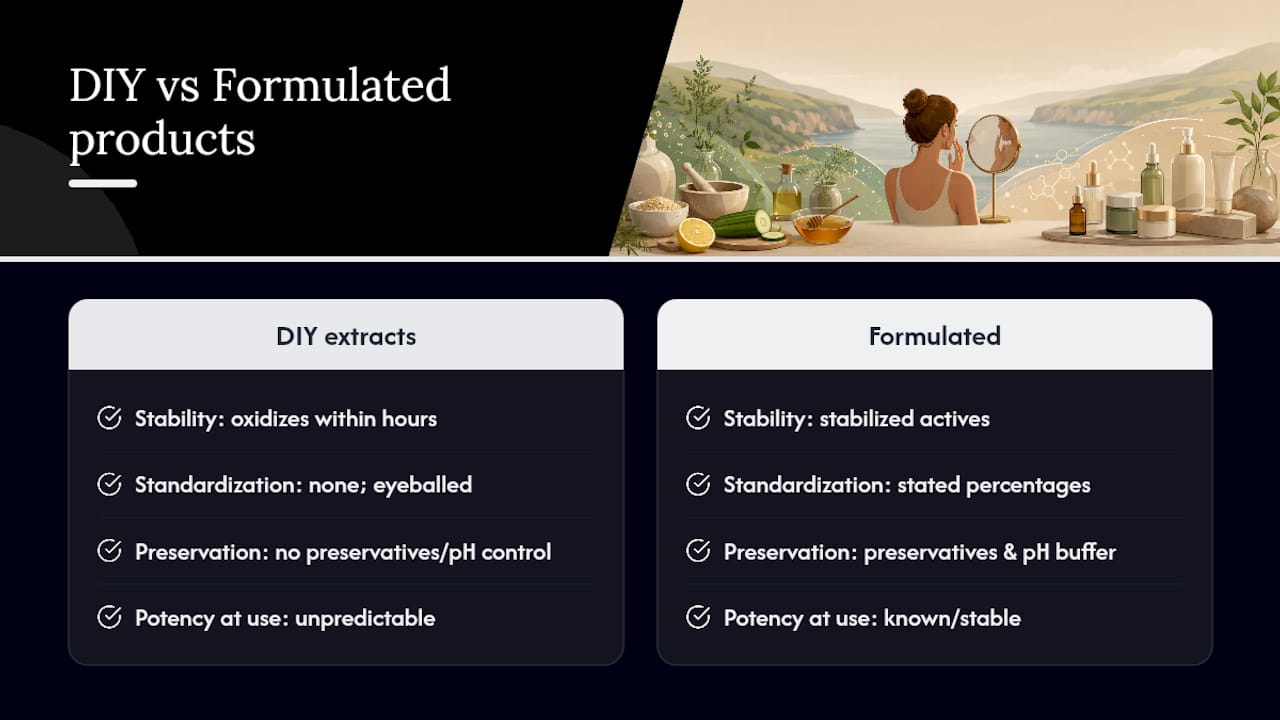
Homemade vitamin C oxidizes within hours. Turmeric masks lose potency the moment you mix them. That’s the core problem with DIY: natural doesn’t mean stable, and stability determines whether an active ingredient actually reaches your skin at a useful concentration. Commercial formulations solve this with preservatives, pH buffering, and standardized percentages, so you know exactly what you’re applying and that it hasn’t degraded before it touches your skin.
When shopping for a formulated alternative, look for three things: stabilized vitamin C (not just “vitamin C” on the label), a clearly stated niacinamide percentage, and sensitive-skin labeling if you’re prone to reactions. Standardized botanical extracts generally outperform kitchen versions of the same ingredients because extraction and concentration are controlled, not eyeballed. Miraclegelnaturalskincare focuses on gentle, natural brightening formulas built around this exact principle, giving readers who’d rather skip the mixing bowl a stable, tested option.
A Quick Perspective on What Actually Moves the Needle
Most people treating dark spots chase the wrong variable. They hunt for the “strongest” ingredient instead of the one they’ll actually use every single day for three months. Sunscreen is boring. Niacinamide takes weeks to show anything. But that’s the trade every natural approach makes: safety and patience in exchange for lasting, real fading instead of a burn that leaves a worse mark behind.
If a spot changes shape or color, skip the home remedies and see a clinician. For everything else, patch test first, then commit to consistency over intensity. Readers who want a stable, ready-made option can explore formulated brightening ranges built around the same actives covered here.
— Barbara
Where MiracleGelnaturalskincare Fits Into This Routine
Skipping the guesswork of DIY mixing means reaching for products that already solve the stability problem this guide keeps circling back to. The brightening lineup includes stabilized vitamin C serums, niacinamide creams, and gentle AHA formulas designed for sensitive, mature skin, the same categories this routine calls for at each stage.

If you’ve read through the recipes above and would rather skip the turmeric stains and short shelf life of homemade serums, the natural skincare collection for radiant, age-defying results is built specifically around brightening and anti-aging needs for skin over 40. Always patch test a new product on your inner arm for 48 hours before applying it to your face, formulated or not. Browse the collection, pick one product that matches your routine’s current gap, whether that’s a morning antioxidant or a nightly niacinamide cream, and start there.
Sources
- Journal of Clinical and Aesthetic Dermatology systematic review (2018)
- American Academy of Dermatology — How to fade dark spots
- PMC review article on botanical depigmenting agents
- Healthline — Home remedies for pigmentation
FAQ
What Can Naturally Get Rid of Dark Spots?
Vitamin C, niacinamide, azelaic acid, and licorice extract have the strongest clinical evidence among natural options, and daily sunscreen is essential for any of them to work.
What Clears Dark Spots the Fastest?
Nothing clears them overnight; most natural actives need 4 to 12 weeks of consistent, twice-daily use before visible fading shows up.
How Do Koreans Get Rid of Dark Spots?
Korean skincare routines lean heavily on layered hydration, daily sunscreen reapplication, and gentle brightening actives like niacinamide rather than aggressive peels, a prevention-first approach that lines up with the dermatology evidence covered above.
Can Apple Cider Vinegar Remove Dark Spots?
There’s no strong clinical evidence supporting apple cider vinegar for pigmentation, and its acidity can cause irritation or chemical burns that trigger new dark spots, so it’s better avoided.
Is Niacinamide or Vitamin C Better for Dark Spots?
Both have solid clinical support but work differently, niacinamide blocks pigment transfer while vitamin C inhibits the enzyme that produces melanin, so many routines use both rather than choosing one.