

The safest way to exfoliate mature skin is with a mild chemical acid, used sparingly, and always followed by barrier-repair moisturizer and daily sunscreen. Skip the scrubs. Patch test anything new. Never layer an acid night on top of your retinoid, and never skip SPF 30+ the morning after.
TL;DR:
- Use gentle chemical exfoliants like PHAs, lactic acid, or mandelic acid, avoiding physical scrubs and coarse particles to prevent micro-tears.
- Match the acid type and strength to your skin barrier status, dry or oily skin, and pigmentation concerns, starting with the mildest options.
- Limit exfoliation to once weekly or every 10 to 14 days for dry or sensitive skin, and up to twice weekly for oilier, tolerant skin.
- Never layer acids with retinoids on the same night and always apply SPF 30+ after exfoliation to protect vulnerable, newly refreshed skin.
- Watch for signs of over-exfoliation, such as persistent redness or flaking, and consult a dermatologist if irritation or reaction occurs.
Table of Contents
- Quick Shortlist: Safe Methods for Mature Skin
- How Do You Choose the Right Exfoliant for Your Skin Type?
- How Often Should You Exfoliate After 40?
- Step-by-Step Routine for Exfoliation Nights
- What to Avoid and When to See a Professional
- Expert Notes and Evidence
- A Practical Take on Exfoliating After 50
- A Gentle Option That Fits This Routine
- Sources
Quick Shortlist: Safe Methods for Mature Skin
Chemical exfoliants dissolve the glue between dead skin cells without the mechanical tugging that a scrub or brush applies to thinning skin, which is why dermatologists generally favor them for mature skin. Physical exfoliation isn’t off the table entirely, but it’s the riskier route once skin has lost collagen density and become more fragile.
Here’s the practical hierarchy, from gentlest to strongest:
- PHAs (gluconolactone, lactobionic acid): the mildest chemical exfoliants available, and a smart starting point for anyone with rosacea, eczema, or a history of reactive skin.
- Lactic acid: a mild AHA that pulls in moisture as it exfoliates, which makes it a good fit for skin that’s dry as well as textured.
- Mandelic acid: larger molecule, slower penetration, well tolerated by reactive skin and often recommended for pigmentation concerns.
- Low-strength glycolic acid: effective on texture and tone but more likely to irritate; escalate concentration slowly and only once your skin has proven it can handle the milder options.
- BHAs (salicylic acid): useful for isolated congestion or clogged pores, but not a daily or full-face habit for most mature skin.
- Coarse scrubs and walnut-shell exfoliants: avoid these. The abrasive particles can create micro-tears in skin that’s already thinner and slower to heal.
If you want something stronger than a low-strength AHA, that’s a conversation for a dermatologist’s office, not your bathroom counter. Guides focused on midlife skin consistently note that lactic acid and PHAs are better tolerated long-term than glycolic acid, and that pushing strength too fast is one of the most common paths to sensitized, angry skin.
How Do You Choose the Right Exfoliant for Your Skin Type?
Not every mature complexion needs the same acid, and matching the wrong one to your skin is how good intentions turn into a week of stinging and flaking. Run through this checklist before you buy anything:
- Assess your barrier first. If your skin feels tight, flushes easily, or reacts to new products within a day, start with PHAs. They’re the gentlest category and the least likely to trigger a reaction.
- Check what else you’re already using. If you’re on a prescription retinoid or over-the-counter retinol, you need a much lower exfoliation frequency than someone with a bare-bones routine. Combining both without a plan is the fastest way to compromise your barrier.
- Factor in dryness versus oiliness. Dry, post-menopausal skin generally does better with lactic acid, since it exfoliates and hydrates at once. Combination or oilier mature skin can sometimes tolerate a low-strength glycolic acid or an occasional BHA spot treatment.
- Consider pigmentation goals. If uneven tone or sun spots are your main concern, mandelic acid is often the better long-term pick because it’s gentler on melanin-rich or easily irritated skin than glycolic acid.
- Look at the ingredient list, not just the acid name. Favor formulas with hydrating bases like hyaluronic acid or glycerin, a pH in the mildly acidic range (not stripped or soap-like), and minimal added fragrance.
- Patch test before committing. Apply a small amount to your inner forearm or behind the ear, wait 24 hours, and watch for redness, itching, or burning before you put anything new near your face.
- Escalate slowly. Start with the lowest concentration available in a product line. If skin stays calm after two or three uses, you can consider a slightly stronger formula or a touch more frequency, never both changes at once.
A dry, sensitive complexion generally does best starting with PHAs or lactic acid at low strength. Combination skin with occasional congestion can often add a low-strength glycolic acid once tolerance is established. Anyone dealing with rosacea, eczema, or a compromised barrier should lean on PHAs almost exclusively and treat anything stronger as a rare, closely watched experiment.
How Often Should You Exfoliate After 40?
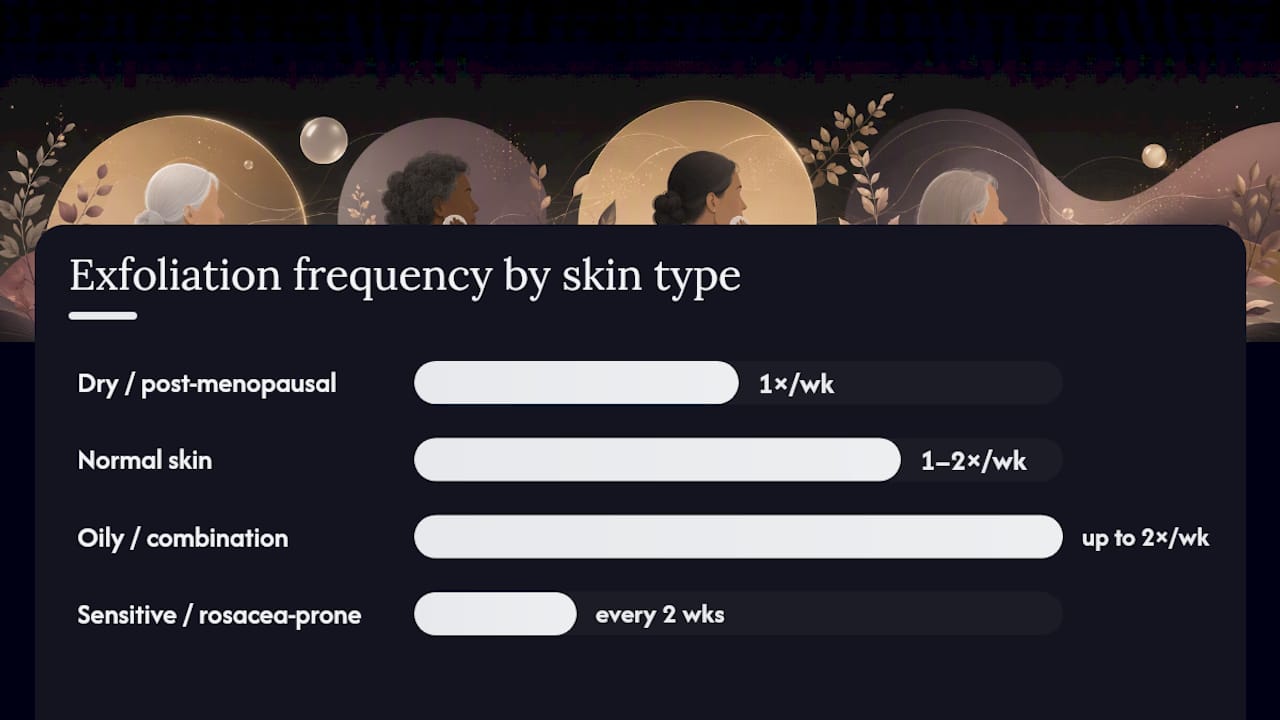
Frequency is where most over-exfoliation problems start, and the fix is almost always to do less, not more. Conservative guidance for aging skin suggests starting around once weekly for many mature complexions, adjusting from there based on how skin responds.
- Dry or post-menopausal skin: once weekly, or every 10 to 14 days if skin runs sensitive or reactive.
- Normal skin with no major complaints: one to two times weekly.
- Oily or combination mature skin: up to twice-weekly, but watch closely for tightness or flaking.
- Sensitive skin or rosacea-prone skin: every two weeks to start, sometimes less, and always with a dermatologist’s input if flushing is frequent.
Skin cycling gives you a simple framework for keeping acids and retinoids from colliding. The rule is straightforward: never apply a strong exfoliating acid and a retinoid on the same night. A sample week might look like Monday for a gentle acid, Tuesday and Wednesday as recovery nights with just moisturizer, Thursday for retinoid, Friday and Saturday as recovery again, and Sunday left open for a second light exfoliation only if skin tolerated the first one well.
Recovery nights matter as much as active nights. On those evenings, skip acids and retinoids entirely and apply a barrier-repair moisturizer with ceramides or hyaluronic acid instead.
Pause exfoliation altogether after any in-office procedure, after starting a new prescription medication, or the moment you notice persistent stinging, unusual redness, or flaking that won’t quit.
Pro Tip: Keep a simple note on your phone logging which product you used and how your skin looked the next morning. Patterns show up faster than memory does, especially when you’re testing more than one active at a time.
Step-by-Step Routine for Exfoliation Nights
Follow this order on nights you exfoliate, and don’t improvise the sequence.
- Patch test first if the product is new, and skip exfoliation entirely if you’ve had any invasive procedure, peel, or laser treatment in the past two weeks.
- Cleanse gently. Use a mild, non-stripping cleanser and lukewarm water, never hot.
- Apply the chemical exfoliant per the label. A thin, even layer is enough. Resist the urge to press it in or rub it around.
- Do not scrub it in. Chemical exfoliants work through contact time, not friction. Let the product do the work.
- Watch for tingling versus stinging. A light tingle that fades within a minute is normal for most acids. Persistent burning is not.
- Finish with a barrier-repair moisturizer. Look for ceramides, hyaluronic acid, or peptides to help reseal skin that’s just been exfoliated.
- If irritation shows up, stop immediately. Remove the product with water, apply a plain, fragrance-free emollient, and skip all actives for at least 48 hours.
The next morning, hydrate first, then apply broad-spectrum SPF 30+ before any sun exposure. This step isn’t optional: freshly exfoliated skin has a thinner, more vulnerable outer layer and is more susceptible to UV damage right after treatment. Sunscreen applied 15 to 30 minutes before you head outside, and reapplied roughly every two hours if you’re out in it, protects the results you’re working for.
For delicate zones like the eye area, crepey neck skin, or the backs of the hands, use a lighter hand and a lower frequency than you would on the rest of the face. These areas have less oil production and thinner skin to begin with, so they show irritation faster and recover more slowly.
What to Avoid and When to See a Professional
Most exfoliation problems on mature skin trace back to the same handful of mistakes. Coarse physical scrubs top the list, followed closely by stacking two or more acids in the same routine and exfoliating on the same night as a retinoid. Exfoliating over an open wound, a healing peel, or freshly treated skin from a professional procedure belongs on that list too.
- Persistent stinging that doesn’t fade within a few minutes of application.
- Redness that spreads or intensifies over several days instead of calming down.
- Widespread flaking or a rough, tight feeling that wasn’t there before you started.
- Any product suddenly causing a reaction it never caused before, which can signal a compromised barrier.
Over-exfoliation is one of the most common ways people damage their skin barrier, and mature skin recovers from that damage more slowly than younger skin does. If you notice a lesion that’s changing shape, bleeding, or not healing, or if irritation looks like it might be turning into an infection, stop everything and see a dermatologist rather than trying to manage it with more products.
Expert Notes and Evidence
Barbara has covered this territory before in pieces like exfoliation tips for glowing skin after 40 and a deeper look at barrier-first skincare routines for 40+. The thread running through all of it is the same one dermatology sources back up: aging skin is inherently thinner and more fragile, which is exactly why aggressive exfoliation causes more harm here than it would on a 25-year-old’s skin.
If you’re bringing this up with a dermatologist or aesthetician, a short checklist makes the conversation faster and more useful:
- Which products you’re currently using, including brand and active ingredient percentages.
- How long you’ve noticed any reaction, and whether it’s improving, stable, or getting worse.
- Any current medications, especially oral retinoids, blood thinners, or topical prescriptions.
- Your typical exfoliation frequency and the last date you exfoliated.
A barrier-first approach, pairing gentle actives with real hydration through ingredients like ceramides and hyaluronic acid, lines up with how most credible guidance on mature skin approaches this now. It’s a supporting step in a routine, not the main event.
A Practical Take on Exfoliating After 50
I’ve watched too many people chase faster results by upping frequency or reaching for a stronger acid the moment progress slows. It almost always backfires. Skin that’s had four decades or more on it doesn’t reward impatience; it rewards consistency.
The habit that actually works is boring: same gentle acid, same modest frequency, tracked over weeks rather than days. Give any new product at least a month before deciding whether it’s working, and always patch test first. Slower and steadier beats aggressive and inconsistent, every time I’ve seen it play out.
— Barbara
A Gentle Option That Fits This Routine
If you’re looking for something that fits the conservative, barrier-first approach this guide recommends, Miracle Gel is built around fast, gentle results rather than harsh, high-strength acids that demand a slow ramp-up. Some formulas are designed to support your skin’s barrier, which is important in the days right after any exfoliation night.

For most mature skin, applying it two to three times weekly alongside a lighter exfoliation schedule gives the barrier room to recover between actives. As with any new product, patch test on your inner arm first and watch for 24 hours before applying it to your face. Orders over €85 ship free, so it’s worth pairing it with a moisturizer from the same natural skincare for women 40+ range if you’re building out a full routine. Start there, see how your skin responds over a few weeks, and adjust frequency from that baseline.
Sources
- Skin care for aging skin: Minimizing age spots, wrinkles, and undereye bags – Harvard Health
- Skin care and aging – National Institute on Aging (NIA)
- PMC article on exfoliation risks and skin barrier (peer-reviewed summary) – PubMed Central
- How often should you exfoliate aging skin? – Anti Aging Care