

Start here: swap your leave-on products first, use up what you already own before buying anything new, and buy from brands that publish full ingredient lists. That’s the core of any eco-friendly beauty checklist that actually changes your footprint instead of just your shelf display. Today, you can pull three products from your bathroom and check them against these five moves:
- Finish your current moisturizer, serum, and sunscreen before replacing them with greener versions.
- Swap disposable cotton pads for washable rounds.
- Check one product’s label for a real certification (USDA Organic, B Corp) instead of the word “natural.”
- Save your empty containers instead of binning them until you’ve confirmed how to recycle them.
- Look up one brand you already own on EWG Skin Deep to see how it rates.
Pro Tip: Before tossing anything, calculate its cost per use. A half-used $40 serum you paid for already beats a “greener” $40 replacement, financially and environmentally, until it’s gone.
Key Takeaways
Prioritizing leave-on products, verifying certifications instead of buzzwords, and using up what you own before replacing it forms the backbone of any workable eco-friendly beauty checklist.
| Point | Details |
|---|---|
| Swap leave-on products first | Moisturizer, serum, and sunscreen matter most since they stay on skin the longest. |
| Use up what you own | Finish existing products before replacing them, regardless of new “green” claims. |
| Verify, don’t trust labels | Look for USDA Organic, B Corp, or NSF/ANSI 305 instead of the word “natural.” |
| Separate your disposal streams | Recyclable containers, take-back-only items, and hazardous waste need different bins. |
| Choose multi-use, concentrated formulas | Products like Miraclegelnaturalskincare’s 2-Minute Miracle Gel cut packaging by doing more per bottle. |
Table of Contents
- Why an Eco-Friendly Beauty Checklist Matters Right Now
- Which Swaps Should You Make First?
- How Do You Recycle Beauty Packaging Correctly?
- How Do You Spot Greenwashing in Beauty Products?
- What Daily Habits Cut Your Beauty Footprint?
- Which Reusable Tools Are Worth Buying?
- Which Swaps Give You the Most Environmental Return?
- What Belongs on a Monthly Beauty Maintenance Checklist?
- How Do You Dispose of Beauty Products Responsibly?
- Do Your Ingredient Choices Actually Affect the Environment?
- Sources
Why an Eco-Friendly Beauty Checklist Matters Right Now
Cosmetic packaging generates a lot of waste, and only a small share of it actually gets recycled, according to the Planet Positive Beauty Guide from the British Beauty Council. Your bathroom cabinet is bigger than it feels: a dozen bottles per person, multiplied across millions of households, adds up fast. The fix isn’t buying an entirely new “sustainable” collection. It’s making sharper choices about what you already buy, use, and throw away.
Which Swaps Should You Make First?
Not every product deserves the same urgency. Prioritize what sits on your skin the longest, since that’s where formulation and packaging choices compound over time.
- Moisturizer, serum, and sunscreen stay on your skin all day, so swap these to natural formulations first once your current bottles run out.
- Multi-use products (a tinted balm that works as blush and lip color, a stick that shades and highlights) cut packaging count without cutting your routine.
- Shampoo and soap bars eliminate the plastic bottle entirely and often outlast liquid versions per gram.
- Reusable makeup remover pads replace disposable wipes, one of the most needlessly wasteful items in most routines.
Judge these by cost-per-use, not sticker price. A Vogue piece on sustainable beauty routines makes the same point: using up what you own beats buying a greener replacement for something that still works.
Pro Tip: If a product is nearly empty, or it’s a prescribed or medically necessary formula, keep using it. Swapping mid-bottle for the sake of the checklist just creates two half-used products instead of one finished one.
How Do You Recycle Beauty Packaging Correctly?
Refillable systems, solid bars, and “naked” products (no box, minimal plastic) cut packaging at the source, which matters more than recycling after the fact. But recycling still matters for what’s left, and most people get it wrong.
- Refill programs and bar soaps skip packaging entirely on repeat purchases.
- Lipsticks, mascara tubes, and sample sachets are usually too small or too mixed-material for curbside bins and need in-store take-back schemes instead, according to guidance on recycling beauty products.
- Check the small triangle symbol and any brand-specific instructions printed on the container before tossing it in a bin.
- Use a recycling locator tool like WRAP’s to find drop-off points for items your curbside service won’t take.
Recycling rates for cosmetic packaging remain low industry-wide, which is exactly why refillable and bar formats matter more than the recycling bin itself.
How Do You Spot Greenwashing in Beauty Products?
“Natural” and “clean” aren’t regulated terms. A product can call itself natural and still contain synthetic preservatives, fragrance, or packaging with zero recycled content, as reporting on greenwashing in the beauty industry points out. The label means nothing on its own. What matters is what backs it up.
Look for certifications with actual standards behind them:
- USDA Organic verifies a set percentage of organic ingredients.
- NSF/ANSI 305 covers organic personal care formulation and processing.
- B Corp certifies the company’s overall environmental and social practices, not just one product line.
- Cruelty-Free seals (Leaping Bunny, PETA) confirm no animal testing at any stage.
- Cradle to Cradle and CarbonNeutral® certifications address material circularity and offset carbon footprint respectively.
Beyond seals, ingredient transparency is the strongest signal you can check yourself. Learn to skim an INCI ingredient list, where ingredients appear in descending order by concentration, and cross-reference anything unfamiliar on EWG Skin Deep before buying.
What Daily Habits Cut Your Beauty Footprint?
You don’t need a routine overhaul. Small, repeatable habits do more over a year than one dramatic swap does in a week.
- Turn off the tap while you lather cleanser or shampoo instead of letting it run.
- Shorten showers by a minute or two, especially if you’re double-cleansing or conditioning.
- Replace single-use cotton rounds and makeup wipes with washable versions you launder weekly.
- Consolidate steps where a multitasking product can replace two single-purpose ones.
Pro Tip: Put a recurring reminder on your phone for the first of each month to audit your shelf. Duplicate products and forgotten items are where most wasted spending and wasted packaging hide.
Which Reusable Tools Are Worth Buying?
A handful of inexpensive, durable tools do more for your footprint than most “eco” marketing claims combined.
- Reusable makeup remover pads (cotton or bamboo terry) wash in a mesh bag and last years, not days.
- Stainless steel safety razors replace disposable plastic cartridges indefinitely once you own the handle.
- Konjac sponges are biodegradable, gentle enough for daily cleansing, and compost at the end of their life.
- Bamboo toothbrushes cut plastic waste from a product you replace every few months.
Wash cloth rounds after each use and let them air dry fully to avoid mildew. Skip DIY on anything that needs a preservative system, like lotions or eye products meant to last weeks. Without proper preservation, homemade versions can grow bacteria fast, which isn’t a tradeoff worth making for sustainability points.
Which Swaps Give You the Most Environmental Return?
Not all swaps are equal, and treating them that way wastes money. Products that stay on your skin the longest, or cover the most surface area, carry the most formulation and packaging weight over a year of use. That’s the research-backed logic behind prioritizing leave-on staples first.
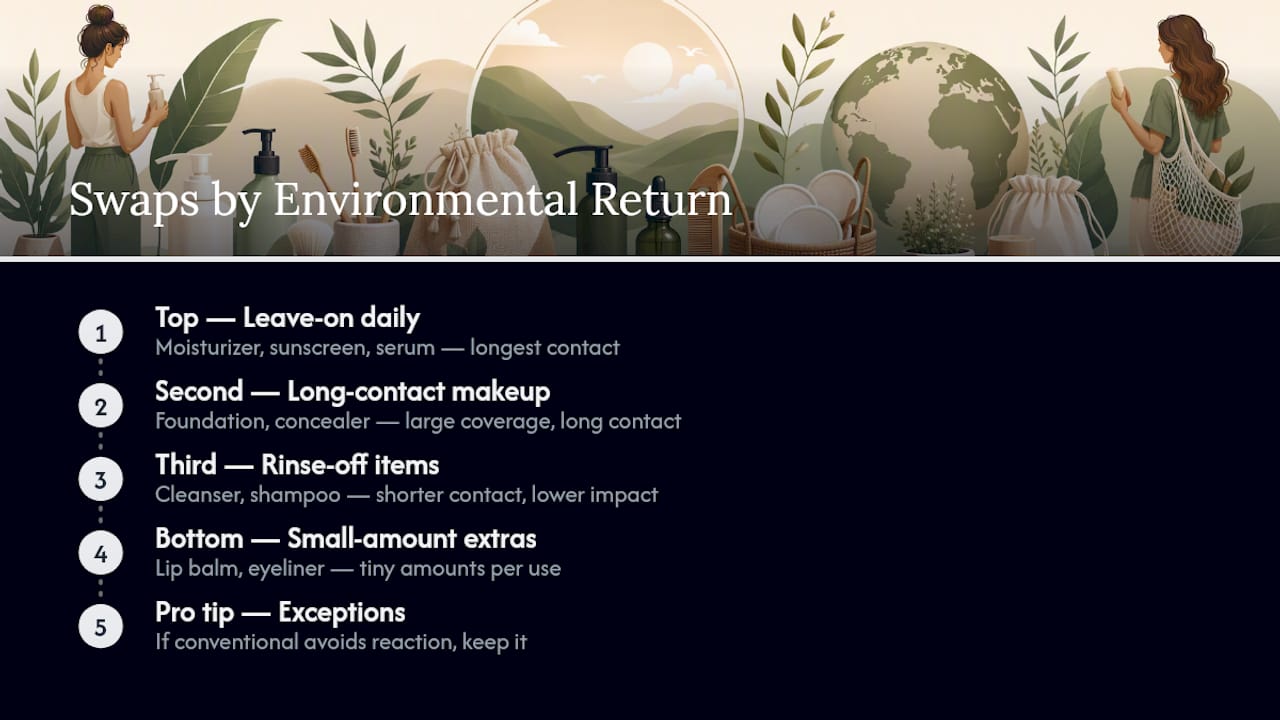
Picture it as a tier list: leave-on daily products (moisturizer, sunscreen, serum) sit at the top, followed by long-contact makeup (foundation, concealer), then rinse-off items (cleanser, shampoo), then tiny-amount extras (lip balm, eyeliner) at the bottom.
Pro Tip: Exceptions apply for damaged or sensitive skin. If a conventional product is the only one that doesn’t trigger a reaction, keep it and focus your swaps elsewhere on the list.
What Belongs on a Monthly Beauty Maintenance Checklist?
A five-minute monthly check keeps your routine sustainable without turning it into a chore.
- Audit your shelf and drawer for duplicates or half-finished products.
- Check expiry dates and toss anything past its shelf life safely.
- Donate unopened, unused items instead of letting them expire in a drawer.
- Confirm which empties qualify for refill or take-back programs before your next order.
- Track one number, like plastic bottles avoided that month, to see your progress build.
How Do You Dispose of Beauty Products Responsibly?
Most beauty waste falls into one of three categories: recyclable packaging, take-back-only items, and hazardous waste. Treating them the same way is the most common mistake people make.
Recyclable packaging includes large, single-material containers like plastic shampoo bottles or glass jars, which most curbside programs accept once rinsed clean. Rinse residue out first. A jar with old cream still inside can contaminate an entire batch of recycling at the sorting facility.
Take-back-only items include small components: mascara wands, lipstick tubes, pumps, and sample packets. These mix metal, plastic, and sometimes glass in one piece, which curbside sorting machines can’t separate. Many brands and retailers run in-store collection bins specifically for this category, so check before assuming it belongs in your household recycling.
Hazardous waste covers aerosols, nail polish, and nail polish remover. These need designated hazardous waste drop-off points in most municipalities, not the regular trash or recycling stream, because leftover propellant and solvents can be flammable or toxic in landfill.
Before anything goes in a bin, empty it fully. A “recyclable” bottle with product residue often gets diverted to landfill anyway because facilities can’t process contaminated containers economically. Rinsing takes ten seconds and is the single most overlooked step in the entire disposal process.
Do Your Ingredient Choices Actually Affect the Environment?
Yes, and the difference is bigger than most people assume. Biodegradable ingredients break down into water, carbon dioxide, and biomass without leaving toxic residue in waterways. Many synthetic surfactants, preservatives, and micro-exfoliating plastics don’t. Some persist in soil and water long after they’ve gone down the drain.
Microplastics, once common in exfoliating scrubs, are a clear example: tiny polyethylene beads that survive water treatment and accumulate in rivers and oceans. Most major markets have restricted them, but it’s worth checking a product’s exfoliant source. Look for ground seeds, sugar, or salt instead of “microbeads” or unspecified “polyethylene” on the ingredient list.
Waterless and concentrated formulas cut environmental impact from a different angle: less water means lighter shipping weight, smaller containers, and often a longer shelf life per unit. A concentrated cleanser or solid conditioner bar delivers more washes per gram than its liquid, water-heavy counterpart, which is part of why refill and bar formats keep showing up throughout this checklist.
None of this means every synthetic ingredient is harmful or every “natural” one is safe. Poison ivy is natural. The point is to check specifics, not categories. Plant-derived ingredients chosen for both skin performance and biodegradability give you both outcomes without a tradeoff.
A Note From the Publisher
This checklist reflects what Miraclegelnaturalskincare stands for: gentle, clinically minded formulas that don’t demand you choose between effective skincare and a lighter footprint. Our own approach to ethical beauty starts with the same priority list you just read.
Build Your Routine Around Products That Do Double Duty
Miraclegelnaturalskincare is built around the same swap-priority logic in this checklist: leave-on formulas that work hard enough that you need fewer of them. The 2-Minute Miracle Gel delivers visible results in one step, so you’re not layering five separate products (and five separate containers) to get the same outcome.
That matters for the checklist you just read: fewer products means less packaging, and a concentrated leave-on formula fits directly into the tier-one priority swap this article recommends. If you’re ready to replace a leave-on staple with something built on natural, multi-functional ingredients, browse the Natural Skincare collection for radiant, age-defying results and start with the one product doing the most work on your skin.
Sources
- Planet Positive Beauty Guide (British Beauty Council)
- How to Make Your Beauty Routine More Sustainable (Vogue)
- EWG Skin Deep