

Yes. Most peptides and vitamin C pair safely, and for a lot of people, layering them is genuinely one of the smarter moves in an anti-aging routine. The one real exception is copper peptides, which fight with vitamin C chemically. Your simplest path: use vitamin C in the morning and peptides at night, or pick a vitamin C derivative and apply both in one step. Clinical data on combined peptide and vitamin C formulas backs up why this combination is worth the small amount of planning it takes.
TL;DR:
- L-ascorbic acid requires a low pH to remain stable and penetrate skin, which can hydrolyze peptides if kept in contact too long, so sequencing or wait times are recommended.
- Vitamin C derivatives like ascorbyl glucoside and sodium ascorbyl phosphate are formulated at neutral pH, making them compatible with peptides in the same application without additional timing.
- Copper peptides, such as GHK-Cu, should be used separately from vitamin C or with derivatives, as copper ions catalyze oxidation of vitamin C, reducing its potency.
- Combining peptides with vitamin C in stable, properly formulated products can lead to visible improvements in fine lines, wrinkles, and cell turnover within approximately four weeks.
- For routine building, schedule L-ascorbic acid in the morning with a wait before applying peptides, and use copper peptides at night, or opt for formulations designed to work together to simplify skincare.
Table of Contents
- Why the Vitamin C Form and pH Matter
- Copper Peptides: The Exception You Actually Need to Know
- Building an AM/PM Routine That Actually Works
- How to Read Ingredient Lists Like a Formulator
- What to Do When Your Skin Reacts
- What the Clinical Evidence Actually Shows
- Why the Copper Peptide Warning Gets Overapplied
- Simplify Your Routine With a Formula Built for Both
- Sources
- FAQ
Why the Vitamin C Form and pH Matter
The confusion around layering peptides and vitamin C almost always traces back to one ingredient: L-ascorbic acid. This is the gold-standard, most-researched form of vitamin C, but it only works at a low pH, typically somewhere between 2.5 and 3.5, according to formulation guidance from FormBlends. That acidity is not a side effect. It’s the mechanism. L-ascorbic acid needs that environment to stay stable and to actually penetrate skin.
That low pH is also the source of nearly every layering concern you’ve read about online. Peptides are chains of amino acids, and amino acid bonds can theoretically be broken down, or hydrolyzed, in a sufficiently acidic environment. In practice, the brief contact time of a leave-on serum doesn’t come close to replicating the prolonged, heated, concentrated acid conditions that actually hydrolyze peptides in a lab setting. So the risk is real in theory, modest in practice, but worth managing with simple sequencing rather than ignoring outright.
Vitamin C derivatives sidestep the pH issue almost entirely. Ingredients like ascorbyl glucoside, sodium ascorbyl phosphate, and tetrahexyldecyl ascorbate are formulated at a near-neutral pH, which makes them naturally compatible with peptides in the same product or the same step, according to Skin Stacker’s ingredient breakdown. They tend to be gentler and more stable, though many people find L-ascorbic acid still delivers a more noticeable brightening effect at higher concentrations.
Here’s what actually determines your approach:
- L-ascorbic acid on the label: low pH, most likely to need sequencing or a wait time before peptides.
- Ascorbyl glucoside, sodium ascorbyl phosphate, or tetrahexyldecyl ascorbate: near-neutral pH, generally fine to layer immediately.
- Unlabeled or proprietary “vitamin C complex” names: treat as L-ascorbic acid unless the brand states otherwise.
A combined peptide and vitamin C ampoule tested in clinical research produced noticeable decreases in crow’s-feet and forehead wrinkles after about 28 days, alongside a statistically significant acceleration in mean cell turnover according to the study published in PMC. That’s a meaningful signal that these two ingredient families work well when the formulation handles the pH problem for you.
Copper Peptides: The Exception You Actually Need to Know
Copper peptides are where the “don’t mix actives” warnings come from, and for once, the warning is grounded in real chemistry. Copper ions can catalyze the oxidation of ascorbic acid, essentially speeding up the process by which vitamin C degrades and loses potency. This is sometimes described as Fenton-type chemistry, and it means pairing copper peptides with L-ascorbic acid in the same application can leave you with a weaker vitamin C serum and, in some cases, a less stable copper peptide as well.
The good news is that copper peptides are a small slice of the peptide world. Most peptides you’ll encounter in serums, things like palmitoyl pentapeptide-4 or acetyl hexapeptide-3, carry none of this oxidation risk and layer with vitamin C without issue, according to SYNC’s skincare encyclopedia.
Here’s how to schedule around copper peptides without giving up either ingredient:
- Split by time of day. Use L-ascorbic acid in the morning under sunscreen, and save copper peptide products for your evening routine.
- Switch the vitamin C form. If you want both in one session, use a derivative like sodium ascorbyl phosphate instead of L-ascorbic acid. The near-neutral pH won’t destabilize the copper peptide.
- Choose a non-copper peptide instead. If your goal is firmness or collagen support, plenty of peptide complexes deliver similar benefits without the copper.
Checking labels takes about ten seconds once you know what to look for. Copper peptides show up under names like GHK-Cu or copper tripeptide-1, usually listed partway down the ingredient panel. If you see either of those alongside “ascorbic acid” near the top of a different product’s list, that’s your cue to separate the two by time of day rather than stacking them.
Pro Tip: Keep your copper peptide serum on your nightstand and your vitamin C on the bathroom counter. The physical separation does half the habit-building for you.
Building an AM/PM Routine That Actually Works
Once you know which vitamin C form you’re using, the routine itself is straightforward. Here’s a version built around L-ascorbic acid, which needs the most care:
Morning:
- Cleanse.
- Apply L-ascorbic acid serum.
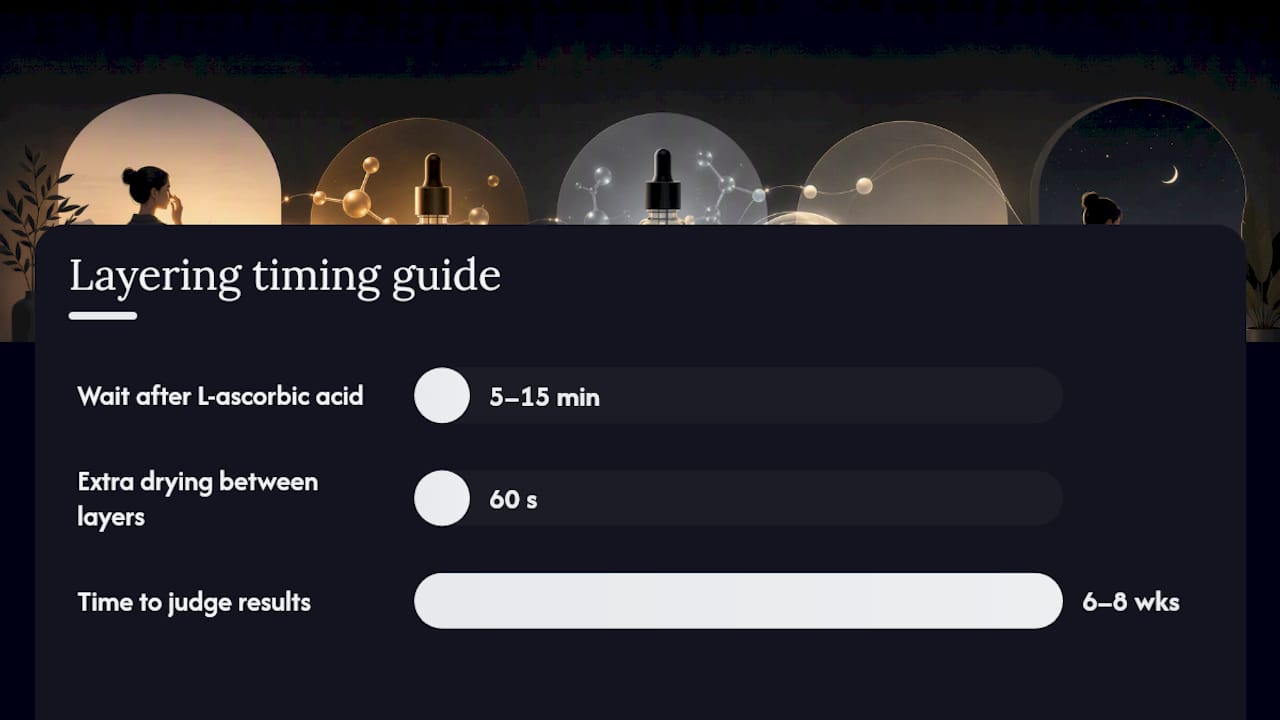
- Wait 5 to 15 minutes. This gives the product’s pH time to normalize on skin, per FormBlends’ formulator guidance, which notes that surface pH begins shifting within minutes of application.
- Apply a non-copper peptide serum, if you’re using one in the morning.
- Moisturize.
- Apply SPF.
Evening:
- Cleanse.
- Apply your peptide serum, including copper peptides if that’s your product.
- Moisturize.
If you’re using a vitamin C derivative rather than L-ascorbic acid, you can skip the wait entirely. Apply vitamin C, then peptide, back to back, in either your AM or PM routine. And if you’re using a formula that combines both ingredients into one product, stabilized to avoid pH conflicts, the whole sequencing question disappears. According to Youth Rituals’ analysis of biotech peptide formulations, integrated formulas exist specifically to remove this layering complexity for people who don’t want to think about timing at all.
A few practical notes that make the difference between a routine that works and one that pills or irritates:
- Introduce one new active at a time. Add vitamin C for two weeks, watch how skin responds, then add the peptide. This makes it obvious which ingredient is responsible if you react to something.
- Thin layers prevent pilling. A dime-sized amount of serum, pressed rather than rubbed in, absorbs faster and leaves less residue for your moisturizer to ball up against.
- Let each layer set before moving on. Even 60 seconds of extra drying time between steps noticeably reduces pilling with vitamin C, which tends to sit closer to the skin surface than heavier peptide serums.
- Give it six to eight weeks before judging results. Both ingredient families work gradually. Cell turnover changes and collagen support don’t show up overnight.
Pro Tip: If your moisturizer pills no matter what you try, apply it slightly damp-handed. A few drops of water mixed into the product on your palm before applying often smooths the texture out completely.
For a broader look at how to layer skincare products beyond just these two ingredients, the same wait-and-observe logic applies to retinoids, acids, and niacinamide too.
How to Read Ingredient Lists Like a Formulator
You don’t need a chemistry degree to spot the ingredients that matter here. You need to know four things to look for, and where they typically show up on a label.
- “Ascorbic acid” or “L-ascorbic acid” near the top of the list. Ingredients are listed by concentration, so if this appears in the first five or six items, you’re almost certainly holding a low-pH formula that benefits from the wait-time approach.
- “GHK-Cu” or “copper tripeptide-1” anywhere on the label. This flags a copper peptide product. Schedule it separately from L-ascorbic acid, as covered above.
- Common non-copper peptide names. Palmitoyl pentapeptide-4, acetyl hexapeptide-3, palmitoyl tripeptide-1, and similar names indicate peptides with no oxidation conflict. These are safe to layer with any vitamin C form.
- Derivative names like ascorbyl glucoside or sodium ascorbyl phosphate. These signal a near-neutral pH product, meaning the sequencing rules relax considerably.
When a label is vague, something like “vitamin C complex” with no further detail, your safest move is to treat it as though it’s L-ascorbic acid and apply the wait-time rule anyway. It costs you nothing to wait an extra ten minutes, but it can cost you results if you assume compatibility that isn’t there. If you’re still unsure, check the brand’s product page directly; most reputable formulators list the specific vitamin C derivative used, precisely because customers ask.
Browsing a brand’s peptide serum lineup or its brightening product line is often the fastest way to see which specific compounds are behind a “vitamin C” or “peptide” label claim, since full ingredient decks are usually posted there.
What to Do When Your Skin Reacts
Irritation after starting a peptide and vitamin C routine is more often about the vitamin C than the peptide. L-ascorbic acid, particularly at concentrations above 15%, is the more likely irritant of the two, so if your skin turns red, tight, or stingy after layering, dial back vitamin C frequency first. Try every other day for two weeks, then reassess before touching your peptide product at all.
Pilling is a texture problem, not a compatibility problem, and it’s fixable in one of three ways:
- Reorder your steps so the thinnest, most watery product goes on first.
- Extend your wait time between layers to a full 60 to 90 seconds.
- Swap one product for a different texture, gel instead of cream, for instance, if the two you’re using simply don’t mix well on skin.
There’s a difference between mild adjustment-period redness and a genuine problem. If you’re seeing persistent burning, swelling, hives, or irritation that doesn’t calm down within a few days of reducing frequency, stop both products and talk to a dermatologist. That’s not a normal layering hiccup.
The bigger lesson buried in most skincare frustration is this: consistent use of moderate-strength vitamin C and peptide products almost always outperforms sporadic use of the strongest formulas you can find.
What the Clinical Evidence Actually Shows
The strongest data point for combining these two ingredient families comes from clinical testing of a peptide and vitamin C ampoule formula. After about four weeks of use, researchers noted reductions in crow’s-feet, forehead wrinkles, and nasolabial folds, with many participants reporting smoother-feeling skin, according to the peer-reviewed clinical studies published in PMC. Cell turnover also showed meaningful acceleration in treated skin compared to untreated skin, a statistically significant difference (P < 0.0001).
That’s a solid result, but it comes with real limits worth naming honestly. The study window was short, under a month, which tells you about early visible change but not long-term outcomes over a year of use. It also tested a specific formulation, not the general concept of “any peptide plus any vitamin C.” Stability and packaging matter enormously here. Vitamin C degrades with light and air exposure regardless of what it’s paired with, so a well-formulated combined product in opaque, airless packaging will outperform a poorly packaged one even with identical ingredients.
What this data supports is a fairly narrow but useful claim: when peptides and vitamin C are formulated together with pH and stability handled correctly, the combination produces measurable improvement in fine lines and skin texture faster than either ingredient tends to work alone. It doesn’t prove every random pairing of a peptide serum and a vitamin C serum from two different brands will replicate those numbers. Formulation quality is doing real work in that result, not just the raw ingredient list.
Why the Copper Peptide Warning Gets Overapplied
The biggest misconception floating around skincare forums is that peptides and vitamin C are broadly risky to combine. They’re not. The copper peptide exception gets treated as a blanket warning against all peptides, and that’s simply not what the chemistry shows. Copper is the variable, not the peptide bond itself.
Where conventional advice actually falls short is in overcomplicating routines that don’t need it. Plenty of people abandon a good vitamin C serum entirely because a forum post told them “peptides and vitamin C don’t mix,” when a five-minute wait or a derivative swap would have solved the whole problem. The instinct to simplify is right. The execution, tossing one whole product category out, is usually wrong.
If you’re building a routine from scratch, prioritize this order: figure out which vitamin C form you own, check for copper peptides on any peptide label, then decide between the wait-time method and a same-step derivative approach. A ready-made combined formulation, like Miraclegelnaturalskincare’s peptide serum, removes that decision entirely for people who’d rather not manage two separate steps. That’s not cutting corners. That’s just letting the formulation chemist do the sequencing work for you.
— Barbara
Simplify Your Routine With a Formula Built for Both
Miraclegelnaturalskincare’s answer to the whole sequencing question is straightforward: build the compatibility in at the formulation stage so you don’t have to think about wait times every night. The 2 Minute Miracle Peptide+ Serum is designed to work into a routine that already includes vitamin C, without the copper peptide conflict this article just walked you through.

Apply it in the evening after cleansing, before your moisturizer, for a straightforward PM peptide step. If your vitamin C is a derivative rather than L-ascorbic acid, you can layer the two back to back in the same session without a wait. A small amount, about a pea-sized drop, is enough to cover the full face and neck; pressing it in rather than rubbing helps it absorb before your next step goes on.
At €54.95, it’s a single, direct way to add a peptide step to your routine without guessing which non-copper peptide names to hunt for on other labels. Visit the Miraclegelnaturalskincare shop to add it to your routine today.
Sources
- Effectiveness of a formulation containing peptides and vitamin C in treating signs of facial ageing: three clinical studies
- Peptides Before or After Vitamin C | FormBlends
- Can You Use Peptides and Vitamin C Together? — Skin Stacker
- Peptides + Vitamin C — SYNC Skin Encyclopedia
- Combining Vitamin C With Biotech Peptides | Youth Rituals
FAQ
Can You Layer Vitamin C and Peptides?
Yes, most peptides layer safely with vitamin C, whether you use L-ascorbic acid with a short wait time or a derivative applied back to back. The one real exception is copper peptides, which should be scheduled separately from L-ascorbic acid to avoid oxidation, according to SYNC’s skincare encyclopedia.
What Should You Not Layer With Peptides?
Copper peptides are the main ingredient to keep away from L-ascorbic acid, since copper can catalyze vitamin C’s breakdown. Beyond that, most peptides layer fine with other actives, though introducing new products one at a time makes it easier to spot irritation early.
Should I Use Peptide or Vitamin C Serum First?
In the morning, apply vitamin C first, wait 5 to 15 minutes, then follow with a non-copper peptide serum, based on formulator guidance from FormBlends. At night, if you’re using copper peptides, apply them on their own without vitamin C, or reserve vitamin C entirely for daytime use.
What Not to Mix With Peptides?
Copper peptides shouldn’t be mixed with L-ascorbic acid in the same step, since the acidity and copper interact poorly. Strong exfoliating acids used at the same time as peptides can also increase irritation risk, so most people do better spacing those out across morning and evening rather than stacking everything at once.