
TL;DR:
- Many “organic” skincare products are not fully certified, often containing minimal organic ingredients and relying on misleading marketing. Genuine certification involves third-party verification, traceability, and ongoing audits, but regulations vary between the EU and US and often do not fully cover cosmetics. Consumers should look for recognizable third-party logos like COSMOS or USDA Organic, verify certificates through official databases, and avoid vague claims or self-certification to ensure authentic organic skincare.
Most “organic” labels on skincare products are not regulated the way you probably think they are. Walk down any beauty aisle or scroll through any skincare website, and you will see the word “organic” used freely, sometimes on products that contain a single organic ingredient among dozens of synthetic ones. For anyone over 40 who is investing real money in anti-aging and brightening skincare, this matters enormously. Understanding what certifications actually mean, and which ones protect you as a consumer, is the difference between spending wisely on proven formulas and being misled by clever marketing.
Table of Contents
- Defining organic certifications: What does “organic” mean?
- How organic certifications work in the EU and US
- Organic vs natural cosmetic certifications: COSMOS and beyond
- How to spot genuine organic skincare: Consumer checklist
- Why most “organic” skincare claims are misunderstood
- Ready for certified organic skincare with proven anti-aging results?
- Frequently asked questions
Key Takeaways
| Point | Details |
|---|---|
| Organic isn’t always certified | Not all products labeled ‘organic’ follow strict certification rules, so double-check for official standards. |
| EU and US standards differ | Skincare certification works differently in the EU and US, so know which logos and authorities you should look for. |
| COSMOS covers cosmetics | COSMOS certification is essential for organic cosmetics, as EU food laws don’t apply to skincare. |
| Check certification, not just labels | Always look for verified certificates—like COSMOS signatures or EU TRACES listings—to ensure authenticity. |
| Consumer checklists empower smarter choices | Using specific label and certificate checklists helps you select trustworthy anti-aging and brightening skincare. |
Defining organic certifications: What does “organic” mean?
The word “organic” in skincare carries a lot of weight, but it rarely carries a legal definition in the way most people assume. In food production, “organic” is tightly regulated. In skincare and cosmetics, the rules are far murkier.
An organic certification is a third-party verification that a product or ingredient meets specific production and handling standards. Without certification, any brand can print “organic” on a label simply because it includes a trace amount of an organic ingredient. That is the gap where a lot of misleading marketing lives.
Here is what genuine certification means in practice:
- Third-party verification: An independent body checks production practices, not just ingredient lists.
- Traceability: Certified ingredients can be traced back to their source.
- Ongoing audits: Certification is not a one-time award. Brands must meet standards every year.
- Specific percentage requirements: True organic certification often requires that a minimum percentage of ingredients be organically produced.
The EU and the US each have formal regulatory systems, but they operate differently, and neither was originally designed with skincare in mind.
“EU organic certification is carried out for organic operators via control authorities and control bodies, and results in operator certificates listed in the EU TRACES system.”
In the US, things are handled through a federal program. USDA Organic certification is a federally regulated system that authorizes labeling with the USDA Organic seal under the National Organic Program (NOP). Both systems are robust for food. For skincare, as you will soon see, the picture is more complicated.
Following an organic skincare workflow designed around certified ingredients is one of the most effective ways to take control of your routine without needing a biochemistry degree.
How organic certifications work in the EU and US
Knowing that certifications exist is one thing. Understanding how a product actually earns one is where real consumer confidence comes from.
The EU system
In the EU, organic certification is managed through the TRACES NT system, a public database where operator certificates are listed with details including the certificate reference, operator name, controlling authority, product categories, and issue and expiration dates. This is a publicly searchable tool, meaning you can actually look up whether a brand’s organic claims are backed by a real certificate.
The process follows these steps:
- An operator (such as a skincare manufacturer) applies to an accredited control body.
- The control body conducts an inspection of production facilities and supply chains.
- If standards are met, the operator is issued a certificate and listed in the TRACES database.
- Annual audits confirm ongoing compliance.
- Certificates can be suspended or revoked if standards drop.
The US system
In the US, USDA Organic certification is issued by NOP-accredited certifying agents who confirm that products comply with organic production and handling requirements under 7 CFR Part 205. One important detail many shoppers miss: businesses earning less than $5,000 per year from organic sales are exempt from certification but cannot use the USDA Organic seal. Above that threshold, full certification is required.
Comparing EU and US organic certification
| Feature | EU Certification | US Certification |
|---|---|---|
| Governing body | EU control authorities/TRACES | USDA National Organic Program |
| Public database | Yes, TRACES NT | Partial, via USDA NOP database |
| Cosmetics covered | No (cosmetics excluded) | Partially (USDA Organic seal applies to some) |
| Minimum organic content | Varies by product category | 95% for “Certified Organic” label |
| Certification body | Private control bodies approved by member states | NOP-accredited certifying agents |
| Annual audit required | Yes | Yes |
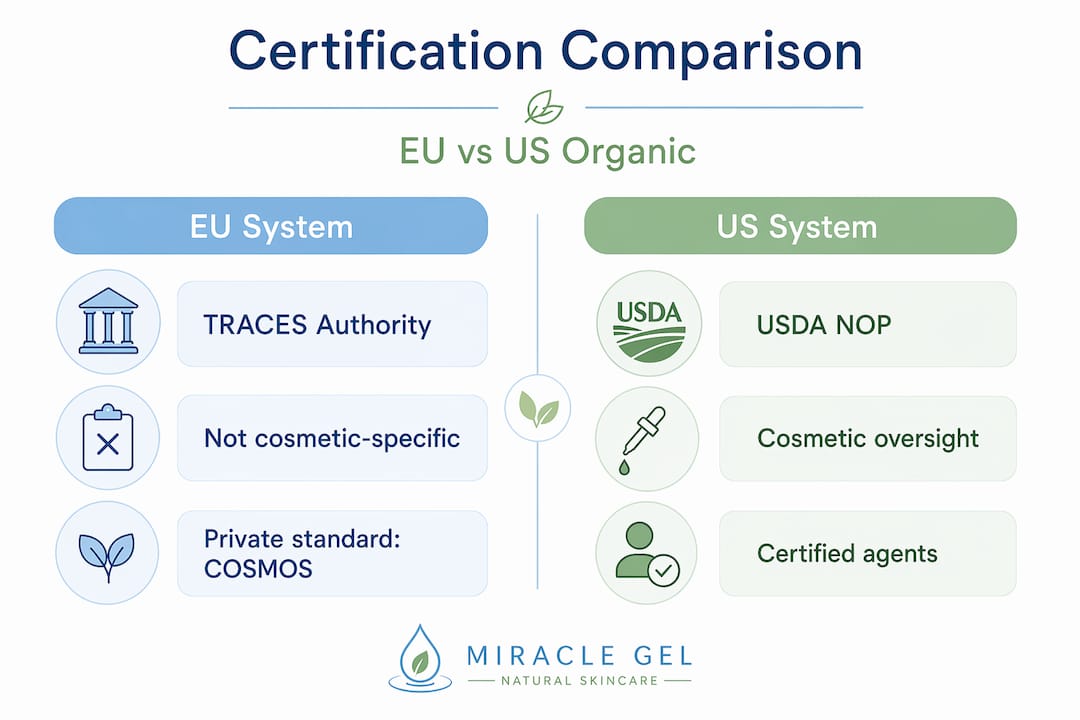
The table makes something very clear: neither system was built for cosmetics as its primary focus. That gap is exactly why the beauty industry developed its own certification standards, which leads us to the most important standard for skincare shoppers.
If you want to understand the full picture of organic skincare benefits for mature skin, or learn how to apply this knowledge when choosing an organic moisturizer after 40, those are smart next steps once you understand the certification framework.
Organic vs natural cosmetic certifications: COSMOS and beyond
Here is the fact that surprises most people: EU food and feed organic law does not cover cosmetics. That means the EU organic leaf logo you see on food packaging cannot legally appear on cosmetics to signal an organic claim. Organic cosmetics fall outside that legislation entirely.
So what does that mean for the “organic” moisturizer sitting in your bathroom cabinet? Without a cosmetics-specific standard behind it, that claim may mean very little.
Enter COSMOS
COSMOS (COSMetic Organic Standard) is the leading international certification standard specifically designed for natural and organic cosmetics. It was created by a coalition of the world’s major natural cosmetics certification bodies to provide a single, unified standard across Europe and beyond.
Here is what COSMOS actually covers:
- Organic agricultural ingredients: These must be produced using organic farming methods.
- Natural ingredients: These must meet strict criteria for origin and processing.
- Manufacturing processes: Only approved processes and ingredients are permitted.
- Packaging: Environmental impact of packaging is assessed.
- Finished product claims: COSMOS certifies both raw materials AND finished products.
The two main COSMOS signatures are COSMOS ORGANIC and COSMOS NATURAL. The COSMOS signature is positioned as a consumer guarantee, requiring certification by approved bodies rather than self-declaration. That word “approved” is doing a lot of work here. It means you cannot simply pay a fee to use the logo. You must pass third-party scrutiny.
| Certification label | Who it covers | Minimum organic content |
|---|---|---|
| COSMOS ORGANIC | Cosmetics with organic ingredients | At least 95% of all agri-ingredients must be organic |
| COSMOS NATURAL | Cosmetics with natural ingredients | No minimum organic content required |
| EU Organic Leaf | Food and feed only | Not applicable to cosmetics |
| USDA Organic | Food; some cosmetics | 95% organic ingredients for full seal |
Pro Tip: When you pick up any skincare product claiming to be organic, look past the word itself and find the certification logo. Then check whether that logo applies to the finished product or just to one or two source ingredients. That single check will tell you more than reading the entire label copy.
Choosing sustainable skincare after 40 also increasingly intersects with COSMOS certification, as many of the environmental standards built into COSMOS align with what sustainability-conscious shoppers want from their routines. The global beauty market continues to grow, and with it comes a flood of new products making natural and organic claims, which makes understanding these distinctions more urgent than ever.
How to spot genuine organic skincare: Consumer checklist
Now that you understand the framework, here is how to apply it in practice. Shopping for certified organic anti-aging skincare does not need to be overwhelming. It just needs to be systematic.
Look for these signals on any product you are considering:
- A recognizable certification logo: COSMOS ORGANIC, COSMOS NATURAL, or USDA Organic are the most credible for skincare.
- A certifying body name: The packaging or website should name the organization that awarded certification, not just say “certified organic.”
- A certificate reference number: Legitimate certified products often carry a code that can be traced back to a certification database.
- Transparent ingredient sourcing: Brands proud of certification will tell you where key ingredients come from.
- An expiration or renewal date on certificates: If a brand cannot confirm their certification is current, treat that as a red flag.
Common pitfalls to avoid:
- “Made with organic ingredients” is not the same as “certified organic.” A product can be made with 1% organic aloe vera and still carry this phrase.
- Vague claims like “natural,” “clean,” or “botanical” carry no certification weight at all without a recognized logo.
- Self-certification is meaningless. Any brand can print “our organic standard” on a label. What counts is external, third-party verification.
Certification for cosmetics is typically handled by private and industry standards like COSMOS rather than EU-wide food law, so shoppers should check which scheme is in use and whether it covers ingredient sourcing alone or the entire finished product. That distinction is more important than most people realize, because a moisturizer could use certified organic shea butter but still contain a range of unchecked synthetic compounds in the rest of the formula.
Pro Tip: Use the EU TRACES database to verify organic operator certificates directly. Go to the public directory, search by brand or product name, and confirm that the certificate reference, activity type, and expiration date are all valid. This takes about two minutes and removes all guesswork.
For a deeper breakdown of how all this connects to everyday choices, the clean beauty guide is an excellent resource for shoppers in their 40s who want to connect certification knowledge to actual product decisions.
Why most “organic” skincare claims are misunderstood
Here is an uncomfortable truth about the organic skincare space: the confusion is not entirely accidental. Certification standards take time, cost money, and require ongoing commitment. For many brands, dropping in a single certified ingredient and calling the product “organic” is easier, cheaper, and still perfectly legal in most markets.
What most consumers do not realize is that not all certification schemes are equal, even among legitimate ones. COSMOS NATURAL and COSMOS ORGANIC sound similar but represent very different commitments to organic ingredient content. A product certified COSMOS NATURAL may contain zero organic ingredients and still carry the certification. That is not fraud. That is simply what the standard covers.
The second misunderstanding is around ingredient-level versus finished-product certification. Many ingredient suppliers hold their own certifications for raw materials, like certified organic argan oil or certified organic rosehip seed oil. A brand can truthfully say those ingredients are certified organic. But if the finished product itself has not been certified, nobody has checked how those ingredients interact with everything else in the formula, how the product was manufactured, or whether the final formulation meets any organic standard.
For consumers over 40, this matters practically. Your skin at this stage is responding to the whole formula, not just one hero ingredient. Choosing products with finished-product COSMOS ORGANIC certification means someone with authority has reviewed the complete picture.
The smartest approach is to treat certifications as your entry filter, not your only filter. Once a product clears the certification test, then look at clinical skincare results and customer evidence to confirm it actually performs. Certification tells you what is in the bottle. Clinical data tells you what that translates to on your skin. You need both.
Ready for certified organic skincare with proven anti-aging results?
Understanding certifications is only the beginning. The real reward is finding products that combine verified organic credentials with genuine, visible results for skin over 40.
At Miracle Gel Natural Skincare, every formulation is built around the principle that clean ingredients and clinical results are not opposites. They work together. Whether you are looking for an anti-aging serum that visibly firms and brightens, or you want to explore clinically proven skincare backed by real-world evidence for women after 40, the range is curated with exactly the transparency you have just learned to demand. Pair your new certification knowledge with our organic skincare workflow to build a complete routine you can trust from first ingredient to finished product. Free shipping on orders over €85 makes it easy to start.
Frequently asked questions
What does it mean if a skincare product has a COSMOS certification?
COSMOS certification means the product has been independently verified by an approved COSMOS body as meeting private industry standards for organic or natural cosmetics, not simply self-claimed by the brand. Look for whether it is COSMOS ORGANIC or COSMOS NATURAL, as each signals a different level of organic ingredient content.
Can I trust the EU organic logo for cosmetics?
No. Organic cosmetics are not covered by EU organic legislation, meaning the EU green leaf logo cannot legally be used on cosmetics. For skincare, look for COSMOS certification instead.
What is the difference between organic and natural certification in skincare?
Organic certification confirms that ingredients were produced using certified organic farming methods, while natural certification confirms naturally derived origins without requiring organic farming. COSMOS authorizes both types via separate COSMOS ORGANIC and COSMOS NATURAL signatures, each with distinct requirements.
Where can I check if an EU skincare product’s organic certification is real?
Search the EU TRACES database for organic operator certificates. The directory shows certificate references, operator names, controlling bodies, product categories, and validity dates so you can confirm any claim directly.
Are USDA Organic skincare products regulated like food?
USDA Organic compliance applies to any product certified under National Organic Program standards by an accredited certifying agent, and the same framework governs both food and eligible skincare products. However, cosmetics are not automatically subject to USDA regulation unless the manufacturer has specifically pursued NOP certification.