

TL;DR:
- Summer can accelerate skin aging after 40 due to UV, humidity, and hormonal changes that cause dullness and fine lines. A targeted routine focusing on gentle cleansing, antioxidant protection, barrier support, and diligent sun protection can improve skin brightness and firmness. Consistent use of natural ingredients and proper layering help mature skin withstand summer challenges and maintain a radiant, youthful appearance.
There’s a particular frustration that hits when warm weather arrives and your skin looks duller, patchier, and somehow older than it did in April. For women over 40 in Ireland, summer isn’t always the season of glowing skin it’s made out to be. Humidity, UV exposure, and shifting hormone levels can all conspire against mature skin, accelerating uneven tone, fine lines, and that telltale loss of luminosity. The good news is that a targeted, natural summer routine can genuinely turn this around. This guide walks you through every step, from the science behind what’s happening to your skin, to a practical morning and evening plan built around real ingredients that deliver real results.
Table of Contents
- Understand your skin’s summer needs after 40
- What you need: Essentials for a summer skin-brightening routine
- Step-by-step: Morning and evening routine for radiant, protected skin
- Troubleshooting: Common mistakes and how to avoid them
- What results to expect and how to track your progress
- The truth most skin experts won’t tell you about summer care after 40
- Feel confident with expert-curated, natural anti-aging routines
- Frequently asked questions
Key Takeaways
| Point | Details |
|---|---|
| Prioritize daily SPF use | Consistent application and reapplication of broad-spectrum SPF 30+ is the most effective summer anti-aging step for mature skin. |
| Choose actives wisely | Incorporate antioxidants like vitamin C by morning, niacinamide for brightening and hydration, and retinoids at night with careful SPF backup. |
| Gentle exfoliation only | Limit exfoliation to 1-2 times per week and never layer with retinoids to prevent dryness or irritation. |
| Hydrate and support barrier | Use lightweight moisturizers and hydrating serums to help maintain skin resilience in summer’s harsher conditions. |
| Track and adjust routine | Monitor your skin’s response and tweak steps for best results; short, consistent routines deliver lasting radiance and protection. |
Understand your skin’s summer needs after 40
Mature skin behaves differently in summer, and knowing why makes all the difference in how you treat it. After 40, your skin produces less sebum (natural oil), its barrier becomes thinner, and cell renewal slows dramatically compared to younger skin. These changes mean moisture evaporates faster, irritants penetrate more easily, and damage accumulates without the same repair speed you had at 25.
Summer compounds every one of these issues. Chronic UV exposure is the primary driver of photoaging in mature skin, causing the kind of cumulative structural and pigment changes that no serum can fully reverse once they’ve set in. Photoaging, which refers to the visible aging caused specifically by UV radiation rather than time alone, encompasses structural and textural changes including loss of collagen density, pigmentation irregularities, and rougher texture. Ireland’s summers may not feel blazing hot, but UV index still climbs significantly from May through August, and UVA rays (which penetrate cloud cover) are present year-round.
Heat and humidity add their own complications. Sweat can disrupt your skin barrier, strip applied products, and create an environment where irritation and breakouts are more likely. For mature skin already working with a compromised barrier, this is a serious issue.
Common myths that damage your skin in summer:
- Higher SPF means you can go longer without reapplying. Not true. SPF measures intensity of protection, not duration.
- You need aggressive exfoliation to remove summer dullness. This actually damages your barrier further.
- Oily-feeling skin doesn’t need moisturizer in summer. Dehydration and oil production are separate issues.
- Ireland’s mild sun isn’t strong enough to cause photoaging. UVA rays don’t care about cloud cover.
| Skin change after 40 | Why it happens | Summer impact |
|---|---|---|
| Thinner skin barrier | Reduced lipid production | Faster moisture loss, more irritation |
| Slower cell turnover | Declining growth factors | Duller, less even complexion |
| Less sebum production | Hormonal shifts | Increased dryness and flaking |
| Reduced collagen density | UV and time | Deeper lines, less firmness |
| More UV sensitivity | Thinner epidermis | Faster pigmentation and burning |
Integrating daily summer skin habits that account for these realities, rather than habits borrowed from your 30s or from general skincare advice, is what makes the real difference. Now that you know why a specific approach is needed, let’s break down what you’ll need for your summer routine.

What you need: Essentials for a summer skin-brightening routine
A summer skin-brightening routine for mature skin doesn’t need to be expensive or complicated. It needs to be strategic. A practical routine for mature skin centers on gentle cleansing, antioxidant brightening with vitamin C, barrier-supporting hydration through niacinamide and hyaluronic acid, and consistent sun protection.
Here’s your core checklist:
- Gentle, sulfate-free cleanser — avoids stripping the already-thinner skin barrier
- Antioxidant serum (vitamin C or botanical alternatives like rosehip or green tea extract) — neutralizes free radicals from UV and pollution
- Niacinamide or hyaluronic acid (HA) serum — niacinamide brightens, boosts elasticity, and reduces fine lines; HA restores surface hydration
- Broad-spectrum SPF 30+ sunscreen — non-negotiable, every morning, regardless of cloud cover
- Lightweight moisturizer — seals active ingredients in without clogging pores in warmer temperatures
- Retinoid (night use only, 2 to 4 times per week) — the gold standard for stimulating collagen and accelerating cell renewal
- Gentle chemical exfoliant (lactic acid or PHA) — used once or twice weekly, never alongside retinoids
Pro Tip: When shopping for SPF, look for formulas that also contain niacinamide. This combination offers protection while simultaneously working to prevent new hyperpigmentation from forming, giving you a double benefit in one step.
| Product type | Multifunctional option | Single-purpose option |
|---|---|---|
| Sunscreen with niacinamide | Prevents UV damage AND brightens | Protects only |
| Vitamin C + SPF combo | Antioxidant defense AND protection | May lack adequate SPF |
| Moisturizer with HA | Hydrates AND plumps fine lines | Basic hydration only |
| Tinted SPF with iron oxides | Protects from UV AND visible light | No visible light defense |
Understanding the natural ingredients for mature skin that actually perform in summer conditions can help you make smarter product choices without trial-and-error frustration. When comparing natural moisturizers for mature skin, prioritize formulas with both hydrating and barrier-supporting ingredients rather than thick, heavy creams that can feel suffocating in summer heat. With your essentials gathered, let’s walk through each step of your summer skincare regimen.
Step-by-step: Morning and evening routine for radiant, protected skin
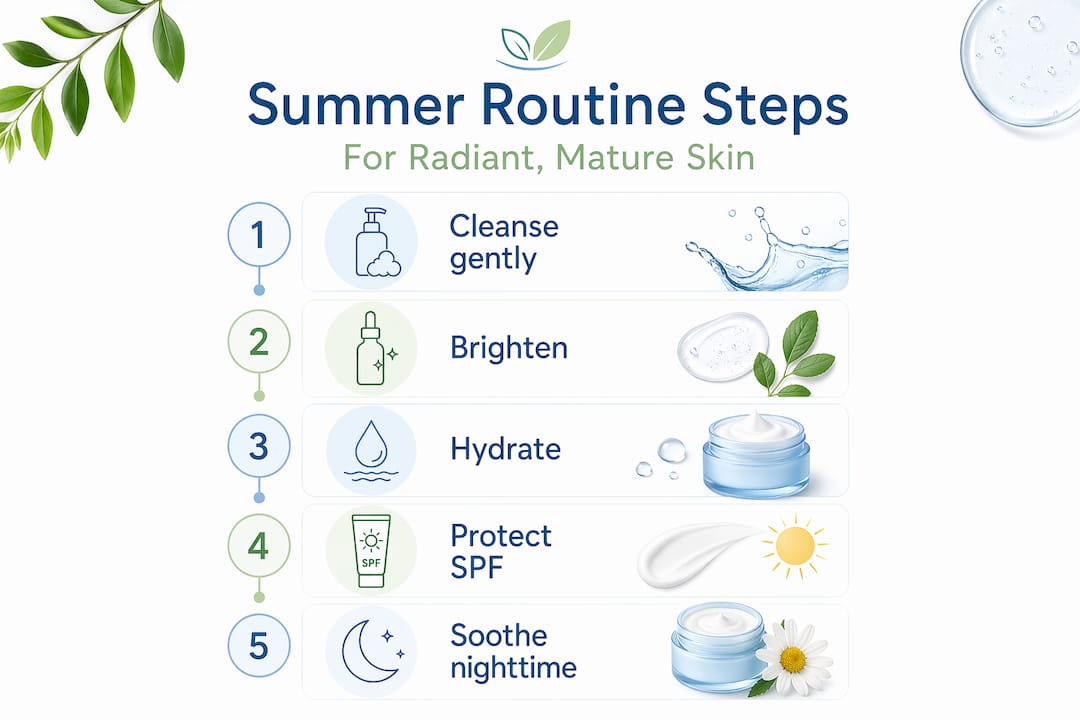
Sequencing matters as much as the products themselves. Applying in the wrong order can reduce the effectiveness of your actives or cause unnecessary irritation.
Morning routine (takes about five minutes):
- Cleanse with a gentle, low-pH cleanser. You don’t need to deep-cleanse in the morning; you’re just removing overnight products and sweat.
- Apply antioxidant serum while skin is slightly damp. Vitamin C serums work best at a slightly acidic pH, so apply before anything else.
- Layer niacinamide or HA serum over the antioxidant serum. These work well together and don’t create any irritation when combined.
- Apply a lightweight moisturizer. In summer, a gel or water-cream formula typically works better than a heavy cream.
- Apply SPF 30+ broad-spectrum sunscreen as your last step. Allow it to sit for a minute before applying makeup. This is not optional. It is the single most important anti-aging step in your entire routine.
During the day:
- Reapply sunscreen every two hours when outdoors. A higher SPF number does not extend the time between applications. It simply means greater intensity of protection within that two-hour window.
- Sweat, swimming, and towel-drying all remove sunscreen from the skin, making reapplication critical even if you applied thoroughly in the morning.
- If reapplying SPF over makeup feels difficult, use a finely milled SPF powder or an SPF setting spray as a top-up.
- Wear a wide-brimmed hat during peak sun hours (11am to 3pm) and choose UPF-rated clothing if you’re spending extended time outdoors.
Pro Tip: Set a phone alarm for SPF reapplication if you tend to lose track of time outdoors. Even Ireland’s overcast summer days carry meaningful UVA exposure.
Evening routine:
- Double cleanse if you wore sunscreen or makeup. Start with a cleansing balm or oil to dissolve SPF, then follow with your gentle cleanser.
- Apply retinoid (2 to 4 nights per week only). If you’re new to retinoids, start with the lowest concentration and use just twice a week.
- On non-retinoid nights, apply niacinamide or a hydrating peptide serum. These actively repair and replenish while you sleep.
- Seal with your moisturizer. Evening is when your skin does most of its repair work, so a slightly richer formula here is appropriate even in summer.
Weekly addition:
- Exfoliate gently once or twice per week using a mild lactic acid or PHA (polyhydroxy acid) product. Never use exfoliation and retinoids on the same evening. The anti-aging routine ingredients that work best for mature skin are those that support renewal without triggering inflammation.
Beyond step-by-step routines, let’s troubleshoot common mistakes and answer top concerns.
Troubleshooting: Common mistakes and how to avoid them
Even with the best products and intentions, certain habits quietly undermine results. Here’s what to watch for:
- Skipping midday SPF reapplication. This is the most widespread error. Many women apply SPF diligently in the morning and then spend three hours outdoors with no protection at all.
- Over-exfoliating. More than twice a week is too much for mature skin in summer. Aggressive resurfacing on already-thinned skin causes inflammation, redness, and can worsen pigmentation.
- Layering retinoids with acids. Combining retinoids with AHAs, BHAs, or vitamin C in the same application significantly increases irritation risk. These products must be kept separate on different nights.
- Underusing antioxidants. A single application of vitamin C serum in the morning provides meaningful protection. Many women skip this step, losing a critical line of defense against UV-induced free radical damage.
- Using sunscreens without added anti-inflammatory actives. Formulas that include niacinamide in their SPF actively help prevent the post-inflammatory hyperpigmentation that can follow sun exposure, insect bites, or minor skin trauma.
“The barrier is not just a passive wall. For mature skin in summer, maintaining and actively supporting that barrier is as important as any brightening treatment you’ll use.” This is the principle that should guide every product decision you make.
Watch your skin closely when you introduce anything new. If you notice tightness, stinging, or increased redness after adding a product, that’s your barrier asking you to slow down. Drop back to basics for a few days before reintroducing. With common pitfalls in mind, see what changes to expect as you apply this routine.
What results to expect and how to track your progress
Realistic expectations protect your investment and your motivation. Skincare results for mature skin accumulate over weeks, not days, and they build on consistency rather than intensity.
What you can realistically expect:
- Brighter, more even complexion within 4 to 6 weeks of consistent antioxidant and niacinamide use
- Reduced surface redness within 2 to 4 weeks of niacinamide application
- Smoother texture within 6 to 8 weeks of regular, gentle exfoliation
- Prevention of new fine lines and pigmentation spots over the full summer season with diligent SPF use
- Niacinamide specifically improves elasticity, reduces fine lines, evens skin tone, and increases moisture retention with consistent use over several weeks
| Concern | Product targeting it | Realistic timeline |
|---|---|---|
| Dullness | Vitamin C, exfoliation | 3 to 5 weeks |
| Uneven tone/pigmentation | Niacinamide, SPF | 6 to 12 weeks |
| Rough texture | PHA exfoliant, retinoid | 6 to 8 weeks |
| Fine lines | Retinoid, peptides | 8 to 16 weeks |
| New sun damage | Prevention via SPF | Ongoing |
Track your progress by taking a consistent photo in natural light every two weeks, always at the same time of day. Note how your skin feels in your journal, not just how it looks. Comfort, suppleness, and reduced tightness are meaningful signals that your routine is working. Explore anti-aging skin tips that help you stay on track through every season. You’ve learned the essentials — now, here’s the real-world perspective that most skincare guides miss.
The truth most skin experts won’t tell you about summer care after 40
Here’s something the viral glow routines and “game-changing” serum launches won’t say out loud: the most powerful anti-aging move you can make this summer is the least exciting one. It’s wearing SPF every single day, supporting your barrier consistently, and resisting the urge to chase correction with harsh actives.
We see it constantly. Women with genuinely beautiful mature skin who get caught up in aggressive chemical peels, trendy retinol concentrations that are too strong, or multi-acid routines that seemed fine at 35 but are creating chronic inflammation at 47. The Irish summer, mild as it is, still delivers enough cumulative UV to accelerate photoaging meaningfully. Real anti-aging results for mature skin come from prevention and slow, barrier-supportive care, not fast-acting exfoliants applied too frequently.
This isn’t a call to do less. It’s a call to do the right things, repeatedly and without skipping. The age-defying skincare approach that works is the one you actually maintain, day after day, even when it feels unremarkable. Consistency beats intensity every time for mature skin. The women who look radiant at 55 and 60 aren’t the ones who did the most aggressive treatments. They’re the ones who showed up for their skin quietly, every morning, with sunscreen and something that nourishes.
Feel confident with expert-curated, natural anti-aging routines
You now have the framework. Putting it into practice with the right products makes all the difference.

At Miracle Gel Natural Skincare, every formula in our range is developed with women over 40 in mind, using gentle, clinically supported natural ingredients that deliver real brightness and protection without irritating mature skin. From our age-defying skincare collection to our targeted anti-aging serums and brightening solutions, everything is designed to work with your skin’s natural rhythm rather than against it. Free shipping is available on orders over €85, and our detailed product guides make it easy to build the right routine for your specific skin concerns this summer.
Frequently asked questions
How often should I reapply sunscreen if I wear makeup?
Reapply sunscreen every two hours outdoors, even over makeup; use a finely milled SPF powder or SPF setting spray for convenient touch-ups without disturbing your look.
Can I use retinoids safely in summer?
Yes, retinoids are safe in summer when applied at night and paired with diligent daily SPF every morning to manage the increased UV sensitivity they can cause.
What’s the best active for brightening mature, summer-prone skin?
Niacinamide is the standout choice, as it brightens, evens tone, and reduces redness without the irritation risk that more aggressive brightening actives carry for mature skin.
Is daily exfoliation safe for mature skin in summer?
No, daily exfoliation is too harsh for mature skin in summer; limit to one or two times per week and never layer exfoliants with retinoids on the same night.
Should I avoid the sun completely?
You don’t need to avoid the sun entirely. Instead, protect consistently with SPF, wide-brimmed hats, and UPF clothing, and limit exposure during peak UV hours between 11am and 3pm.