
If your new product caused burning, stinging, or redness spreading past your usual breakout zones, stop using it now. If you’re seeing small clogged pimples and blackheads in the same spots you always break out, and it’s been less than six weeks, you’re likely purging. Keep it up a bit longer, but watch closely. The checklist below tells you exactly what to track and when patience has run out.
TL;DR:
- Skin purging usually appears within 2 to 6 weeks after starting active ingredients like retinoids or acids, primarily in areas prone to breakouts.
- Irritation occurs rapidly within hours or days and is characterized by burning, redness, swelling, or blistering, often in new or unrelated areas.
- Continuing purging beyond 6 to 8 weeks or if symptoms spread outside usual breakout zones indicates it has likely turned into irritation or another issue.
- Ingredients like retinoids, AHAs, and BHAs are linked to purging, while fragrance, exfoliant overuse, and certain preservatives more often cause irritation.
- Managing reactions involves reducing or pausing actives, emphasizing barrier support, patch testing, and consulting a dermatologist for severe or persistent symptoms.
Table of Contents
- What Is Skin Purging? Mechanism, Appearance, and Timeline
- What Skin Irritation Looks and Feels Like
- Skin Purging vs. Irritation: A Practical Checklist
- Ingredients Behind Purging vs. Ingredients Behind Irritation
- How to Manage a Purge or Irritation Safely
- Choosing Gentle, Barrier-First Products During Adjustment
- A Note on Patience and Not Making It Worse
- A Gentler Way to Get Through the Adjustment Period
- Sources
What Is Skin Purging? Mechanism, Appearance, and Timeline
Purging happens when an active ingredient speeds up skin cell turnover, pushing existing microcomedones (the invisible clogs already forming under your skin) to the surface faster than they’d normally emerge. It’s not detox, whatever the skincare aisle implies. It’s mechanical acceleration of something that was already brewing beneath the surface, and dermatologists are careful to point out that “purging” itself is a colloquial term with limited formal research behind it.
Purging typically shows up as:
- Small whiteheads and blackheads
- Tiny inflamed papules, not deep cystic bumps
- Breakouts concentrated in areas where you already tend to get spots
That last point matters more than people realize. Purging clusters in pre-existing acne-prone areas like the forehead and chin, rather than spreading somewhere new. A useful trick before starting any new active: mentally map your usual breakout zones so you have a baseline to compare against, a method some clinicians call microcomedone mapping.
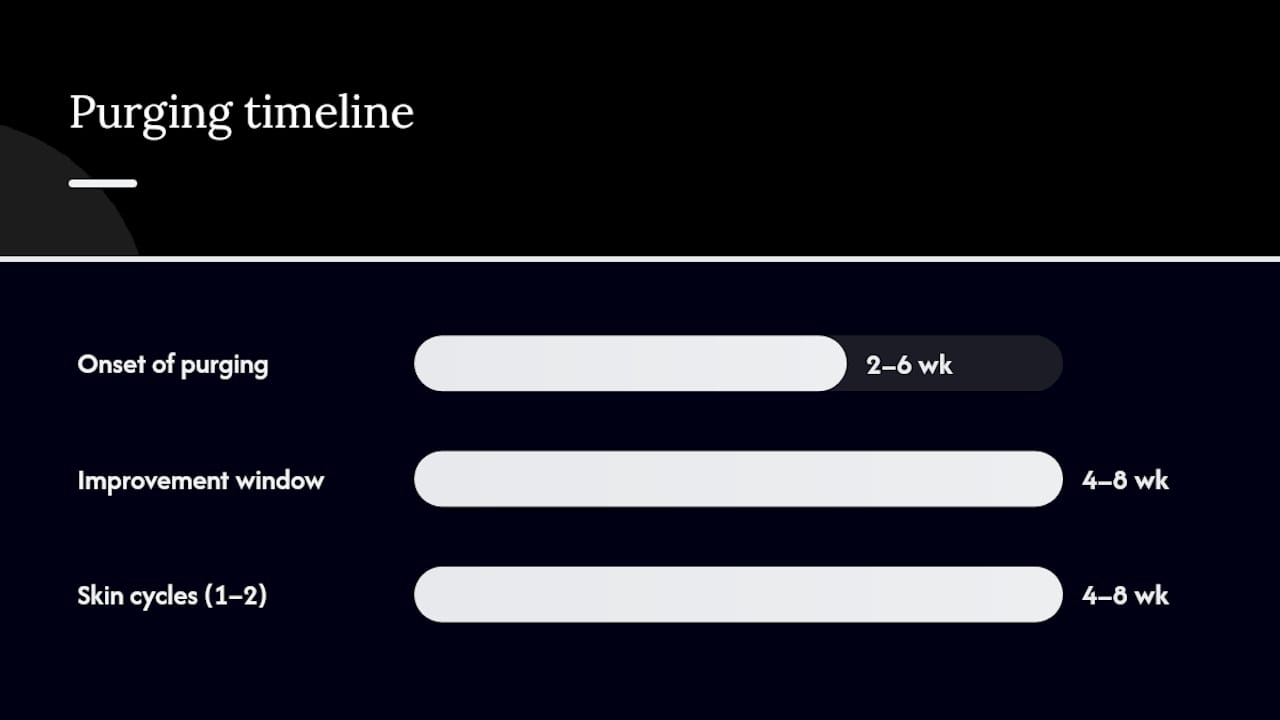
Timeline to expect: most purging appears within 2 to 6 weeks of starting a new retinoid, AHA, or BHA. A common clinical rule of thumb holds that improvement should show within about 4 to 8 weeks, roughly one to two full skin cycles.
What Skin Irritation Looks and Feels Like
Irritation announces itself through sensation, not just appearance. Where purging is mostly quiet, irritation tends to burn, sting, or itch almost immediately after application, and that sensory signature is one of the clearest ways to separate the two.
Watch for these signs of skin irritation:
- Burning or stinging within minutes of applying a product
- Persistent, intense itching that doesn’t fade
- Marked redness that looks angrier than a typical breakout
- Widespread flaking, scaling, or tightness
- Blistering, swelling, or hives (signs of a possible allergic reaction)
Irritation is defined by these sensory and visual markers, a raw, inflamed quality that purging simply doesn’t produce. Irritation also has a habit of showing up in places you never break out. Cheeks, neck, or around the eyes suddenly reacting when they never have before is a strong tell that you’re dealing with contact dermatitis or a straightforward allergic response, not purging.
Pro Tip: If a reaction shows up in a new location within a day or two of using a product, treat it as irritation until proven otherwise. Purging follows your skin’s history; irritation ignores it.
Skin Purging vs. Irritation: A Practical Checklist
Run through these questions in order. Your answers point you toward continuing carefully or stopping altogether.
- When did it start? Purging tends to appear gradually within the first 2 to 6 weeks of a new active. Irritation often shows up within hours to a few days.
- Where is it showing up? Usual breakout zones point to purging. New territory (cheeks, neck, around the mouth) points to irritation.
- What does it feel like? Small bumps with no real sensation lean purging. Burning, stinging, or persistent itch leans irritation.
- How is it changing week to week? Purging should be trending down by the midpoint of that 4 to 8 week window. If it’s holding steady or getting worse, that’s a red flag.
- Is anything severe? Painful cysts, blistering, swelling, or spreading redness means stop immediately and consider seeing a dermatologist.
A rule of thumb worth repeating: purging that hasn’t improved within 6 to 8 weeks, or that spreads beyond your normal breakout areas, probably isn’t purging anymore. At that point you’re either dealing with irritation, an allergic reaction, or a product that simply isn’t right for your skin.
Ingredients Behind Purging vs. Ingredients Behind Irritation
Certain ingredient categories fall reliably on one side of this line or the other, though overlap happens when products are poorly formulated or overused.
Ingredients commonly linked to purging:
- Retinoids (retinol, tretinoin, adapalene)
- AHAs like glycolic and lactic acid
- BHAs like salicylic acid
- Professional-strength peels
Ingredients and formulation choices more often tied to irritation:
- Added fragrance and essential oils
- High-strength actives used at full concentration too soon
- Certain solvents, denatured alcohol, and some preservatives
- Layering multiple exfoliants in the same routine
The real danger zone is combination use. Stacking a retinoid with a strong acid exfoliant, or applying two different chemical exfoliants in the same week, multiplies irritation risk far faster than either ingredient alone would.
How to Manage a Purge or Irritation Safely
Your next move depends entirely on severity, not on which label feels more comforting.
- Triage first. If you see hives, swelling, blistering, or intense burning, stop the product immediately. This isn’t a “wait and see” situation.
- If it’s mild, ease off rather than quit. Reduce frequency (every other night instead of nightly) or drop to a lower strength.
- Simplify everything else. Switch to a gentle cleanser, a ceramide-rich moisturizer, and daily sunscreen. Skip additional exfoliation and resist picking at anything.
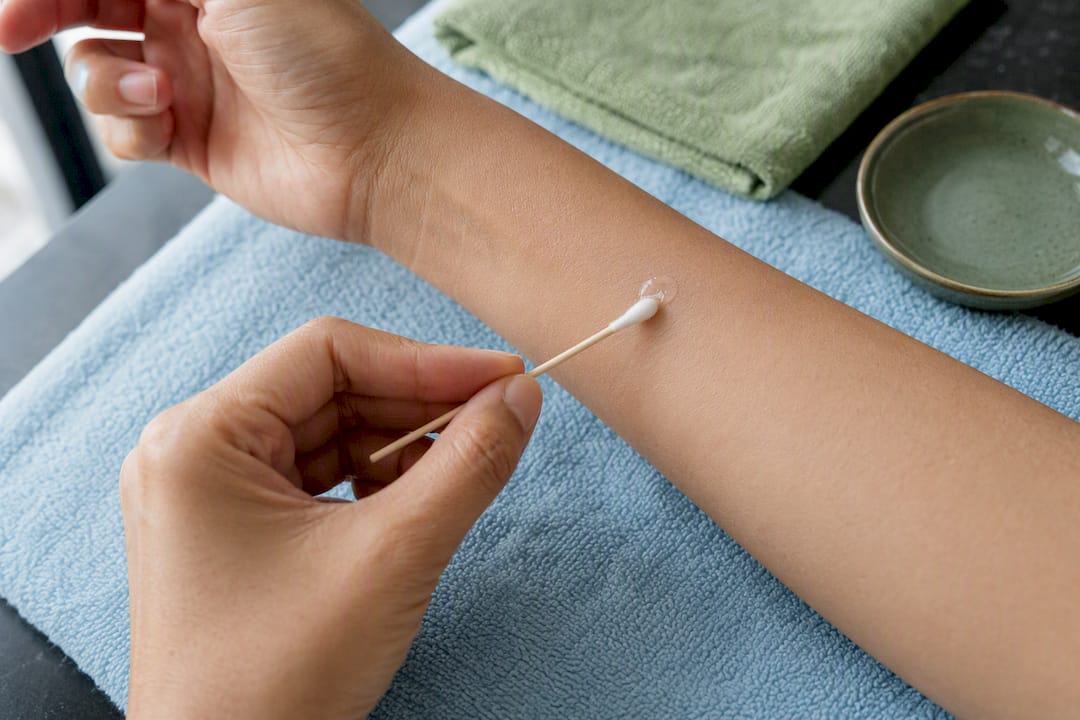
- Patch test before reintroducing. Apply a small amount to your inner forearm or behind the ear for a few days before returning it to your face.
- Reintroduce slowly. Start once a week, then increase gradually only if your skin tolerates it.
- Know when to call a dermatologist. Persistence beyond 6 to 8 weeks, painful cystic lesions, scarring, or signs of an allergic reaction all warrant professional evaluation.
Pro Tip: Over-exfoliating or adding new actives mid-purge is the single most common mistake people make. It rarely speeds recovery and often turns a temporary purge into lasting irritation or post-inflammatory discoloration.
For a structured way to slow things down without giving up on actives entirely, patch testing new products before full use is worth building into your routine permanently, and reviewing what your skin barrier actually does helps explain why gentle support matters during this window.
Choosing Gentle, Barrier-First Products During Adjustment
Skin adjusting to a new active needs support, not more stimulation. That’s the thinking behind Miraclegelnaturalskincare’s formulas: fragrance-free, non-comedogenic, and built around barrier-supportive ingredients rather than aggressive actives layered on top of each other.
If you’re navigating a purge or recovering from irritation, a few practical moves help:
- Choose non-comedogenic, fragrance-free moisturizers while your skin recalibrates
- Favor gentle exfoliant alternatives over daily acids or scrubs during this window
- Follow a barrier-first routine that prioritizes hydration and calm over speed
- Reintroduce actives one at a time, never as a stack
None of this replaces medical advice for severe reactions, but it does reduce the odds of turning a normal adjustment period into a chronic problem.
A Note on Patience and Not Making It Worse
The instinct to fix a bad reaction fast usually backfires. Give your skin its full adjustment window before judging a product. Don’t pick at bumps, don’t pile on more exfoliants hoping to speed things along, and don’t ignore burning or spreading redness because you want a product to work. If something feels wrong beyond mild and temporary, a dermatologist can tell you in one visit what weeks of guessing can’t.
— Barbara
A Gentler Way to Get Through the Adjustment Period
There are other ways to handle a reacting complexion, stronger actives at lower doses, slower ramp-up schedules, or simply toughing it out and hoping it resolves. Miraclegelnaturalskincare takes a different route: formulas built around barrier support first, so your skin has less to fight through while it adjusts.

The natural skincare regimen for radiant, youthful skin is designed for exactly this transition period, gentle enough to use while your skin settles, without asking you to abandon results. If you’re not sure where to start, browse the sensitive-skin safe collection and pick one product to patch test this week before adding it to your routine.
This article is general information, not a substitute for advice from a qualified doctor. Consult a qualified healthcare professional about your own circumstances before acting on anything here.
Sources
- How to Tell If Your Skin Is Purging or Breaking Out – Healthline
- Skin purging: Causes, signs and treatment – WebMD
- Skin purging vs breakout — Medical News Today