

TL;DR:
- Zero-waste skincare brands aim to eliminate waste through sustainable design, packaging, and supply chains. They focus on principles like refuse, reduce, reuse, and recycle, often using concentrated formulas and refillable containers. Choosing genuinely zero-waste products involves checking packaging, ingredients, certifications, and brand ethics for true sustainability.
A zero-waste skincare brand is defined as a company that designs its products, packaging, and supply chain to eliminate or drastically reduce waste at every stage, from production through disposal. This goes well beyond swapping plastic for glass. Genuine zero-waste beauty products follow four core principles: refuse unnecessary materials, reduce what remains, reuse containers through closed-loop systems, and recycle what cannot be avoided. For anyone aged 20–40 who cares about both their skin and the planet, understanding what separates a truly sustainable skincare brand from a greenwashed one is the most practical first step you can take.
The industry term for this category is “zero-waste beauty,” though you will also see it labeled as “package-free,” “circular beauty,” or “eco-conscious skincare.” All of these describe the same commitment: products that leave the smallest possible footprint on the environment. Miraclegelnaturalskincare, which focuses on natural and organic formulations, reflects this broader shift toward ingredient transparency and responsible production that defines the category.
What is a zero-waste skincare brand and its core principles?
Zero-waste skincare practices focus on plastic-free, compostable, recyclable packaging, refillable options, concentrated formulas, and minimal natural ingredients to reduce environmental impact throughout the product lifecycle. These are not marketing preferences. They are operational commitments that change how a brand sources, manufactures, ships, and recovers its products.
The four principles break down into concrete practices:
- Plastic-free packaging. Brands replace single-use plastic with glass, aluminum, bamboo, or paper-based materials that can be composted or recycled through standard municipal programs.
- Compostable and biodegradable materials. Outer packaging, mailers, and inserts break down in home compost bins rather than sitting in landfills for centuries.
- Refillable and reusable containers. Customers return empty containers to be sterilized and refilled, keeping the same vessel in circulation rather than discarding it.
- Closed-loop shipping models. Some brands use reusable shippers that customers send back, which the brand sanitizes and reuses for the next order.
- Concentrated, minimal formulas. Fewer ingredients mean less water, less energy to produce, and less packaging per effective dose.
- Made-to-order or small-batch production. Producing only what is sold prevents overstock waste and reduces the energy cost of storing unsold inventory.
Pro Tip: When you evaluate a brand’s zero-waste claim, check whether it addresses all four principles or only one. A brand that switches to glass jars but still ships in non-recyclable bubble wrap has not closed the loop.
Ingredient sourcing matters as much as packaging. Brands that use biodegradable, naturally derived ingredients reduce the chemical load that enters waterways when products wash off your skin. This is where sustainable skincare and zero-waste beauty overlap most directly.

How do zero-waste products compare to conventional skincare in environmental impact?
The lifecycle difference between a zero-waste product and a conventional one is measurable. Concentrated shampoo bars last 75–90 washes per 3oz bar, replacing about 3 standard liquid shampoo bottles. That single swap eliminates 3 plastic bottles per person per product cycle. Multiply that across a household or a year, and the reduction in plastic waste becomes significant.
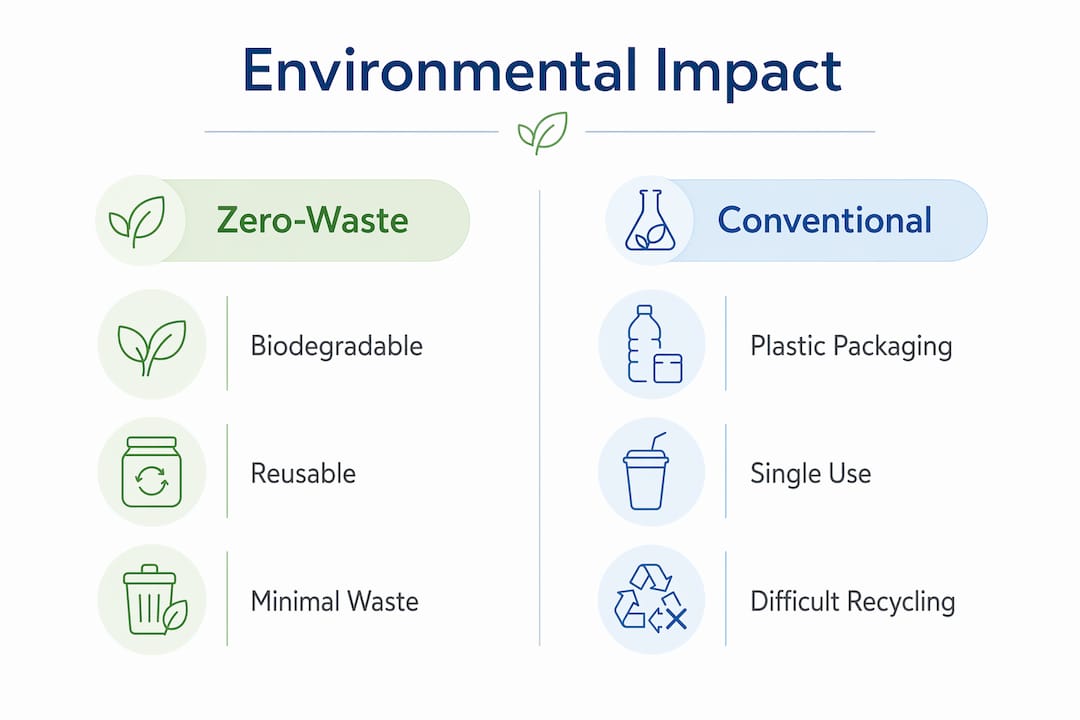
Reusable containers push the math further. Closed-loop reusable shippers can repeat 10,000 or more reuse cycles before they need to be retired. That means one container does the work of 10,000 disposable ones. No recycling program on earth achieves that kind of material efficiency.
| Format | Packaging fate | Reuse potential |
|---|---|---|
| Standard liquid cleanser | Single-use plastic, landfill or recycling | None |
| Solid bar cleanser | Paper or cardboard, compostable | None needed |
| Refillable glass jar | Returned, sterilized, refilled | High, multiple cycles |
| Closed-loop reusable shipper | Returned and reused by brand | 10,000+ cycles |
| Biodegradable compostable tube | Home compost bin | None needed |
Carbon neutral shipping and compostable shipping materials further reduce the environmental cost of getting products to your door. This matters because transportation is one of the largest contributors to a beauty brand’s total carbon output.
“The most effective zero-waste skincare brands do not just change what a product is made of. They redesign the entire system around it, from the farm where ingredients are grown to the bin where the last scrap of packaging ends up.”
Conventional skincare, by contrast, relies on multi-layer plastic packaging that most municipal recycling programs cannot process. Pumps, caps, and mixed-material tubes typically go straight to landfill even when consumers try to recycle them. The gap between intent and outcome is one of the biggest problems in conventional beauty packaging.
How to choose zero-waste skincare brands and products
Choosing a genuinely eco-friendly skincare brand requires more than reading the front label. Here is a practical checklist you can apply to any product before you buy.
- Check the packaging type. Look for materials labeled compostable, home recyclable, or refillable. Avoid vague terms like “eco-friendly packaging” without a specific material claim.
- Read the ingredient list. Shorter lists with recognizable, naturally derived ingredients signal a cleaner formula. Brands that publish full ingredient sourcing data are more transparent than those that do not.
- Look for refill or return programs. Genuine zero-waste brands offer refill pouches, in-store return bins, or mail-back programs. If a brand has no recovery system, it is not truly closed-loop.
- Verify certifications. Cruelty-free certification from Leaping Bunny, vegan certification, and organic certification from bodies like COSMOS or USDA Organic are independently verified. Self-declared claims are not.
- Assess shipping materials. Outer packaging should be paper-based, compostable, or reusable. Polystyrene peanuts and plastic bubble wrap contradict a zero-waste commitment.
- Research brand ethics. Brands that publish annual sustainability reports or carbon offset disclosures are held to a higher standard of accountability than those that do not.
Pro Tip: Search for a brand’s packaging claims on third-party databases like the How2Recycle label program or check whether their compostable claims meet ASTM D6400 or EN 13432 standards. These are the two most recognized international standards for compostable materials.
Ethical beauty practices and zero-waste commitments often go hand in hand. Brands that care about packaging waste tend to care about ingredient sourcing, labor practices, and animal welfare as well. When you find one area of genuine commitment, the others usually follow.
What are the most popular zero-waste skincare product formats?
Zero-waste beauty products come in formats that are often more effective per use than their conventional counterparts, not just better for the environment.
- Solid shampoo and conditioner bars. Solid bars eliminate plastic packaging entirely while delivering the same cleansing and conditioning performance as liquid products. They are also more concentrated, so a small bar lasts longer than a full-size bottle.
- Reusable brow gels and color cosmetics. Zero-waste brow gels use all-natural, ethically sourced ingredients in reusable, refillable packaging to minimize carbon footprint and plastic pollution. The container is designed to be returned and refilled rather than discarded.
- Biodegradable lip stains. Plastic-free vegan lip stains use mineral pigments and natural oils, packaged in 100% biodegradable, compostable containers. The entire product, formula and packaging, breaks down without leaving toxic residue.
- Facial oils and serums in glass droppers. Glass is infinitely recyclable and does not leach chemicals into the formula. Dropper bottles also reduce product waste by dispensing only what you need.
- Powder and waterless formulas. Removing water from a formula reduces weight, shipping emissions, and the need for preservatives. Powder cleansers and waterless moisturizers represent one of the fastest-growing segments in zero-waste beauty.
| Product format | Key environmental benefit | Packaging type |
|---|---|---|
| Solid shampoo bar | Replaces 3 plastic bottles per bar | Paper or cardboard |
| Refillable brow gel | 10,000+ reuse cycles per container | Reusable glass or metal |
| Biodegradable lip stain | Home compostable, zero plastic | Compostable tube |
| Glass dropper serum | Infinitely recyclable, no chemical leach | Glass and metal |
| Waterless powder cleanser | Reduced shipping weight and emissions | Paper sachet or tin |
Exploring green beauty product formats gives you a clearer picture of how wide the category has become. There is now a zero-waste alternative for almost every step in a standard skincare routine.
Key Takeaways
A zero-waste skincare brand is defined by its commitment to eliminating waste across packaging, ingredients, and supply chain, not just by swapping one material for another.
| Point | Details |
|---|---|
| Definition matters | Zero-waste brands address refuse, reduce, reuse, and recycle across the full product lifecycle. |
| Closed-loop systems win | Reusable containers can repeat 10,000+ cycles, far outperforming recycling programs. |
| Solid formats deliver more | A 3oz shampoo bar replaces 3 plastic bottles and lasts 75–90 washes. |
| Certifications verify claims | Look for COSMOS, USDA Organic, Leaping Bunny, or ASTM D6400 compostable standards. |
| Ingredient transparency counts | Short, naturally derived ingredient lists reduce chemical waste in waterways. |
What I’ve learned from years of watching the zero-waste beauty space
The most common mistake I see is treating zero-waste skincare as an all-or-nothing commitment. People read about closed-loop shipping and 10,000-cycle reusable containers and immediately feel like their current routine is a failure. It is not. The most effective transition is gradual and deliberate.
Start with one product swap. Replace the item you finish fastest, usually a cleanser or shampoo, with a solid bar or a refillable option. That single change removes several plastic bottles from your waste stream per year without requiring you to overhaul everything at once.
The second thing I have noticed is that people underestimate how much ingredient quality matters in this space. A product with a short, naturally derived ingredient list is not just better for the environment. It is often gentler on your skin. Fewer synthetic preservatives, fewer fillers, and fewer harsh surfactants mean less irritation, especially for people with sensitive or mature skin. The overlap between eco-friendly skincare for women 40+ and zero-waste beauty is real and growing.
The brands worth your loyalty are the ones that publish their sustainability data openly, offer a genuine recovery or refill program, and do not hide behind vague “green” language. Those brands exist. You just have to know what to look for.
— Barbara
Natural skincare that aligns with your values
Miraclegelnaturalskincare was built around the belief that effective skincare does not require harsh chemicals or excessive packaging. The brand’s focus on natural, organic formulations, including the 2 Minute Miracle Gel with its Tri-Moisture Cryo Complex™, reflects the same ingredient transparency that defines the best zero-waste beauty products.
If you are ready to build a routine that works with your skin and your values, the natural skincare collection at Miraclegelnaturalskincare offers age-defying options formulated without unnecessary fillers. For a deeper look at building a complete routine, the natural skincare regimen guide walks you through every step with products designed for real results.
FAQ
What is a zero-waste skincare brand?
A zero-waste skincare brand designs its products, packaging, and supply chain to eliminate or drastically reduce waste at every stage. It follows four core principles: refuse, reduce, reuse, and recycle.
How do solid shampoo bars reduce plastic waste?
A standard 3oz shampoo bar lasts 75–90 washes and replaces about 3 plastic shampoo bottles. That makes it one of the most efficient single swaps in a zero-waste beauty routine.
What certifications should I look for in zero-waste skincare?
Look for COSMOS or USDA Organic for ingredients, Leaping Bunny for cruelty-free status, and ASTM D6400 or EN 13432 for compostable packaging claims. These are independently verified standards, not self-declared labels.
What is a closed-loop reuse system in skincare?
A closed-loop system means the brand takes back empty containers, sterilizes them, and refills them for the next customer. Some systems support 10,000 or more reuse cycles per container, which eliminates the need for recycling entirely.
Are zero-waste skincare products as effective as conventional ones?
Yes. Concentrated solid bars, glass dropper serums, and waterless formulas often deliver more active ingredients per use than diluted liquid products. Removing water and fillers from a formula frequently improves both performance and shelf life.