
TL;DR:
- Sensitive skin often manifests as burning, stinging, or itching without visible signs, challenging proper diagnosis. It results mainly from a weakened skin barrier caused by age, environmental factors, and irritants like fragrance and harsh cleansers. Managing it requires consistent, gentle routines focused on barrier repair, avoiding triggers, and using minimal, supportive products.
If you’ve ever applied a new moisturizer and felt an immediate sting, or walked into cold air and ended up with tight, burning skin, you already know what sensitive skin feels like. But here’s what most people get wrong: what is sensitive skin, exactly? Many assume it always looks red or visibly irritated. The reality is that sensitive skin often manifests only as burning, stinging, or itching with zero visible signs, which makes it one of the most misunderstood skin types, especially for adults navigating the changes that come with age.
Table of Contents
- Key takeaways
- What is sensitive skin: definition, symptoms, and who it affects
- Causes and triggers: what makes skin become sensitive
- The skin barrier: why it is the foundation of everything
- Practical tips for managing sensitive skin after 30
- When sensitivity signals something more serious
- My take on what most people get wrong about sensitive skin
- Natural, gentle skincare built for sensitive, mature skin
- FAQ
Key takeaways
| Point | Details |
|---|---|
| Sensitive skin is a syndrome | It is defined by unpleasant sensations triggered by stimuli that most skin tolerates without reaction. |
| Symptoms are often invisible | Burning, stinging, and itching can occur without any visible redness or lesions. |
| Your skin barrier is central | A weakened barrier is the most common mechanism behind sensitivity, especially in adults 30 and above. |
| Triggers are multi-factorial | Fragrance, harsh surfactants, UV exposure, pollution, and frequent product switching all worsen sensitivity. |
| Consistency beats quick fixes | A simple, gentle routine maintained over time outperforms aggressive treatments and constant product changes. |
What is sensitive skin: definition, symptoms, and who it affects
The sensitive skin definition used by dermatologists describes it as a syndrome of unpleasant sensations, including stinging, burning, pain, itching, and tingling, triggered by stimuli that would not normally provoke such responses. It is not a disease. It is a symptom pattern, and that distinction matters because it means there is no single test that confirms it. Diagnosis relies heavily on what you report feeling.
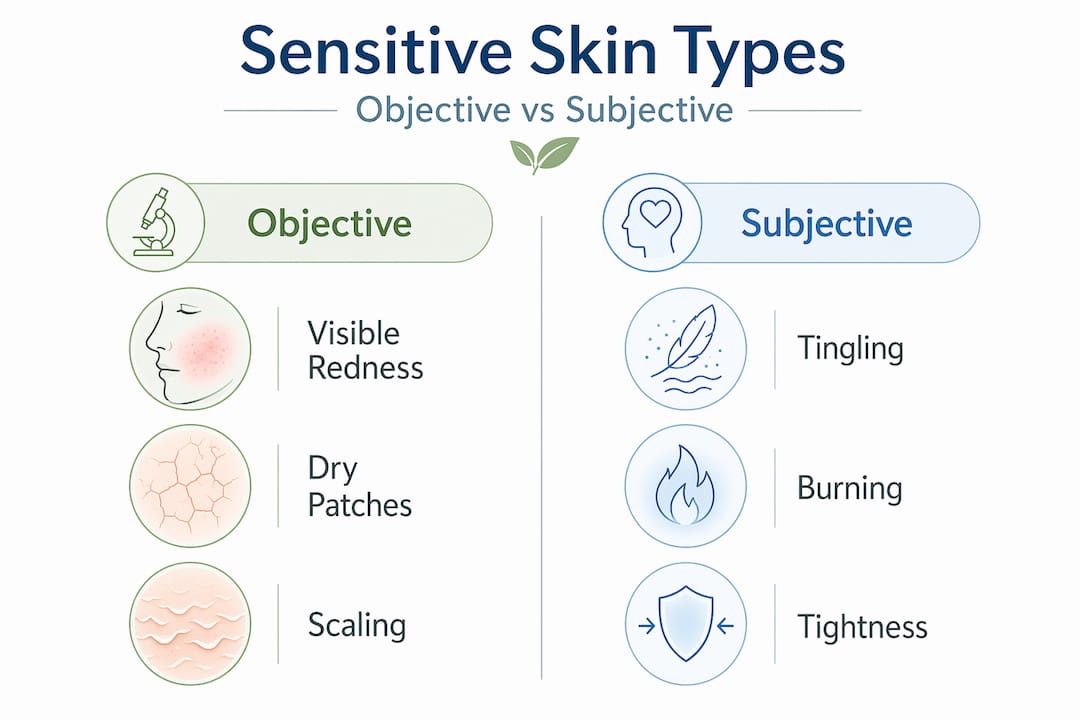
Sensitive skin shows up in two distinct forms:
- Objective sensitive skin: Visible clinical signs are present. These include redness, discoloration, small bumps, or swelling that a clinician can observe.
- Subjective sensitive skin: Unpleasant sensations occur without visible changes. You feel burning or itching, but your skin looks completely normal to anyone else.
The subjective form is far more common and far more frequently dismissed. People are told their skin looks fine, so they assume nothing is wrong. But the discomfort is real, and it needs to be addressed.
Here is a quick comparison of how objective and subjective sensitive skin differ:
| Feature | Objective sensitive skin | Subjective sensitive skin |
|---|---|---|
| Visible signs | Yes (redness, bumps, swelling) | No visible changes |
| Symptoms felt | Yes | Yes |
| Diagnosable by observation | Yes | No, requires patient reporting |
| Common triggers | Allergens, irritants | Products, temperature, stress |
Age is a significant factor. Adults over 50 tend to experience greater skin sensitivity because the skin becomes thinner and drier over time, reducing its tolerance to environmental and product-related stressors. If you are in your 30s or 40s and noticing your skin is less forgiving than it used to be, this is not your imagination. It is a real physiological shift.
Causes and triggers: what makes skin become sensitive
Understanding what causes sensitive skin helps you stop blaming yourself for reactions that are rooted in biology, not carelessness. The causes fall into two categories: internal and external.
Internal causes include genetic predisposition, meaning some people are simply born with a thinner or more reactive skin barrier. Hormonal changes, particularly during perimenopause and menopause, also shift skin behavior significantly. Aging itself changes the skin’s structure, with reduced lipid production and slower cell turnover making the barrier less effective at keeping irritants out.
External causes are where most people have the most control. The most common irritants include:
- Fragrance (the number one cause of cosmetic reactions)
- Alcohol-based toners and astringents
- Harsh sulfate-based cleansers
- UV radiation and heat exposure
- Pollution and cold, dry air
- Frequent product switching
That last point deserves more attention than it gets. Common triggers include fragrance, alcohol, harsh surfactants, and frequent product changes that disrupt the skin barrier. Every time you introduce a new product, your skin has to adapt. Do that too often, and the barrier never gets a chance to recover.
Dry skin and sensitive skin often travel together, but they are not the same condition. Dry skin presents with visible dryness and flaking, while sensitive skin involves unpleasant sensations that can occur even on oily or combination skin. You can have oily skin and still experience burning and stinging from certain products.
Pro Tip: Keep a simple skin diary for two weeks. Write down what products you used, the weather conditions, and any symptoms you felt. Patterns emerge faster than you expect, and you will quickly identify your personal triggers.
Many adults also find that their skin worsens in dry or cold climates and after using specific cosmetic products, which confirms how both environment and product choices compound sensitivity.
The skin barrier: why it is the foundation of everything
Think of your skin barrier as a brick wall. The skin cells are the bricks, and the lipids, ceramides, and fatty acids between them are the mortar. When that mortar breaks down, the wall develops gaps. Irritants get in. Moisture gets out. The result is the burning, tightness, and reactivity that define sensitive skin.
Disruption to the skin barrier leads to dryness, irritation, and inflammation, and evidence supports that gentle cleansing combined with consistent moisturizing is the most effective approach to repairing it. This is not a complex prescription. It is the kind of unglamorous, consistent care that actually works.

Here is how aging and environment impact barrier function:
| Factor | Effect on skin barrier | Result for sensitivity |
|---|---|---|
| Aging (30+) | Reduced ceramide and lipid production | Increased dryness and irritant penetration |
| UV radiation | Degrades structural proteins | Heightened redness and stinging |
| Harsh cleansers | Strips natural oils | Prolonged barrier disruption |
| Cold and dry weather | Dehydrates the outer skin layer | Tightness, flaking, and itching |
When barrier function is compromised, even water can cause a stinging sensation. This is not an exaggeration. Many people with impaired barrier integrity report that plain water on the face triggers discomfort. If that resonates with you, barrier repair should be your first priority, not an afterthought.
Pro Tip: Look for products that list ceramides, niacinamide, or hyaluronic acid early in the ingredient list. These are evidence-supported barrier-restoring ingredients, and they work best when paired with a simple, fragrance-free routine.
Check out the evidence-backed steps for glowing skin that Miraclegelnaturalskincare recommends for adults navigating barrier repair alongside aging concerns.
Practical tips for managing sensitive skin after 30
Managing sensitive skin is less about finding the perfect product and more about building the right habits. Here is what actually makes a difference for adults in their 30s, 40s, and beyond.
Build a shorter routine, not a longer one. Every product you add is another potential trigger. A good sensitive skin routine needs three things: a gentle cleanser, a barrier-supportive moisturizer, and a mineral sunscreen. Everything else is optional. Read about gentle cleansing for mature skin to understand why cleanser choice matters more than people realize.
Choose fragrance-free formulations, always. Fragrance is the most common cause of cosmetic reactions, and it hides under many names including “parfum,” “essential oils,” and “natural fragrance.” None of these are safe assumptions for sensitive skin.
Use mineral sunscreens, not chemical ones. UV and heat increase redness and irritation in reactive skin, and mineral-based sunscreens containing zinc oxide or titanium dioxide sit on top of the skin rather than absorbing into it. This makes them far less likely to trigger stinging or burning.
Additional habits that protect sensitive skin:
- Apply moisturizer within two minutes of washing your face while skin is still slightly damp to lock in hydration
- Wear a scarf or balaclava in cold, windy weather to physically protect facial skin
- Avoid touching your face repeatedly throughout the day
- Wash pillowcases weekly since accumulated product residue and oils can trigger overnight flare-ups
- Introduce new products one at a time, waiting at least two weeks between additions
Dermatologists also note that sensitive skin affects the body beyond the face. Your neck, chest, and hands need the same thoughtful care, especially as skin thins with age. Many people invest in their facial routine while ignoring their body, then wonder why they experience itching or irritation elsewhere.
For a fuller approach, the natural skincare tips for women 40+ from Miraclegelnaturalskincare offer guidance on how to adapt your routine as your skin’s needs evolve.
When sensitivity signals something more serious
Sensitive skin is not a formal diagnosis. It is a pattern of symptoms that can be self-managed in many cases. But sometimes, those symptoms are pointing to an underlying condition that requires medical attention. Here is how to tell the difference:
- Persistent redness with visible broken capillaries may indicate rosacea, a chronic condition that benefits from specific prescription treatments and a managed lifestyle.
- Intensely itchy patches with thickened or scaly skin may signal eczema or psoriasis, both of which require a dermatologist’s input for safe management.
- Reactions that occur only after contact with specific materials such as metals, rubber, or certain fabrics point toward contact dermatitis, which is an allergic reaction requiring identification and avoidance of the allergen.
- Symptoms that worsen despite consistent gentle care suggest something beyond product sensitivity, and blood work or patch testing may be needed to identify the cause.
A dermatologist can perform patch testing, review your product history, and rule out underlying skin diseases. If your sensitivity is disrupting your daily life or causing significant emotional distress, that level of impact alone is a reason to seek professional guidance.
My take on what most people get wrong about sensitive skin
I’ve spent a lot of time paying attention to how people talk about their skin, and the biggest mistake I keep seeing is this: people wait for redness before they take their discomfort seriously. If your skin stings after washing, pulls throughout the day, or burns when you apply something new, that matters. The absence of visible redness does not mean your skin is fine.
What I’ve also learned is that sensitive skin in adults over 30 is often a barrier problem first and a product problem second. People chase solutions with more products when the real fix is fewer, better chosen ones. I’ve seen skin transform when someone goes from a ten-step routine to three thoughtful steps and actually sticks with them.
There is also an emotional weight to this that rarely gets mentioned. Living with skin that reacts unpredictably to the world around it is exhausting. It makes you hesitant to try new things, worried about social situations, and frustrated by advice that doesn’t account for your skin’s actual behavior. That frustration is valid, and the answer is not to push through with more aggressive treatments. It is to slow down, simplify, and give your barrier the consistency it needs to recover.
Skin barrier health is not a trend. It is the foundation. Everything else, the serums, the actives, the treatments, only works when the barrier is stable enough to tolerate them.
— Barbara
Natural, gentle skincare built for sensitive, mature skin

If you’ve recognized your skin in this article, the next step is finding products that are actually formulated with your needs in mind. Miraclegelnaturalskincare is built around exactly that: effective, gentle, natural formulations that support barrier health without relying on harsh chemicals, synthetic fragrances, or aggressive actives. The product range includes cleansers, moisturizers, eye serums, and body products that work for reactive, aging skin.
Explore the full collection of natural skincare for 40+ to find formulations designed with sensitive, mature skin as the starting point, not an afterthought. If you want to go deeper, the sensitive skin safe products archive lets you filter specifically for options that avoid common irritants. Every formulation reflects a commitment to clinically supported results delivered through ingredients your skin can actually trust.
FAQ
What is sensitive skin exactly?
Sensitive skin is a syndrome characterized by unpleasant sensations such as stinging, burning, itching, and tingling in response to stimuli that would not normally cause reactions. It can appear with or without visible signs like redness, making it difficult to identify without paying attention to how your skin feels.
How do I know if I have sensitive skin?
You likely have sensitive skin if you regularly experience burning, tightness, or stinging after applying products, washing your face, or exposure to weather changes. Keeping a two-week symptom diary tracking products and conditions can help confirm patterns and identify triggers.
What causes sensitive skin to get worse with age?
As skin ages past 30, it produces fewer ceramides and lipids, which weakens the protective skin barrier. This makes it easier for irritants to penetrate and harder for skin to retain moisture, both of which increase sensitivity and reactivity to products and environmental factors.
What is sensitive skin care focused on?
Sensitive skin care centers on supporting the skin barrier with gentle, fragrance-free, minimal-ingredient routines. The goal is to reduce triggers, restore barrier integrity with ceramide and moisture-rich products, and use mineral sunscreens daily to protect against UV-related irritation.
Can sensitive skin be cured?
Sensitive skin cannot be permanently cured, but it can be effectively managed. Consistent use of gentle, barrier-supporting products and avoidance of known triggers significantly reduces the frequency and severity of reactions for most adults.