
TL;DR:
- Choosing anti-aging creams requires understanding your specific skin concerns such as wrinkles, dryness, or pigmentation to select ingredients that address those issues effectively.
- Key actives like retinol, hyaluronic acid, vitamin C, peptides, and niacinamide provide proven benefits, but their efficacy depends on proper formulation, concentration, and consistent use over weeks.
The shelves and screens are flooded with anti-aging creams that promise everything from erasing deep wrinkles overnight to reversing a decade of sun damage by Tuesday. For women over 40 in Ireland and the UK, figuring out how to choose anti-aging creams that actually deliver, without loading your skin with harsh chemicals, is genuinely confusing. The claims are loud, the ingredient lists are long, and the price tags vary wildly. This guide cuts through all of that. You’ll learn what your skin actually needs at this stage, which ingredients are worth your money, and how to build a routine that works.
Table of Contents
- Understanding your skin and anti-aging needs
- Key ingredients to look for in anti-aging creams
- Evaluating product claims and ingredient effectiveness
- Building an effective anti-aging skincare routine
- Monitoring progress and managing expectations
- Rethinking anti-aging creams: Beyond hype and quick fixes
- Explore natural skincare solutions for women over 40
- Frequently asked questions
Key Takeaways
| Point | Details |
|---|---|
| Know your skin needs | Identify your dominant aging concerns like dryness or wrinkles to choose the right cream. |
| Focus on key ingredients | Select products with retinol, peptides, vitamin C, and hyaluronic acid for proven benefits. |
| Manage expectations | Visible improvements take weeks of consistent use; no cream works instantly or miraculously. |
| Build a proper routine | Apply skincare in the correct order and introduce actives gradually to minimize irritation. |
| Use daily sun protection | Broad-spectrum SPF 50 every morning is crucial to protect skin and preserve your anti-aging results. |
Understanding your skin and anti-aging needs
Before you can make a smart anti-aging cream selection, you need to know what problem you’re actually trying to solve. This sounds obvious, but most women over 40 reach for a product labeled “anti-aging” without asking whether it addresses their specific concern. The result? A collection of expensive jars that do a little of everything and a lot of nothing.
Aging skin doesn’t follow a single script. Some women in their 40s are dealing primarily with dryness and a dull, tired complexion. Others notice deeper expression lines around the eyes and mouth. Some are managing uneven pigmentation from years of sun exposure, while others find their skin has become reactive and sensitive in ways it never was before.
Here are the most common concerns to identify before you shop:
- Deep lines and wrinkles: Usually around the eyes, mouth, and forehead. These need collagen-supporting ingredients and consistent treatment.
- Loss of firmness and elasticity: Skin that feels looser or less “bouncy.” Look for peptides and ingredients that support skin structure.
- Dryness and dullness: A compromised moisture barrier is extremely common after 40. Hydration-focused formulas with barrier-repair ingredients are your foundation.
- Uneven skin tone and dark spots: Often driven by UV exposure accumulated over decades. Vitamin C, niacinamide, and exfoliating actives help here.
- Sensitivity and redness: Reactive skin needs gentle, fragrance-free formulas above everything else.
As choosing anti-aging products should address your most relevant skin concern right now, whether that’s dryness, wrinkles, or uneven tone, starting with that clarity shapes every decision that follows. You’ll avoid wasting money on the wrong actives and reduce the chance of irritating your skin with ingredients you don’t yet need.
For deeper reading on what mature skin specifically responds well to, this guide on natural ingredient guidance for mature skin is a solid starting point.
Now that you recognize the importance of tailoring your skincare to your personal aging concerns, let’s examine what key ingredients to look for in effective creams.
Key ingredients to look for in anti-aging creams
Not all actives are equal, and not all of them suit every skin type. Knowing what each ingredient does, and what it costs your skin in terms of tolerance, helps you make smarter choices rather than just following whatever’s trending.
The ingredients with the strongest clinical support include:
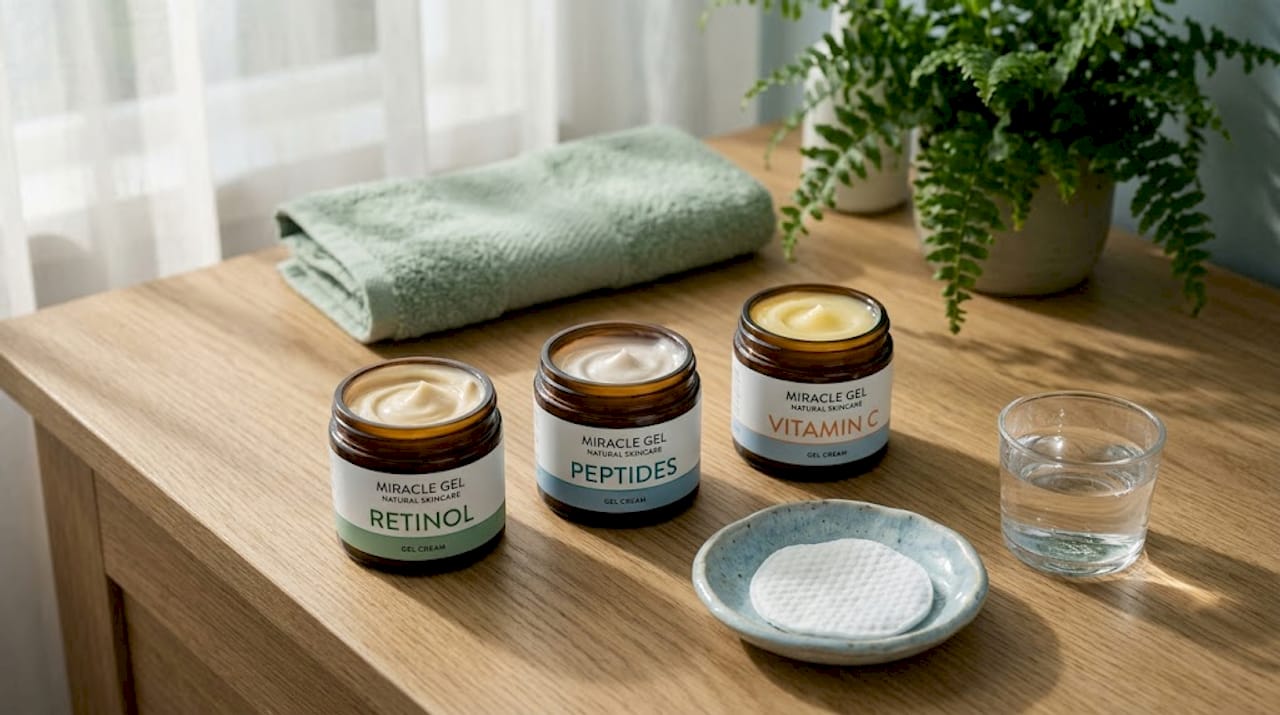
- Retinol and retinoids: The gold standard for cell turnover and collagen production. They work, but they need a gradual introduction. Start two nights a week and build up slowly.
- Hyaluronic acid: Draws moisture into the skin and visibly plumps fine lines caused by dehydration. Lightweight and well-tolerated by almost all skin types.
- Vitamin C: A potent antioxidant that brightens skin and defends against environmental damage. Stability matters here; look for formulas in opaque, airtight packaging.
- Peptides: Short chains of amino acids that signal the skin to produce more collagen. Gentler than retinoids and excellent for building long-term resilience.
- Niacinamide: Regulates oil, reduces redness, and improves the appearance of pores and pigmentation. One of the most versatile and forgiving ingredients on the market.
As retinol, peptides, hyaluronic acid, and vitamin C each target different signs of aging, from collagen loss to dehydration to environmental damage, combining them thoughtfully is where the real results come from.
For women who prefer a fully natural approach, bakuchiol is worth knowing. It’s a plant-derived ingredient extracted from the Psoralea corylifolia plant, and as bakuchiol functions as a gentler alternative to retinol, safe for sensitive skin and during pregnancy, it fills a real gap for women whose skin doesn’t tolerate retinoids well.
Here’s a quick comparison to help with your anti-aging cream selection:
| Ingredient | Primary benefit | Skin type suitability | Speed of results |
|---|---|---|---|
| Retinol | Cell turnover, collagen | Most, with gradual intro | 8 to 12 weeks |
| Bakuchiol | Collagen, anti-inflammatory | All, including sensitive | 8 to 12 weeks |
| Hyaluronic acid | Deep hydration | All | 1 to 2 weeks |
| Vitamin C | Brightening, antioxidant | Most, avoid if reactive | 4 to 8 weeks |
| Peptides | Firmness, resilience | All | 6 to 12 weeks |
| Niacinamide | Tone, pore appearance | All, great for sensitive | 4 to 8 weeks |
Pro Tip: If you’re new to active ingredients, start with just one or two. Layering multiple actives too soon is the fastest way to trigger irritation and make it impossible to identify which product caused the problem. Introduce one new product every three to four weeks.
For a broader breakdown of what each natural active actually does at the molecular level, this guide on key natural ingredients for anti-aging goes deep.
With an understanding of key ingredients, the next step is to learn how to evaluate product claims and ingredient strengths realistically.
Evaluating product claims and ingredient effectiveness
Marketing language on skincare products is designed to excite, not inform. Phrases like “visibly lifts in 10 seconds” or “clinically proven to reduce wrinkles by 80%” sound impressive but often rely on tiny studies, subjective measurements, or conditions you’ll never replicate at home. Learning to read between the lines is one of the most useful skills you can build as a skincare consumer.
Key things to understand about how over-the-counter products work:
- Concentration matters: OTC wrinkle creams contain lower concentrations of active ingredients than prescription products, results typically require at least six weeks of consistent use, and a higher price tag does not guarantee better performance.
- Ingredient order signals concentration: Ingredients are listed from highest to lowest concentration. If your key active appears near the bottom of a long list, you’re getting very little of it.
- “Clinically tested” is not the same as “clinically proven”: Tested means a study was done. Proven means the study demonstrated a statistically significant result. The distinction matters.
In independent lab testing, top-performing creams reduced wrinkle depth by up to 25% after 28 days of use, with no product delivering a miracle transformation.
That 25% figure sounds significant, but in practice, it represents a gradual, modest visible improvement, not a before-and-after advertisement result. And importantly, EU and UK cosmetic anti-aging claims must be truthful and not misleading under Regulation (EC) No 1223/2009, which does give consumers in Ireland and the UK some protection against the most egregious claims.
Pro Tip: Search for the brand’s published clinical data. A trustworthy brand will tell you the study size, duration, and measurement method. A brand hiding behind “up to” and vague percentages is telling you something important about its confidence in the product.
To see what clinically backed results look like in practice, this resource on clinical anti-aging results for 40+ offers useful real-world context.
Understanding how to read claims prepares you to build an effective routine with the right application techniques and product layering.
Building an effective anti-aging skincare routine
Knowing which ingredients to look for is only half the job. How you apply them, and in what order, determines whether they actually reach the skin layers where they can do their work. This is where a lot of well-intentioned routines fall apart.
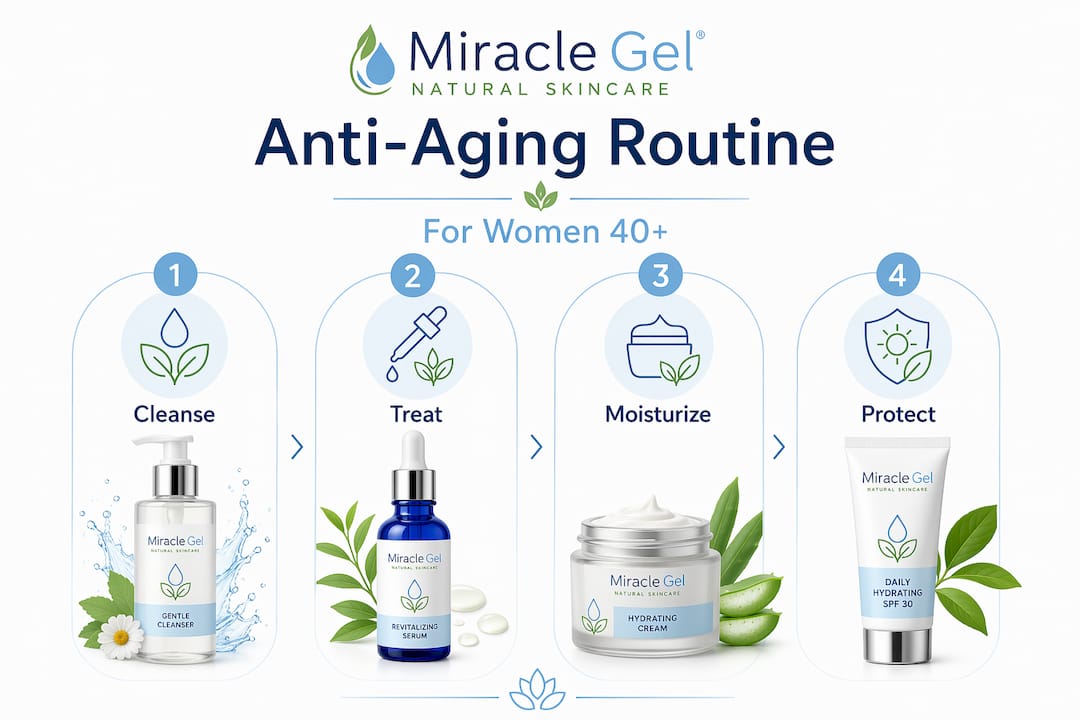
Morning routine (the protective phase):
- Gentle, non-stripping cleanser
- Antioxidant serum, typically vitamin C
- Moisturizer to seal hydration
- Broad-spectrum SPF 50 as the final step
Evening routine (the treatment phase):
- Thorough but gentle cleanse to remove SPF and daily buildup
- Any hydrating serum or toner if needed
- Retinoid or bakuchiol product applied to dry skin
- Moisturizer to buffer any dryness and support barrier repair
The key principle here is sequence. Apply skincare from lightest to heaviest, use retinoids in the evening, and follow with moisturizer to reduce dryness and support tolerance.
For those new to retinoids, the ramp-up period is non-negotiable. Start retinoids every second or third night and use a daily broad-spectrum SPF 50 to protect newly sensitized skin from UV damage.
Additional routine tips worth following:
- Allow SPF to fully absorb before applying makeup or leaving the house
- On retinoid nights, wait 15 minutes after applying moisturizer before applying your retinoid to reduce irritation (this is called the “buffer method”)
- Alternate active treatment nights with recovery nights, especially in the first month
- Never skip sunscreen, even in Ireland or the UK where sunshine feels optional. UV damage is cumulative and is the single largest driver of visible skin aging
For further guidance on how moisturizing fits into your anti-aging practice, see this piece on moisturizing anti-aging benefits. And if you want to nail the practical side of application, this overview of application techniques for anti-aging products is worth bookmarking.
With a routine in place, let’s explore how to monitor your skin’s response and adjust your approach for best outcomes.
Monitoring progress and managing expectations
The most common reason anti-aging creams “don’t work” is that the user stopped before the product had a chance to perform. Or they mistook initial dryness for failure. Understanding the typical timeline for results, and what counts as progress, keeps you on track.
Here’s what to expect at each stage:
- Weeks 1 to 2: Your skin may feel temporarily drier or more sensitive, especially with new retinoid products. This is normal and not a reason to stop.
- Weeks 3 to 4: Many women notice improved skin texture and better hydration. Lines may look softer simply because skin is better moisturized.
- Weeks 6 to 8: Subtle reduction in fine line depth becomes visible. Tone may appear more even.
- Weeks 8 to 12+: More significant changes in skin firmness and pigmentation, if you’ve been consistent.
As visible wrinkle reduction takes several weeks of ongoing use, and stopping treatment causes the skin to revert to its prior state, consistency is your single most powerful tool.
Independent testing found that wrinkle depth reductions of up to 25% were possible after 28 days, which is encouraging, but only for those who stayed the course.
Pro Tip: Take a photo of your skin in consistent lighting every four weeks. Because you see your face every day, you’ll underestimate gradual improvement. The photo comparison is often the most convincing evidence that a product is working.
If irritation develops, reduce frequency rather than stopping entirely. Pausing for a few days then reintroducing gradually is far more effective than abandoning an active that was starting to make a difference.
For a more detailed look at expected timelines for anti-aging results, the data there helps calibrate realistic expectations.
Rethinking anti-aging creams: Beyond hype and quick fixes
Here’s something the skincare industry rarely admits: most women who quit their anti-aging routine early aren’t quitting because the product failed. They’re quitting because nobody prepared them for what success actually looks like at the start.
Retinoid irritation is the perfect example. Redness, flaking, and tightness in the first few weeks are almost universal. The instinct is to interpret this as an allergic reaction or proof that the product is “too strong.” But as retinoid irritation is a ramping issue rather than a sign of failure, managing it through gradual introduction improves long-term adherence and outcomes.
The same logic applies to natural alternatives. Bakuchiol doesn’t “just” suit sensitive skin types or women who prefer natural options. It’s a legitimate active with its own body of evidence, not a compromise. Women who dismiss it as the “soft” choice are often the same ones who abandoned retinoids after week two and concluded that nothing works.
We’ve seen this pattern consistently: the women who get the best results from anti-aging skincare aren’t the ones using the most expensive products. They’re the ones who chose ingredients suited to their specific skin type, introduced them carefully, and stayed consistent over months rather than weeks. That’s not glamorous advice. But it’s the advice that actually changes skin.
Focusing on skin health, hydration, and protection yields more visible improvement than chasing miracle claims or cycling through every new launch. Natural ingredients combined with proven actives like peptides and bakuchiol can offer results that are both effective and genuinely comfortable to live with long term.
For a deeper look at the actives worth investing in, this resource on anti-aging ingredient insights for 40+ is particularly useful.
Explore natural skincare solutions for women over 40
If this guide has helped you cut through the noise and identify what your skin actually needs, the next step is finding products that match those criteria without compromising on ingredient quality or gentleness.
At Miracle Gel, every product in our range for natural skincare for women 40+ is formulated with clinically supported natural ingredients including bakuchiol, peptides, and hyaluronic acid. Whether you’re building your first real anti-aging routine or refining what you already have, our range covers hydration, firmness, and glow with formulas gentle enough for sensitive mature skin. You’ll also find natural anti-aging skincare tips from founder Shelly Maguire alongside real customer results. Browse our full anti-aging serums collection and discover what consistent, natural skincare can do for you.
Frequently asked questions
How long does it usually take to see results from anti-aging creams?
Most over-the-counter anti-aging creams show modest improvements after 4 to 6 weeks of consistent use, with more noticeable changes visible around 8 to 12 weeks. As OTC wrinkle creams require up to six weeks before differences appear, and ongoing use is needed to maintain results, patience is essential.
What are the safest active ingredients for sensitive or reactive mature skin?
Bakuchiol, niacinamide, and fragrance-free formulas are generally the safest starting points for sensitive mature skin. As bakuchiol works like retinol but more gently, and slow retinoid introduction with moisturizer buffering minimizes irritation, you have real options beyond just avoiding actives entirely.
Does a higher price guarantee a better anti-aging cream?
No. As higher price doesn’t guarantee better results for wrinkle creams, midrange products with transparent ingredient lists and clinical backing can easily outperform expensive luxury alternatives. Focus on the ingredient list, not the packaging.
How important is sun protection when using anti-aging creams?
It’s non-negotiable. Broad-spectrum SPF 50 is essential every morning when using retinoids due to increased UV sensitivity, and UV exposure is the leading driver of premature skin aging regardless of which products you use.
Can natural ingredients be as effective as synthetic ones in anti-aging creams?
Yes, for specific concerns. Bakuchiol, a plant-based ingredient, delivers comparable anti-aging benefits to retinol with less irritation, making it a genuinely effective choice rather than a compromise, particularly for women prioritizing gentle, natural formulas.