

TL;DR:
- Skin becomes more reactive with age due to thinning, collagen decline, and weakened barriers. Hormonal changes during menopause further reduce skin tolerance through decreased ceramides and increased sensitivity. Managing reactivity involves simplifying routines, repairing the barrier, and avoiding environmental stressors.
Skin reactivity is defined as the tendency of skin to respond with stinging, burning, redness, or tightness to stimuli that previously caused no reaction. The reason why skin becomes more reactive with age is biological: the epidermis thins at 6% per decade, collagen and elastin decline, and the skin’s lipid barrier weakens. Hormonal shifts during perimenopause and menopause accelerate these changes, while chronic low-grade inflammation, known as inflammaging, lowers the skin’s tolerance threshold further. Reactive skin after 40 is not a single condition. It is a knot of several overlapping processes, and understanding each one is the first step toward managing it well.
Why skin becomes more reactive with age: the structural story
The skin’s barrier function depends on a tightly organized system of cells, lipids, and proteins. When that system degrades, sensitivity follows.
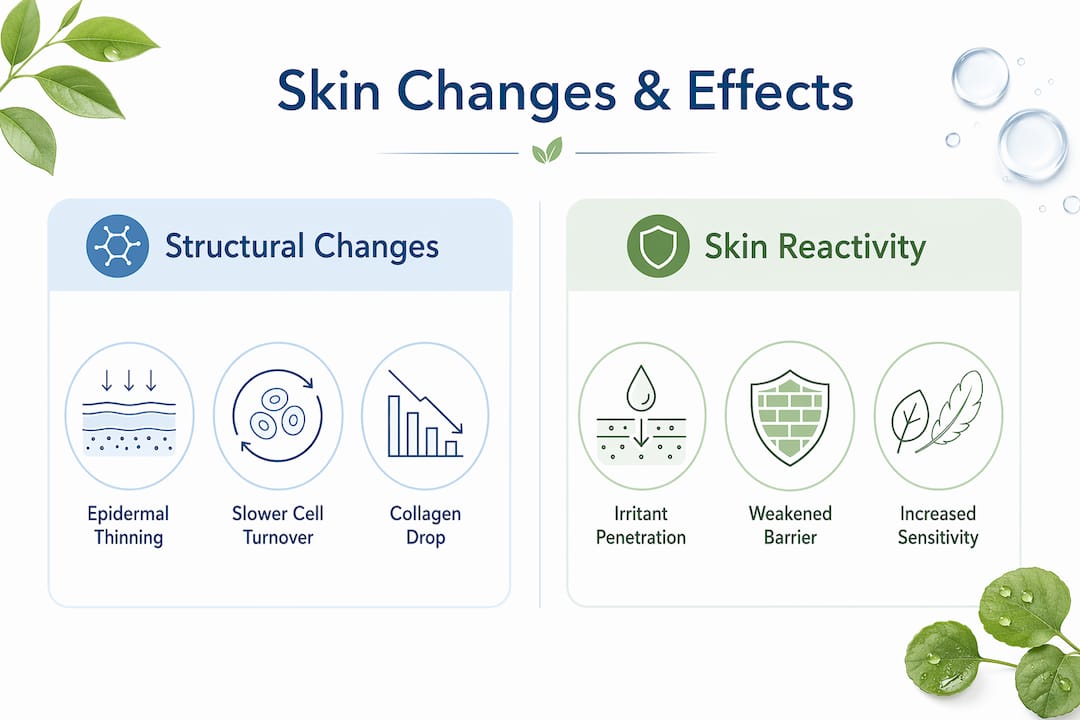
Epidermal thinning is the most measurable change. At a loss of 6% per decade, a person in their 50s has noticeably thinner skin than they did at 30. Thinner skin means fewer layers to absorb and deflect irritants before they reach nerve endings.
Cell turnover also slows. Younger skin renews itself roughly every 28 days. By the mid-40s, that cycle extends significantly. Slower renewal means damaged cells stay on the surface longer, and the repair response to irritation takes more time.
Collagen and elastin production drops steadily after the mid-20s. By 40, the structural scaffolding beneath the skin is measurably weaker. This loss reduces the skin’s ability to spring back from physical or chemical stress.
Natural moisturizing factors (NMF) and lipids decline in parallel. NMF includes amino acids, urea, and lactic acid that keep the outer skin layer hydrated. When NMF drops, transepidermal water loss (TEWL) increases. Higher TEWL means the skin dries out faster and becomes more permeable to irritants.
| Structural change | Effect on skin reactivity |
|---|---|
| Epidermal thinning (6% per decade) | Irritants reach nerve endings more easily |
| Slower cell renewal | Damage lingers longer; repair is delayed |
| Collagen and elastin loss | Reduced resilience to physical and chemical stress |
| NMF and lipid decline | Higher TEWL; increased permeability to irritants |
| Weakened immune response | Slower recovery from inflammation |
Pro Tip: Patch-testing new products on the inner arm for 48 hours before applying them to your face gives aging skin time to signal a reaction before it becomes a full flare.
How do hormonal changes during perimenopause and menopause drive skin sensitivity?
Estrogen is the most influential hormone for skin health in women. It regulates collagen synthesis, ceramide production, hyaluronic acid levels, and skin thickness. When estrogen declines, all of these functions weaken simultaneously.
The perimenopause transition spans 4 to 8 years, during which estrogen levels fluctuate unpredictably before dropping sharply at menopause. Skin during this window becomes inconsistent. It may feel fine one week and intensely reactive the next, reflecting the hormonal instability underneath.
Ceramides are lipids that form the mortar between skin cells. Estrogen loss reduces ceramide production directly. Less ceramide means wider gaps in the barrier, allowing irritants, allergens, and microbes to penetrate more easily.
Vascular and neurocutaneous sensitivity also increases as estrogen falls. Blood vessels near the skin surface become more reactive, contributing to flushing and redness. Nerve endings in the skin become more easily triggered, lowering the threshold at which stimuli register as uncomfortable.
Key hormonal effects on aging skin sensitivity include:
- Reduced ceramide and hyaluronic acid production, weakening the moisture barrier
- Decreased collagen synthesis, thinning the dermis and reducing cushioning
- Increased vascular reactivity, causing easier flushing and visible redness
- Heightened neurocutaneous sensitivity, making previously tolerable products feel irritating
- Lower overall tolerance threshold, meaning the skin reacts to smaller amounts of a trigger
Pro Tip: If your skin started reacting to products you used for years without issue, hormonal changes are the most likely cause. Simplify your routine before adding anything new, and consider discussing hormonal health with your doctor.
Supplements that support collagen and skin hydration from the inside may also help during this transition. A 2026 guide on aging supplements outlines which nutrients have the strongest evidence for skin-related benefits.
What external factors make aging skin reactivity worse?
Biology sets the stage, but environment and lifestyle determine how quickly sensitivity escalates.
Hard water. Hard water disrupts the skin’s acid mantle, the slightly acidic film that protects against bacteria and irritants. As skin pH shifts with age, hard water minerals push it further out of balance, triggering dryness and inflammation. This is one of the most overlooked irritation factors in daily life.
UV radiation and pollution. Cumulative UV exposure degrades collagen and generates free radicals that damage the skin barrier. Air pollution deposits particulates that clog pores and trigger low-grade inflammation. Both stressors compound the barrier weakening already caused by aging.
Chronic stress and poor sleep. Cortisol, the stress hormone, breaks down collagen and disrupts the skin’s repair cycle. Poor sleep reduces the time the skin has to regenerate overnight. Both factors accelerate the aging of the barrier and lower its tolerance.
Overuse of active skincare ingredients. Strong actives and multi-step routines are the leading modifiable cause of skin sensitivity in 2026. Retinoids, AHAs, BHAs, and vitamin C serums are effective when used correctly, but layering them on already-compromised aging skin strips the barrier further. Many people interpret the resulting reactivity as a sign they need stronger products, when the opposite is true.
Seasonal and temperature changes. Cold air reduces humidity and pulls moisture from the skin. Central heating does the same indoors. Hot showers dissolve the lipid layer. Each of these is a minor stressor, but the cumulative load of multiple daily stressors reduces skin resilience faster than any single cause.
How do you tell the difference between sensitive and sensitized skin?
These two conditions look similar but have different causes and require different responses.
Genetically sensitive skin is a fixed trait. People with this skin type have a naturally thinner barrier, higher nerve density near the surface, and a lifelong pattern of reacting to products, weather, and touch. Genetically sensitive skin is rarer than commonly thought. Most people who identify as having sensitive skin actually have a temporarily sensitized barrier caused by external factors.
A sensitized barrier is a condition, not a skin type. It develops when the barrier is damaged by aggressive skincare, environmental stress, illness, or hormonal changes. It can be repaired. The key distinction is that sensitized skin has a history of tolerating products it now reacts to, while truly sensitive skin has always reacted.
Symptoms that point to a sensitized barrier rather than genetic sensitivity include:
- Stinging or burning after applying products that previously felt neutral
- Tightness without visible redness or flaking
- Reactions that vary by season, stress level, or hormonal cycle
- Sensitivity that appeared or worsened after starting a new skincare routine
- Skin that feels reactive in some areas but not others
After 35 to 40, the skin’s sensory system reacts faster and registers stimuli more intensely. This means even people without a history of sensitivity can develop reactive skin purely from age-related changes. Persistent stinging or tightness that does not improve with barrier repair may indicate rosacea or contact dermatitis, both of which benefit from professional evaluation.
What are the most effective ways to manage reactive skin after 40?
The evidence points in one clear direction: less is more. Minimalist skincare routines built around consistent use of a well-tolerated moisturizer are the primary evidence-backed intervention for reactive aging skin.
The goal is barrier restoration first. Until the barrier is repaired, adding actives, exfoliants, or new products will continue to provoke reactions. Pause retinoids and chemical exfoliants until the skin stabilizes. This is not giving up on results. It is creating the conditions under which results become possible.
Barrier-supportive ingredients that dermatologists recommend for reactive aging skin include:
- Ceramides: Replenish the lipids lost through hormonal decline and aging
- Glycerin: A humectant that draws moisture into the skin without irritation
- Panthenol (vitamin B5): Soothes inflammation and supports cell repair
- Colloidal oatmeal: Clinically proven to calm reactive and inflamed skin
- Squalane: A lightweight oil that mimics the skin’s natural sebum and reinforces the barrier without clogging pores
Lifestyle adjustments matter as much as product choices. Wash with lukewarm water, not hot. Use a gentle, fragrance-free cleanser that does not strip the skin. If you live in a hard water area, a filtered showerhead reduces mineral exposure. Managing chronic stress through sleep, exercise, and recovery directly improves skin tolerance over time.
Pro Tip: Build your routine around three products: a gentle cleanser, a barrier-repair moisturizer with ceramides and glycerin, and SPF. Add anything else only after your skin has been stable for at least four weeks.
For skin renewal after 30, the same principle applies: consistency with well-chosen basics outperforms a complex routine every time. When reactivity is severe, persistent, or accompanied by visible skin changes, a dermatologist can rule out underlying conditions and guide a targeted recovery plan.
Key Takeaways
Aging skin becomes more reactive because barrier integrity, hormonal balance, and sensory sensitivity all decline together, and addressing all three is the only way to restore tolerance.
| Point | Details |
|---|---|
| Barrier thinning drives reactivity | The epidermis loses 6% thickness per decade, letting irritants reach nerve endings faster. |
| Hormones accelerate sensitivity | Estrogen decline during perimenopause reduces ceramides, collagen, and moisture, lowering the skin’s tolerance threshold. |
| Most “sensitive” skin is sensitized | A damaged barrier caused by actives or environment is temporary and repairable, unlike genetic sensitivity. |
| Minimalism is the evidence-backed fix | Pausing actives and using ceramides, glycerin, and panthenol restores barrier function more effectively than adding products. |
| External stressors compound aging | Hard water, UV exposure, stress, and overuse of actives each reduce resilience and must be managed alongside skincare. |
What I’ve learned from years of watching skin change after 40
Most people come to reactive skin with the wrong mental model. They assume that if a product is causing a reaction, they need a stronger or more targeted product to fix it. That instinct makes sense in other areas of life, but skin biology after 40 works differently.
Many people damage their skin barrier by layering multiple active ingredients, then interpret the resulting reactivity as evidence that their skin needs even more intervention. The cycle is self-reinforcing and genuinely hard to break without stepping back and seeing the pattern.
What I have found, both personally and in watching others navigate this, is that the skin after 40 is not broken. It is speaking a different language. It is asking for less stimulation, more consistency, and ingredients that work with its biology rather than against it. Reading those signals correctly is the skill that separates people who struggle with reactive skin for years from those who find their way to calm, resilient skin relatively quickly.
The hardest part is patience. Barrier repair takes weeks, not days. But the people who commit to a simple, barrier-focused routine and resist the urge to add “just one more thing” consistently see better outcomes than those who keep experimenting. That is not a theory. It is the pattern I have seen play out repeatedly.
— Barbara
Natural skincare for reactive, aging skin from Miraclegelnaturalskincare
Reactive skin after 40 needs products that respect its biology, not fight it. Miraclegelnaturalskincare formulates with that principle at the center, using natural ingredients that support barrier repair and calm sensory sensitivity without harsh chemicals or unnecessary complexity.

The age-defying skincare collection for 40+ at Miraclegelnaturalskincare is built around the same barrier-first approach that dermatologists recommend: gentle formulations, skin-compatible ingredients, and results that build over time. If you are ready to simplify and support your skin the way it needs after 40, the sensitive skin safe range is a practical place to start. Free shipping applies on orders over €85.
FAQ
Why does skin suddenly react to products it tolerated for years?
Hormonal changes during perimenopause and aging-related barrier thinning lower the skin’s tolerance threshold. Products that were previously fine can trigger reactions once the barrier is compromised.
Is reactive skin after 40 the same as having sensitive skin?
No. Most reactive skin after 40 is a sensitized barrier caused by hormonal shifts, environmental stress, or overuse of active ingredients. Genetically sensitive skin is a fixed trait present from birth and is less common.
What ingredients help calm reactive aging skin?
Ceramides, glycerin, panthenol, colloidal oatmeal, and squalane are the most evidence-supported ingredients for barrier repair and calming in reactive aging skin.
When should I see a dermatologist about skin reactivity?
Seek professional advice if stinging, burning, or redness persists despite simplifying your routine. Persistent symptoms may indicate rosacea or contact dermatitis rather than a sensitized barrier.
Does diet or stress affect skin reactivity after 40?
Yes. Chronic stress raises cortisol, which breaks down collagen and disrupts barrier repair. Poor sleep compounds this effect. Both are modifiable factors that directly influence how reactive aging skin behaves.