

TL;DR:
- Reading skincare labels involves understanding the INCI ingredient list, which reveals what is actually in a product and at what concentration. The first five to seven ingredients make up most of the product, indicating its primary texture and function, while ingredients at or below 1% often appear after marker ingredients like phenoxyethanol. Active ingredients that produce skin benefits must be listed near the top of the list, above the 1% line, to be effective.
Reading skincare labels means decoding the INCI ingredient list, a globally standardized system that reveals what is actually in your product, in what order, and at what concentration. Most shoppers read the front of the packaging. The people who get real results read the back. Knowing how to read skincare labels separates products that genuinely work from those that rely on marketing copy to sell a promise. This guide gives you the exact framework to judge any product in under two minutes.
How are ingredients ordered on skincare labels?
The INCI (International Nomenclature of Cosmetic Ingredients) system is the foundation of every skincare label you will ever read. Ingredients are listed in descending order by weight for anything present above 1% concentration. This rule applies in the US, EU, Japan, Korea, Australia, and Canada. That consistency means the same decoding skill works on every product you pick up, regardless of where it was made.
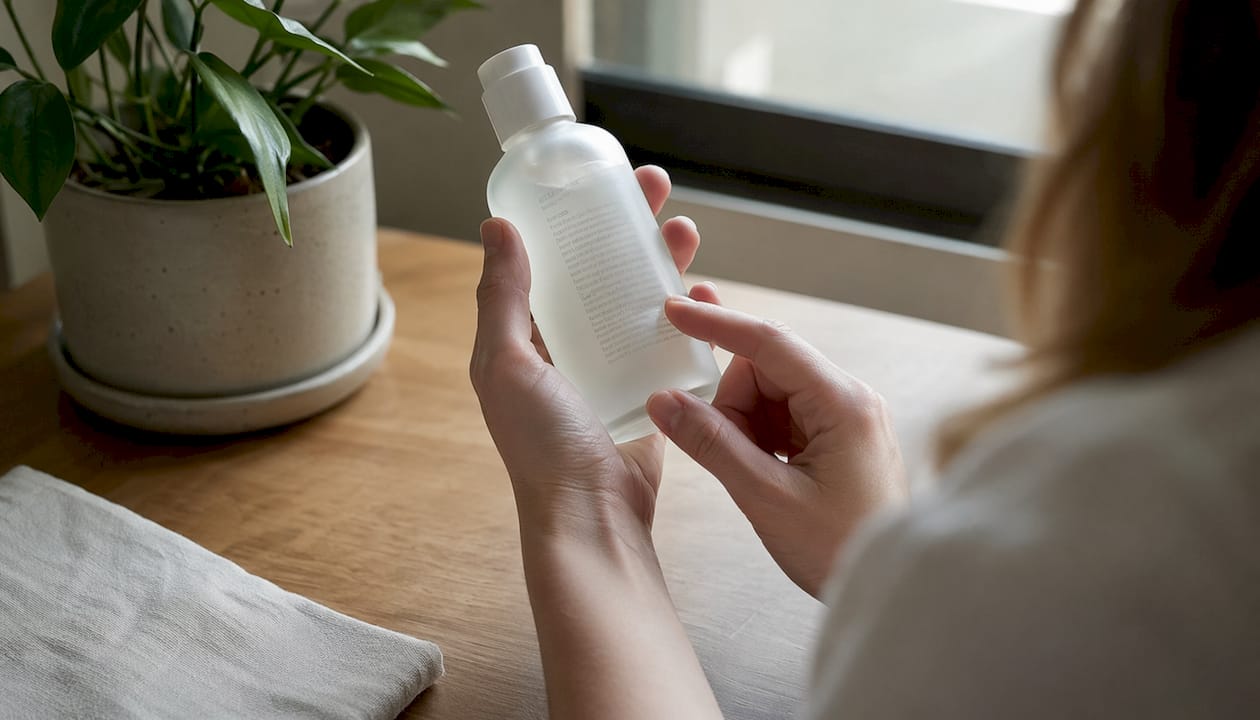
The first five to seven ingredients define the product
The first 5–7 ingredients make up 70%–80% of the product’s formula. That means whatever you see at the top of the list is what you are mostly putting on your skin. A moisturizer that leads with water, glycerin, and dimethicone is a water-based, silicone-smoothed formula. One that leads with caprylic/capric triglyceride and jojoba oil is oil-rich and occlusive. The base ingredients tell you the product’s texture, feel, and primary function before you even read the rest.
| First ingredient | What it signals |
|---|---|
| Aqua (water) | Water-based, lightweight formula |
| Glycerin | Humectant-forward, hydration focus |
| Caprylic/capric triglyceride | Oil-rich, occlusive base |
| Aloe barbadensis leaf juice | Soothing, water-like base |
| Dimethicone | Silicone-smoothing, texture-focused |
Finding the 1% line
Ingredients at or below 1% can be listed in any order the manufacturer chooses. That is a critical fact. It means a brand can place a glamorous-sounding ingredient like gold extract or rare botanical oil right after the preservative, and it looks prominent even if it is present at a trace amount. Marker ingredients like phenoxyethanol, tocopherol, and disodium EDTA are almost always used below 1%. When you spot them in a list, everything after them is likely at trace concentration.
Pro Tip: Scan for phenoxyethanol in any ingredient list. Everything listed after it is almost certainly below 1%, which means it contributes little to the product’s actual performance.
How to identify key active ingredients and assess their effectiveness
Active ingredients are the ones that produce a measurable change in your skin: retinol rebuilds collagen, vitamin C brightens, niacinamide tightens pores and reduces redness. Actives must appear near the top of the list, above the 1% line, to be present at concentrations that produce clinical results. An active listed after phenoxyethanol is almost certainly decorative. It is there to appear on the label, not to work on your skin.
Here is a step-by-step method for evaluating actives on any label:
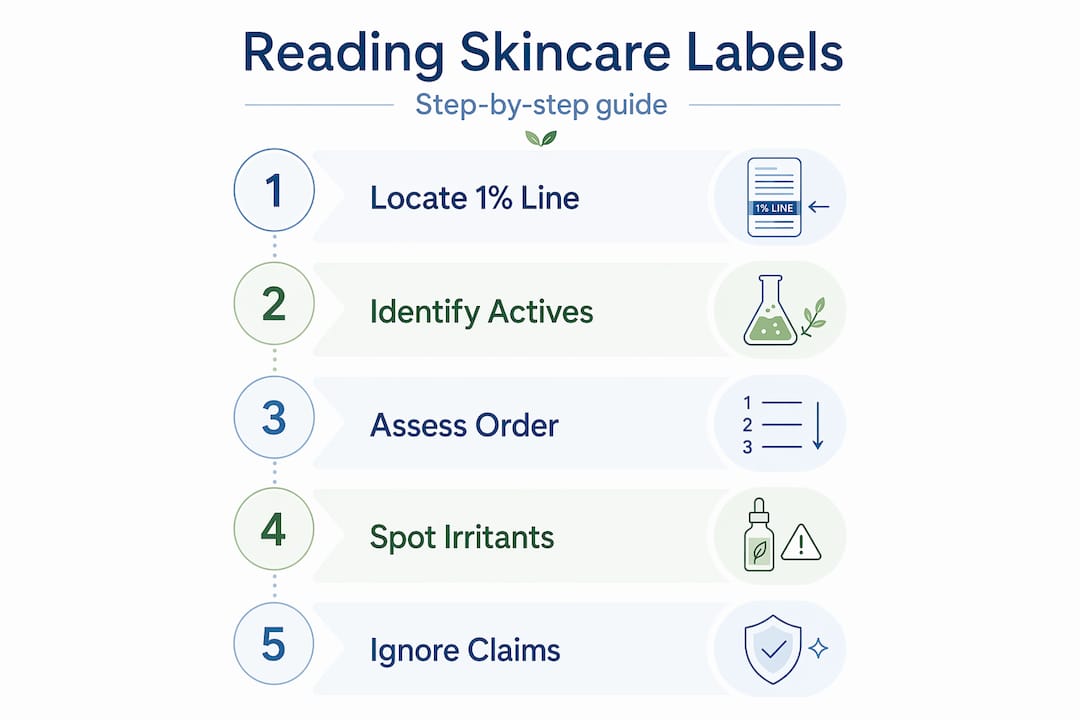
- Locate the 1% line. Find phenoxyethanol, tocopherol, or disodium EDTA. Draw a mental line there.
- Check where your target active sits. Is retinol above or below that line? If it is below, the concentration is likely too low to produce results.
- Count how many actives appear above the line. A product with five actives all listed above the 1% marker is genuinely concentrated. One with all actives below it is mostly base formula.
- Look for the active’s INCI name, not its marketing name. Vitamin C appears as ascorbic acid or sodium ascorbyl phosphate. Retinol appears as retinol or retinyl palmitate. Niacinamide appears as niacinamide. If you only search for the common name, you may miss it entirely.
- Cross-reference concentration against known effective ranges. Niacinamide works at 2%–5%. Retinol shows results at 0.025%–1%. Vitamin C as ascorbic acid requires at least 10%–20% for brightening. If the active is buried near the bottom of a long list, it almost certainly falls short of these thresholds.
Pro Tip: Use a free ingredient decoder app to paste in a full ingredient list and instantly see which actives are present and roughly where the 1% threshold falls. This takes under 60 seconds and removes all guesswork.
Understanding active ingredient concentration is the single most useful skill you can build when choosing skincare products. A product with a well-placed, correctly concentrated active will outperform a product with ten actives all listed below the preservative.
Do marketing claims on skincare labels tell the truth?
The short answer is no. Marketing terms like “dermatologist-tested,” “natural,” and “hypoallergenic” have no standardized legal definition in most markets. A brand can print “dermatologist-tested” on a product that was reviewed by a single dermatologist with no formal study. “Hypoallergenic” has no regulatory threshold in the US. These terms are designed to create confidence, not to communicate formulation facts.
Common front-label claims and what they actually mean:
- “Natural” or “naturally derived”: No legal definition in the US or EU. A product labeled “natural” can contain synthetic preservatives, synthetic emulsifiers, and lab-made fragrances. The term “natural” is a marketing construct without regulatory backing. Check the INCI list instead.
- “Fragrance-free” vs. “unscented”: These are not the same. Fragrance-free means no fragrance compounds were added. Unscented means the product has no detectable smell, but it may still contain masking fragrances that neutralize odor. Those masking fragrances can trigger reactions in sensitive skin.
- “Paraben-free”: Accurate as stated, but parabens are not the only preservatives that cause reactions. A paraben-free product may still contain methylisothiazolinone or formaldehyde-releasing preservatives.
- “Clinically proven”: Means a study was conducted, but says nothing about the study’s size, design, or independence. Always look for the actual ingredient doing the work.
- “Hypoallergenic”: No legal standard exists for this claim in the US. It signals marketing intent, not formulation safety.
The rule is simple: ignore front-label claims and check the INCI list for the real picture. The ingredient list cannot legally lie. The front of the package can.
For a deeper look at what “naturally derived” actually means in formulation terms, Miraclegelnaturalskincare has a clear breakdown of naturally derived ingredients worth reading before your next purchase.
How to spot hidden irritants and allergens in skincare ingredients
You do not need to memorize every chemical name in cosmetic science. Learning the top 10–15 allergens and irritants covers the vast majority of adverse skin reactions. That focused knowledge is far more practical than trying to decode every ingredient from scratch.
The most common irritants and allergens to watch for:
- Fragrance / parfum: Fragrance is the top allergen in skincare and hides under dozens of names including linalool, limonene, citronellol, geraniol, and eugenol. If you have sensitive skin, treat any of these as a red flag.
- Methylisothiazolinone (MI) and methylchloroisothiazolinone (MCI): Preservatives with a high sensitization rate. The EU has restricted MI in leave-on products. The US has not.
- Drying alcohols: Ethanol, alcohol denat., and isopropyl alcohol can disrupt the skin barrier with repeated use. They appear high on lists in many toners and astringents.
- Sodium lauryl sulfate (SLS): A surfactant that strips the skin barrier. Common in cleansers and body washes. Sodium laureth sulfate (SLES) is milder but still worth noting for very sensitive skin.
- Formaldehyde-releasing preservatives: DMDM hydantoin, imidazolidinyl urea, and diazolidinyl urea release small amounts of formaldehyde over time. They are legal but worth avoiding if you react to preservatives.
The US does not require individual fragrance allergens to be listed separately. The EU mandates disclosure of 26 specific fragrance allergens above certain concentrations. That means an American-market product labeled “fragrance” may contain multiple sensitizers with no further detail. For sensitive skin, fragrance-free formulations are the safest starting point.
Key Takeaways
Reading skincare labels effectively requires mastering three skills: locating the 1% line, identifying active ingredient positions, and ignoring unregulated front-label claims in favor of the INCI list.
| Point | Details |
|---|---|
| INCI order reveals concentration | Ingredients above 1% are listed by descending weight; the first 5–7 define the product base. |
| The 1% line is your key tool | Phenoxyethanol, tocopherol, and disodium EDTA mark the boundary; actives below it are likely ineffective. |
| Marketing claims are unregulated | Terms like “natural,” “hypoallergenic,” and “dermatologist-tested” have no legal standard in the US. |
| Active position determines results | Retinol, vitamin C, and niacinamide must appear above the 1% line to reach clinically effective concentrations. |
| Fragrance hides under many names | Linalool, limonene, and parfum all signal fragrance; fragrance-free and unscented are not interchangeable. |
What I have learned from years of reading ingredient lists
Most people approach skincare labels the wrong way. They try to memorize chemical names, get overwhelmed, and give up. The skill is not about memorization. Reading ingredient labels is pattern recognition: you learn to spot the base, find the 1% marker, and check where your target active sits. That three-step scan takes under two minutes once it becomes habit.
The insight that changed how I evaluate products is this: a short ingredient list with well-placed actives almost always outperforms a long list full of exotic-sounding botanicals buried below the preservative. Brands that lead with water, a good humectant, and a correctly concentrated active are being honest with you. Brands that bury their actives after a dozen trace-level plant extracts are selling you a story.
I am also skeptical of products that use the word “natural” prominently while listing synthetic fragrance compounds in the middle of the INCI list. The herbal skincare ingredient guide from Miraclegelnaturalskincare is one of the clearer resources I have seen for understanding which plant-derived ingredients actually have functional evidence behind them, versus which ones are present for label appeal.
My practical advice: pick three marker ingredients to memorize (phenoxyethanol, tocopherol, disodium EDTA) and one active you care about (retinol, niacinamide, ascorbic acid). Check every new product for those four names and where they fall. That single habit will make you a more informed shopper than 90% of the people in the beauty aisle.
— Barbara
What Miraclegelnaturalskincare offers when you know what to look for
Once you know how to read an ingredient list, you start to see the difference between products built around real actives and those built around marketing copy. Miraclegelnaturalskincare formulates with that distinction in mind.
The natural skincare range for 40+ at Miraclegelnaturalskincare is built around transparent ingredient choices, with actives positioned to actually work rather than simply appear on the label. Founder Shelly Maguire, a recognized industry professional, has shaped a product line where the INCI list reflects the product promise. If you have spent time learning to read labels, these formulations reward that knowledge. The best actives for anti-aging and brightening page is a useful next step for matching what you have learned here to specific ingredient-led products.
FAQ
What does INCI stand for on skincare labels?
INCI stands for International Nomenclature of Cosmetic Ingredients. It is the standardized system used globally to name and list cosmetic ingredients in descending order by concentration.
How do I find the 1% line on an ingredient list?
Look for phenoxyethanol, tocopherol, or disodium EDTA. These ingredients are almost always used below 1%, so everything listed after them is likely at trace concentration.
Is “fragrance-free” the same as “unscented”?
No. Fragrance-free means no fragrance compounds were added. Unscented means the product has no detectable smell but may still contain masking fragrances that can irritate sensitive skin.
Can I trust “natural” or “hypoallergenic” claims on skincare packaging?
No. Neither term has a legal definition in the US. A product labeled “natural” can contain synthetic ingredients, and “hypoallergenic” has no regulatory threshold. Always verify by reading the INCI list.
Where should retinol appear on an ingredient list to be effective?
Retinol must appear above the 1% line, well before marker ingredients like phenoxyethanol, to reach concentrations that produce visible results. Retinol listed near the end of a long formula is present at ineffective levels.