
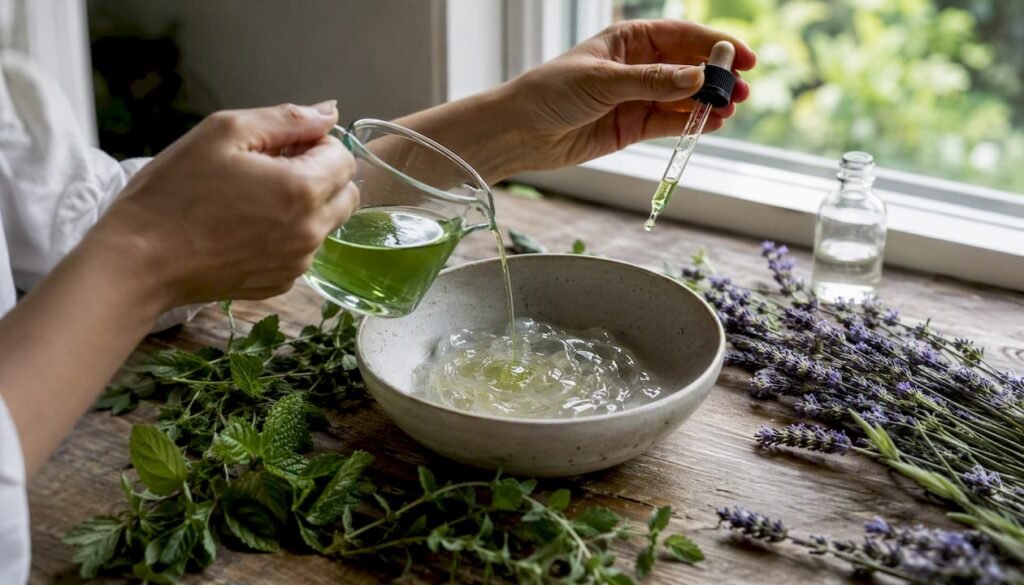
The most useful herbal extracts for skincare are bakuchiol, Centella asiatica, green tea (Camellia sinensis), aloe vera, jojoba, argan, grape seed (Vitis vinifera), chamomile, licorice (Glycyrrhiza glabra), rosehip (Rosa canina), and lotus germ, chosen for their antioxidant, anti-inflammatory, barrier-support, retinol-like, and humectant properties. For anti-aging formulations, prioritize bakuchiol, standardized Centella, and green tea; for hydration and soothing, lead with aloe vera, jojoba, and chamomile.
Three quick steps before you order any botanical extract:
- Confirm the standardized marker percentage on the spec sheet (e.g., % bakuchiol, % asiaticoside, % EGCG) so you know what you are actually dosing.
- Match solubility to your vehicle: oil-soluble actives belong in the oil phase; polyphenol-rich water or glycerin extracts go in the water phase.
- Request a Certificate of Analysis (CoA) covering the marker assay, microbial limits, and heavy-metal testing before committing to a batch.
Key Takeaways
Prioritizing standardized botanical extracts, matching solubility to vehicle, and requiring a full CoA with safety data are the three actions that separate effective herbal skincare formulations from inconsistent ones.
| Point | Details |
|---|---|
| Standardization is non-negotiable | Always request the marker compound percentage (% bakuchiol, % asiaticoside, % EGCG) before dosing any botanical extract. |
| Match solubility to vehicle | Oil-soluble extracts (jojoba, argan, bakuchiol) go in the oil phase; water-soluble extracts (aloe, green tea, licorice) go in the water phase. |
| Bakuchiol leads clinical evidence | A 2018 randomized trial showed bakuchiol matched retinol for wrinkle and pigmentation reduction with lower irritation. |
| Safety testing is required, not optional | Patch testing, HRIPT, and preservative efficacy testing are standard pre-launch steps for any botanical formula. |
| Miraclegelnaturalskincare applies these standards | Miraclegelnaturalskincare’s finished anti-aging products use standardized botanical actives formulated for women 40+ seeking visible, gentle results. |
Selected primary sources and supplier references
The evidence claims in this guide draw from peer-reviewed trials, systematic reviews, and supplier-level specifications. Here is where to go deeper:
The 2018 bakuchiol clinical trial (PubMed) is the primary source for bakuchiol’s retinol-comparable efficacy claim and remains the strongest human evidence for any plant-derived retinol alternative. Read the full methods section: the trial was randomized and placebo-controlled, which is the standard you should apply when evaluating any botanical anti-aging claim.
The PMC review of natural cosmetic oils covers argan, jojoba, coconut, and olive oils with chemical profiles, measured cosmetic outcomes, and formulation notes. It is the most useful single reference for oil-phase ingredient decisions.
The 2025 MDPI safety-validation study on 50 plant-derived materials is the most current systematic safety screen available for botanical cosmetic ingredients. Its filaggrin and wound-healing findings are directly relevant to barrier-repair formulation claims.
The Nature coverage of lotus germ extract summarizes the in vitro screening work and provides the mechanistic detail (DAPK1-Beclin1 autophagy pathway) behind the ingredient’s current industry interest. Treat it as a signal to watch, not a clinical green light.
For supplier-level specifications and standardized extract listings, New Directions Aromatics’ botanical extract catalog is a practical reference for typical use levels, extraction methods, and ready-to-use ratios. Supplier specs complement peer-reviewed evidence but do not substitute for it: a supplier’s recommended use level reflects formulation convention, not necessarily clinical dose-response data.
Table of Contents
- What do herbal extracts actually do for your skin?
- Key herbal extracts used in skincare: evidence, formulation notes, and use levels
- How herbal extracts are made and why the method matters
- Practical formulation notes: solubility, pH, stability, and packaging
- Safety, allergenicity, phototoxicity, and U.S. regulatory considerations
- What does the science actually support for anti-aging outcomes?
- How do you select extracts and vet suppliers?
- Miraclegelnaturalskincare: finished products built on standardized botanicals
- Sources
What do herbal extracts actually do for your skin?
Botanical extracts work through four overlapping mechanisms: free-radical scavenging, inhibition of matrix metalloproteinases (MMPs), modulation of inflammatory cytokines, and direct support of barrier proteins like filaggrin. Each pathway maps to a cosmetic outcome you can measure.
Free-radical scavenging is the most familiar. Polyphenols in green tea and grape seed intercept reactive oxygen species before they degrade collagen or trigger pigmentation cascades. MMP inhibition is less discussed but arguably more relevant to anti-aging: MMPs are the enzymes that break down collagen and elastin, and several plant extracts suppress their activity in keratinocytes and fibroblasts. Centella asiatica’s triterpenoids, for example, stimulate collagen synthesis while simultaneously dampening MMP expression.
Inflammatory cytokine modulation explains why chamomile and licorice reduce redness. Bisabolol (chamomile) and glabridin (licorice) both suppress NF-κB signaling, which is the upstream switch for many pro-inflammatory pathways. Barrier protein support is where aloe vera and some standardized plant-derived materials shine: filaggrin upregulation improves the skin’s ability to hold water, which is the structural basis for lasting hydration rather than surface-level moisturization.
Statistic callout: A 2018 randomized clinical trial found bakuchiol reduced hyperpigmentation and the appearance of wrinkles with comparable efficacy to retinol, while participants reported significantly lower irritation, making it the strongest clinical case for a plant-derived retinol alternative.
Realistic outcomes from well-formulated botanical actives include reduced fine lines over 8–12 weeks, measurable improvements in skin elasticity, decreased erythema, and improved transepidermal water loss (TEWL) scores. What they do not do is replicate the speed of prescription retinoids or the acute effect of chemical exfoliants. Set that expectation clearly in your product copy and your own formulation targets.
Key herbal extracts used in skincare: evidence, formulation notes, and use levels
The eleven extracts below cover the full spectrum from clinically validated to promising-but-early. Each entry gives you the practical data points you need before formulating: benefit, evidence tier, form, concentration, solubility, and cautions. For a deeper ingredient inventory, the herbal skincare ingredients guide covers additional standardization notes.
Pro Tip: Always request the standardized marker percentage, not just the extract name. The same logic applies to % EGCG in green tea, % glabridin in licorice, and % bakuchiol in bakuchiol oil.
A comprehensive review of plant-based cosmetic oils confirms that argan and jojoba oils deliver moisturizing, antioxidant, and barrier-support benefits, with differing fatty-acid profiles that affect formulation behavior. Jojoba is technically a liquid wax ester, not a triglyceride oil, which is why it resists oxidation far better than rosehip or argan and suits longer-shelf-life formulas. For plant-derived anti-aging ingredients in mature-skin formulas, argan’s tocopherol content and jojoba’s wax-ester structure make them complementary rather than interchangeable.
Lotus germ extract stands apart from the others because its evidence base is entirely in vitro. Laboratory screening found it outperformed 74 other plant extracts on autophagy induction, mitochondrial restoration, and collagen stimulation in aged human fibroblasts. Promising, yes. Ready for a clinical efficacy claim? Not yet.
How herbal extracts are made and why the method matters
The extraction method determines which actives survive into your formula and at what concentration. A glycerin extraction of chamomile pulls different compounds than an ethanol extraction of the same plant material, and neither matches what CO2 supercritical extraction delivers. Choose suppliers who standardize to marker compounds because raw botanical variation (soil, harvest timing, storage conditions) can shift active content dramatically between batches.
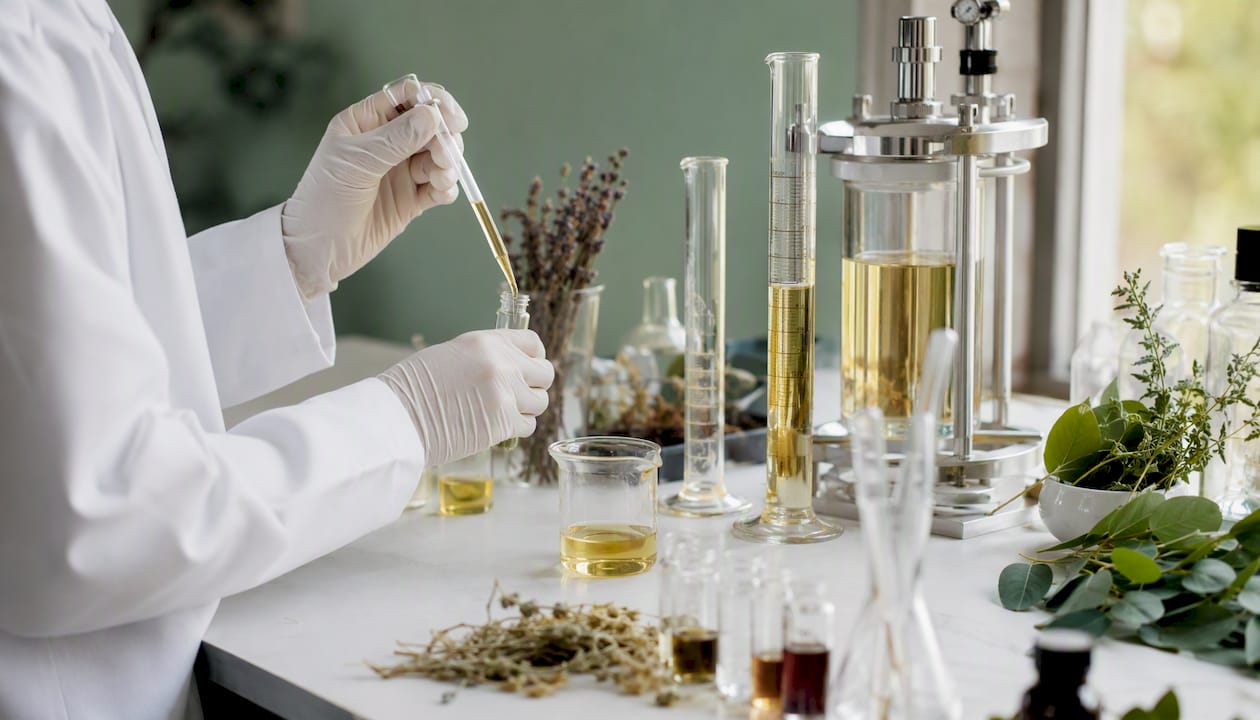
Common extraction methods and their practical implications:
Solvent extraction using ethanol or glycerin is the most common approach for water-phase extracts. Ethanol pulls a broad spectrum of polyphenols and flavonoids; glycerin produces gentler extracts with lower active concentrations but better skin tolerance and preservative compatibility. CO2 supercritical extraction uses pressurized carbon dioxide as a non-polar solvent, yielding concentrated, solvent-free extracts with excellent stability. It is the preferred method for lipophilic actives like rosehip carotenoids and chamomile’s volatile fractions. Pressurized liquid extraction (PLE) uses elevated temperature and pressure with conventional solvents to improve yield and reduce extraction time. Mechanical cold-pressing applies to oils: jojoba, argan, and rosehip seed oils are pressed without heat, preserving fatty-acid profiles and tocopherols.
Polarity matters enormously for formulation. CO2 and cold-pressed oils are oil-soluble; ethanol and glycerin extracts are water-soluble or water-dispersible. Mixing a water-soluble polyphenol extract into an oil phase without an emulsifier will give you phase separation and uneven dosing. Residual solvent is a regulatory and safety concern: request solvent residue data from any supplier using ethanol or other organic solvents, particularly for products marketed to sensitive skin.
What to request from a supplier before placing an order:
- Botanical Latin name and plant part used (root, leaf, seed, flower)
- Harvest batch and season (active content varies seasonally)
- Extraction method and solvent details
- Marker compound assay with percentage (e.g., 40% asiaticoside, 95% bakuchiol)
- Full Certificate of Analysis (CoA) covering marker assay, microbial limits, and heavy-metal results
- Stability data and recommended storage conditions
- Shelf-life data from the supplier’s own testing
Supplier catalogs from established botanical ingredient houses typically list standardized liquid extracts with ready-to-use ratios and stability guidance. Use those spec sheets as a baseline, then request batch-specific CoAs for every order.
Practical formulation notes: solubility, pH, stability, and packaging
Matching extract chemistry to your vehicle and stabilizing the actives is what separates a formula that works from one that looked good on paper. The two most common formulation failures with botanical extracts are phase incompatibility (putting a water-soluble extract in the oil phase) and pH-driven degradation (adding a pH-sensitive polyphenol to an alkaline base).
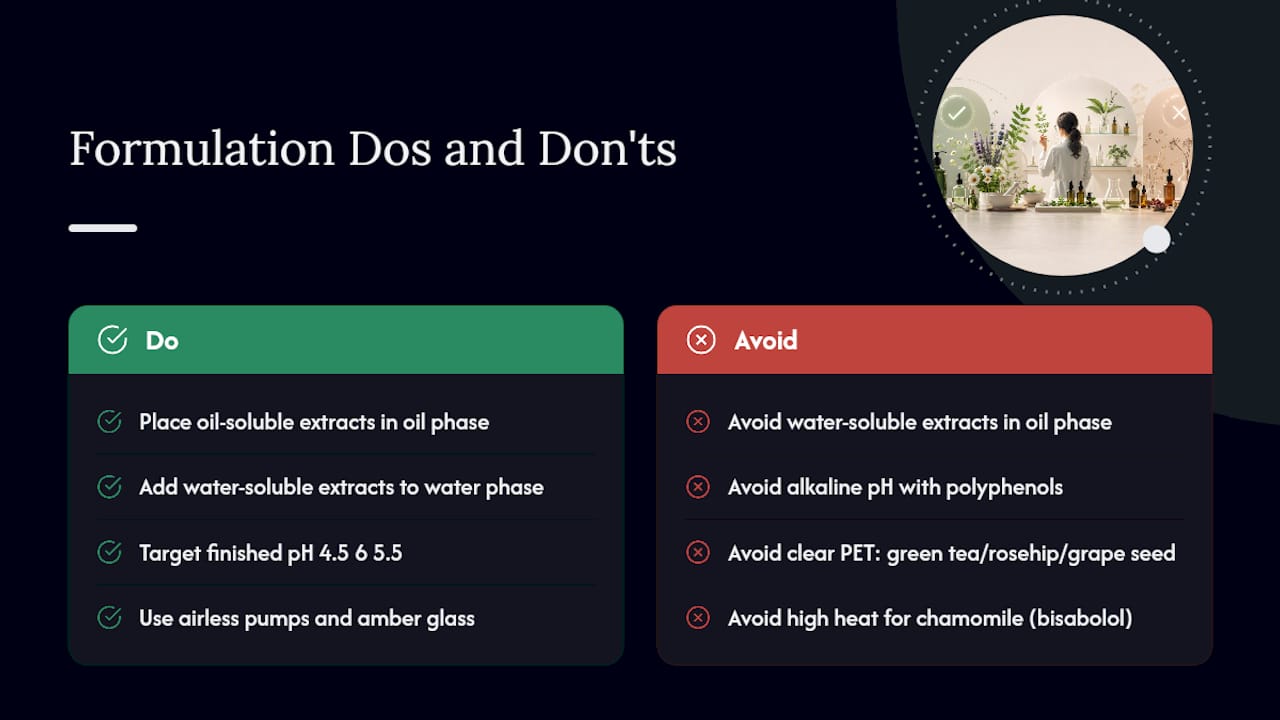
Solubility rules in practice: Oil-soluble ingredients, including jojoba, argan, rosehip oil, and CO2 extracts, go into the oil phase before emulsification. Water-soluble extracts, including aloe vera gel, green tea, licorice, and glycerin-based Centella extracts, go into the water phase.
pH sensitivity is the second major constraint. Green tea catechins (EGCG) oxidize rapidly above pH 7, turning the formula brown and losing antioxidant activity. Licorice’s glabridin is stable in the pH 4–6 range but discolors in alkaline environments. Chamomile extracts are generally stable across a wider pH range but lose bisabolol potency if exposed to high heat during processing. Target a finished formula pH of 4.5–5.5 for most polyphenol-rich botanical formulas, which also aligns with skin’s natural acid mantle.
Oxidation is the primary stability threat for oil-containing formulas. Rosehip oil’s high linolenic acid content makes it particularly vulnerable. Packaging matters as much as the formula: airless pumps reduce oxygen exposure per use, and amber glass blocks UV-driven degradation. Avoid clear PET bottles for any formula containing green tea, rosehip, or grape seed extracts.
Pro Tip: Bakuchiol pairs well with niacinamide and peptides in the same formula, unlike retinol, which can conflict with vitamin C at low pH. This makes bakuchiol the more formulation-flexible retinol alternative for multi-active anti-aging serums.
Delivery system decisions affect bioavailability. Encapsulating polyphenol extracts in liposomes or lipospheres improves skin penetration and protects actives from oxidation during storage. Micelle systems work for water-soluble actives that need to penetrate the lipid-rich stratum corneum. For most mid-market formulas, a well-stabilized oil-in-water emulsion with a pH-adjusted water phase is sufficient. Encapsulation adds cost and complexity that is only justified when the active’s stability or penetration profile genuinely requires it.
Safety, allergenicity, phototoxicity, and U.S. regulatory considerations
Botanical extracts can be safe and well-tolerated, but they carry real allergen and phototoxic risks that synthetic actives often do not. Patch testing and human irritation data are non-negotiable before launch, not optional extras.
Common safety flags by extract type:
- Citrus peel extracts contain furanocoumarins (bergapten, psoralen) that are phototoxic. Cold-pressed bergamot and lime oils are the most cited examples. Furanocoumarin-free (FCF) versions are available and should be specified.
- Chamomile (Matricaria recutita) carries an Asteraceae allergy risk. Users sensitive to ragweed, chrysanthemum, or echinacea may react. Declare chamomile clearly on the label.
- Argan oil is derived from the argan nut. While not a tree nut in the allergenic sense, it warrants a label declaration for allergy-prone consumers.
- Sesame oil, sometimes used as a carrier, is a major allergen under FDA’s Food Allergen Labeling and Consumer Protection Act framework. Its status in cosmetics is less regulated, but labeling transparency is advisable.
- Concentration-dependent irritation applies to most actives. Bakuchiol at 2% is generally well-tolerated; above that threshold, irritation reports increase.
Statistic callout: A 2025 safety-validation study evaluating 50 plant-derived materials found most were non-irritant in vitro and in preliminary human testing, with several showing wound-healing activity and filaggrin upregulation, supporting their use in barrier-repair formulations.
U.S. regulatory framework for botanical extracts in cosmetics:
Under FDA’s cosmetic regulatory framework, botanical extracts are regulated as cosmetic ingredients when used for appearance-related claims. Ingredient naming on U.S. labels follows INCI (International Nomenclature of Cosmetic Ingredients) conventions: “Camellia sinensis leaf extract” rather than “green tea extract.” Claims that cross into therapeutic territory (“repairs damaged skin,” “treats eczema”) can trigger drug classification under the Federal Food, Drug, and Cosmetic Act, requiring a different regulatory pathway. Stick to structure-function language: “helps improve the appearance of fine lines,” not “repairs collagen.”
The Cosmetic Ingredient Review (CIR) Expert Panel publishes safety assessments for cosmetic ingredients that serve as the industry-standard reference in the U.S. Before launching a product with a less common botanical, check whether a CIR review exists. IFRA (International Fragrance Association) standards apply specifically to fragrant botanicals like chamomile essential oil and citrus extracts used in leave-on products.
Recommended pre-launch safety steps: patch testing on a minimum of 25–50 subjects, a Human Repeat Insult Patch Test (HRIPT) for leave-on products, preservative efficacy testing, and a stability-linked safety assessment. For any extract without a CIR review, commission an independent safety assessment from a qualified toxicologist.
What does the science actually support for anti-aging outcomes?
Some botanical actives have genuine clinical backing for wrinkle reduction, pigment improvement, and barrier repair. Many others have compelling in vitro data that has not yet translated to controlled human trials. Knowing which is which protects you from overclaiming and helps you prioritize formulation investment.
Evidence tiers for common anti-aging claims:
- Bakuchiol: The strongest clinical case. The 2018 randomized trial comparing bakuchiol to retinol showed comparable reductions in hyperpigmentation and wrinkle appearance with better tolerability. This is the only plant-derived retinol alternative with this level of head-to-head evidence.
- Centella asiatica: Multiple human trials support its role in collagen synthesis and wound healing. Evidence for wrinkle reduction specifically is less consistent, but barrier improvement data is solid.
- Green tea (EGCG): Strong in vitro antioxidant and anti-inflammatory data; human trial evidence for topical anti-aging is more limited and dose-dependent.
- Aloe vera: Well-supported for hydration and barrier function in human studies. Anti-aging claims (collagen stimulation) exist in smaller trials but are not as robust.
- Licorice (glabridin): Good in vitro evidence for tyrosinase inhibition (brightening); human trial data for pigmentation reduction is limited but directionally positive.
- Grape seed (OPC): Strong in vitro antioxidant data; human topical evidence is sparse.
- Chamomile, jojoba, argan, rosehip: Primarily review-level and observational evidence for their respective benefits. Useful and well-tolerated, but not backed by placebo-controlled anti-aging trials.
Statistic callout: A Healthline clinical review notes that botanical products are rich in vitamins, antioxidants, and bioactives that can support hydration and barrier repair, but evidence quality varies considerably and interactions and contraindications exist, underscoring the need for ingredient-level scrutiny rather than category-level trust.
Realistic timelines: clinical trials for topical botanical actives typically run 8–12 weeks to show measurable changes in wrinkle depth or pigmentation. Effect sizes are generally modest compared to prescription actinoids but meaningful for a cosmetic claim. Formulators should set internal benchmarks at 8 weeks minimum and use validated measurement tools (Visiometer, Mexameter, TEWL meter) rather than self-assessment alone.
For readers also considering systemic support alongside topical actives, nutraceuticals for aging support offer a complementary perspective on antioxidant strategies that work from the inside out.
How do you select extracts and vet suppliers?
Request the extraction method, standardized marker percentage, CoA, microbial and heavy-metal results, and stability data before placing any order. A supplier who cannot provide all of these is not ready to supply a serious formulation.
- Confirm the botanical Latin name and plant part. “Chamomile extract” could be Matricaria recutita (German chamomile, high bisabolol) or Anthemis nobilis (Roman chamomile, different chemistry). The Latin name and plant part (flower, root, seed) are non-negotiable on the spec sheet.
- Ask for the harvest batch and season. Active content in botanicals varies with growing conditions and harvest timing. A supplier who tracks batch-to-season data takes quality seriously.
- Request the extraction method and solvent details. Ethanol, glycerin, CO2, or mechanical pressing each produce different active profiles. You need to know this to predict solubility and stability in your formula.
- Verify the marker compound assay. The percentage of the standardized marker (% bakuchiol, % asiaticoside, % EGCG, % glabridin) is the only number that tells you what you are actually dosing. A vague “standardized extract” label without a percentage is a red flag.
- Review the full Certificate of Analysis. The CoA should cover the marker assay, microbial limits (total plate count, yeast and mold, absence of pathogens), heavy-metal testing (lead, arsenic, cadmium, mercury), and residual solvents if applicable.
- Ask for stability and shelf-life data. Supplier-generated stability data under defined storage conditions tells you how long the extract remains active before it reaches you, which affects your formula’s shelf-life calculation.
- Ask sustainability and traceability questions. Where is the plant material sourced? Is it wild-harvested or cultivated? Is there a fair-trade or regenerative sourcing certification? These questions matter for both ethical positioning and supply-chain reliability.
Red flags to walk away from: no CoA available, vague percentage actives (“standardized” with no number), no microbial or heavy-metal testing, inconsistent assay results between batches, and a supplier who cannot name the extraction solvent.
Recent findings: bakuchiol, standardization trends, and ethical sourcing
Recent in vitro and clinical work continues to reinforce bakuchiol as the most evidence-backed plant-derived retinol alternative, while the broader industry is moving toward standardized extracts and vegan-compliant raw materials as baseline expectations rather than premium differentiators.
Lotus germ extract is the most discussed emerging ingredient in this space. Laboratory screening found it outperformed 74 other plant extracts on autophagy induction via DAPK1-Beclin1 signaling, mitochondrial restoration, and collagen stimulation in aged human fibroblasts. The mechanism is specific and the in vitro signal is strong. Human trial data does not yet exist, so present it as a high-potential experimental ingredient rather than a proven active.
The 2025 MDPI safety-validation study of 50 plant-derived materials is worth reading in full if you are building a PDM-forward line. It demonstrates that systematic in vitro and preliminary human testing can efficiently screen a large botanical library, and that filaggrin upregulation is a measurable, meaningful endpoint for barrier-repair claims.
Industry movement toward vegan and ethically sourced raw materials is accelerating. Labs are running more targeted cellular assays (NRF2 activation, autophagy induction) to validate mechanisms rather than relying on broad antioxidant DPPH assays. For vegan skincare evidence, the shift is not just marketing: it reflects a genuine tightening of the evidence bar.
- Standardized extracts are becoming the supplier baseline, not a premium option.
- Cellular mechanism assays (autophagy, NRF2, filaggrin) are replacing generic antioxidant claims as the new evidence currency.
- Lotus germ, bakuchiol, and Centella asiatica are the three most-cited botanicals in current anti-aging formulation research.
Pro Tip: Before adding an emerging extract like lotus germ to a commercial formula, run a pilot stability study and a small controlled user trial (20–30 subjects, 8 weeks) to confirm the extract behaves as expected in your specific base. In vitro results do not guarantee in-formula stability or in-use tolerability.
Why standardized botanicals matter more than “natural” branding
The most important shift in botanical skincare over the past decade is not the ingredients themselves. It is the move from “contains plant extracts” to “standardized to X% active compound.” That shift is what separates a formula with predictable clinical performance from one that varies batch to batch based on where the chamomile was grown and when it was harvested.
Standardization is not a marketing claim. It is a quality-control mechanism. Without that number, you are formulating with a variable you cannot control.
The same logic applies to consumer choices. A product that lists “Camellia sinensis leaf extract” tells you nothing about EGCG content. A product that discloses the standardized marker percentage, or whose manufacturer can provide that data on request, is making a fundamentally different and more credible commitment to efficacy. That is the standard worth holding both your suppliers and your finished products to.
Miraclegelnaturalskincare: finished products built on standardized botanicals
Miraclegelnaturalskincare formulates its anti-aging and brightening products around the same principles this guide covers: standardized botanical actives, matched to the right vehicle, at concentrations that have clinical or review-level support. The 2-Minute Miracle Gel and the 2-Minute Miracle Moisturizer are built for women 40+ who want the benefits of botanical actives without the formulation homework. Both products are designed for quick, visible results using gentle, multi-functional complexes rather than harsh synthetic actives. If you want to see which standardized botanical ingredients go into each formula, the full natural skincare range for 40+ is the right starting point.
Sources
- Bakuchiol: A Retinol-like Functional Alternative
- Natural cosmetic oils review (PMC)
- Safety Validation of Plant-Derived Materials for Skin Application
- Exploring plant extracts for improved skincare (Nature coverage)
- Natural skincare routine: Should you try it? (Healthline)