
Tretinoin, the prescription retinoid, remains the strongest evidence-backed option for reducing wrinkle depth and boosting collagen. Over-the-counter retinol works on the same pathway, just more gently. Peptides are the safer, calmer alternative when your skin can’t tolerate retinoids or you’re pregnant, and they pair well with retinol to soften its rough edges rather than replace it outright.
TL;DR:
- Peptides take longer than retinol to show visible firmness improvements, often requiring 8 to 16 weeks for noticeable results.
- Unlike retinol, peptides rarely cause redness, flaking, or irritation, making them suitable for sensitive or reactive skin.
- Retinol increases sun sensitivity and requires daily SPF use, whereas peptides do not affect UV protection.
- Peptides are generally safe during pregnancy and breastfeeding, unlike retinoids, which are contraindicated.
- Starting retinol should involve slow titration over several weeks, while peptides can be integrated more easily without an adjustment period.
Table of Contents
- Peptides vs Retinol: A Side-By-Side Look
- How Retinol and Peptides Actually Work in Your Skin
- What the Clinical Evidence Actually Shows
- Retinol Side Effects, Sun Sensitivity, and When to Stop
- How to Introduce Retinol and Peptides Without Wrecking Your Skin
- What If You Can’t Use Retinol At All?
- Where Miraclegelnaturalskincare Fits Into This Choice
- Why the “Which Is Better” Question Misses the Point
- Try a Peptide-Forward Routine Built for Sensitive, 40+ Skin
- Sources
Peptides vs Retinol: A Side-By-Side Look
Retinol works by speeding up cell turnover and switching on genes that build collagen. That’s exactly why it delivers results and why it irritates skin on the way there. Peptides send different signals, mostly telling skin cells to behave as if they’d just been wounded, prompting repair without disrupting the surface barrier.
Retinoids have accumulated more than five decades of clinical data, giving them the deepest evidence base of any topical anti-aging ingredient available without a prescription upgrade. Peptides have real trial support too, just thinner and often funded by the brands selling them.
Here’s the quick breakdown:
- Speed of results: Retinol shows change in 8 to 12 weeks; peptides often take 8 to 16 weeks for visible firmness gains.
- Irritation risk: Retinol commonly causes redness, flaking, and peeling as skin adjusts; peptides rarely cause any of that.
- Pregnancy safety: Retinoids are off limits during pregnancy and breastfeeding; peptides are generally considered safe.
- Sun sensitivity: Retinol increases UV sensitivity and demands daily SPF; peptides carry no such requirement.
- Evidence depth: Retinol has decades of RCTs behind it; peptides have a smaller but growing body of trials.
Retinoid dermatitis is a predictable side effect that typically peaks within the first 4 to 8 weeks of use, while peptides are largely non-sensitizing and leave the skin barrier intact. That single fact explains most of the debate: retinol works faster and deeper, peptides work slower and kinder.
How Retinol and Peptides Actually Work in Your Skin
Retinol doesn’t do anything on its own. It has to convert, first to retinaldehyde, then to retinoic acid, before it can bind to nuclear receptors inside skin cells. Once bound, those receptors switch on genes that speed up cell turnover and ramp up collagen production. That conversion process is also the reason retinol is gentler than prescription tretinoin, which arrives already in its active acid form and skips the conversion steps entirely.
Peptides work through an entirely different mechanism. They’re short chains of amino acids that mimic fragments of larger proteins, and skin cells read them as chemical messages rather than raw material.
- Signal peptides (like palmitoyl pentapeptide-4, marketed as Matrixyl) tell fibroblasts to produce more collagen and elastin, as if the skin had detected damage that needs repairing.
- Carrier peptides shuttle trace minerals like copper into skin cells to support enzyme activity involved in wound healing.
- Neurotransmitter-inhibiting peptides relax the tiny muscle contractions that deepen expression lines over time.
- Enzyme-inhibiting peptides slow the breakdown of existing collagen rather than building new collagen from scratch.
None of these peptide actions require the skin to shed its outer layer faster, which is exactly why they don’t cause the peeling and redness retinol does. Retinol’s turnover boost is also what makes it more sun sensitive: newer, thinner skin cells at the surface offer less natural UV protection until they mature. Peptides don’t touch that turnover cycle, so photosensitivity isn’t part of their side effect profile at all.
This is the real split between the two ingredients. Retinol changes how fast your skin renews itself and how much collagen it manufactures at the genetic level. Peptides change what signals are circulating in the skin, nudging repair processes without altering the renewal timeline. One is a faster, more disruptive lever. The other is a slower, steadier nudge.
What the Clinical Evidence Actually Shows
Retinoids carry the strongest and longest track record of any topical anti-aging ingredient, backed by decades of randomized controlled trials and systematic reviews measuring wrinkle depth, collagen density, and pigmentation. That evidence is why dermatologists default to tretinoin, or its milder cousin retinol, before recommending almost anything else.
Peptide research tells a different story. Trials exist, and some show genuine benefit, but they tend to run smaller, shorter, and are frequently funded by the company that owns the peptide. That doesn’t make the findings worthless. It means you should read peptide marketing claims with more caution than you’d apply to a retinoid study.
One finding worth knowing in detail: a cosmetic regimen combining niacinamide, a peptide, and retinyl propionate matched the wrinkle improvement of low-dose 0.02% tretinoin at 24 weeks, while causing noticeably less irritation during the early adjustment period. That’s a genuinely useful data point for anyone who can’t tolerate straight retinoids. It also shows peptides aren’t just a consolation prize. Combined intelligently, they can hold their own against a real prescription comparator, at least at a low dose.
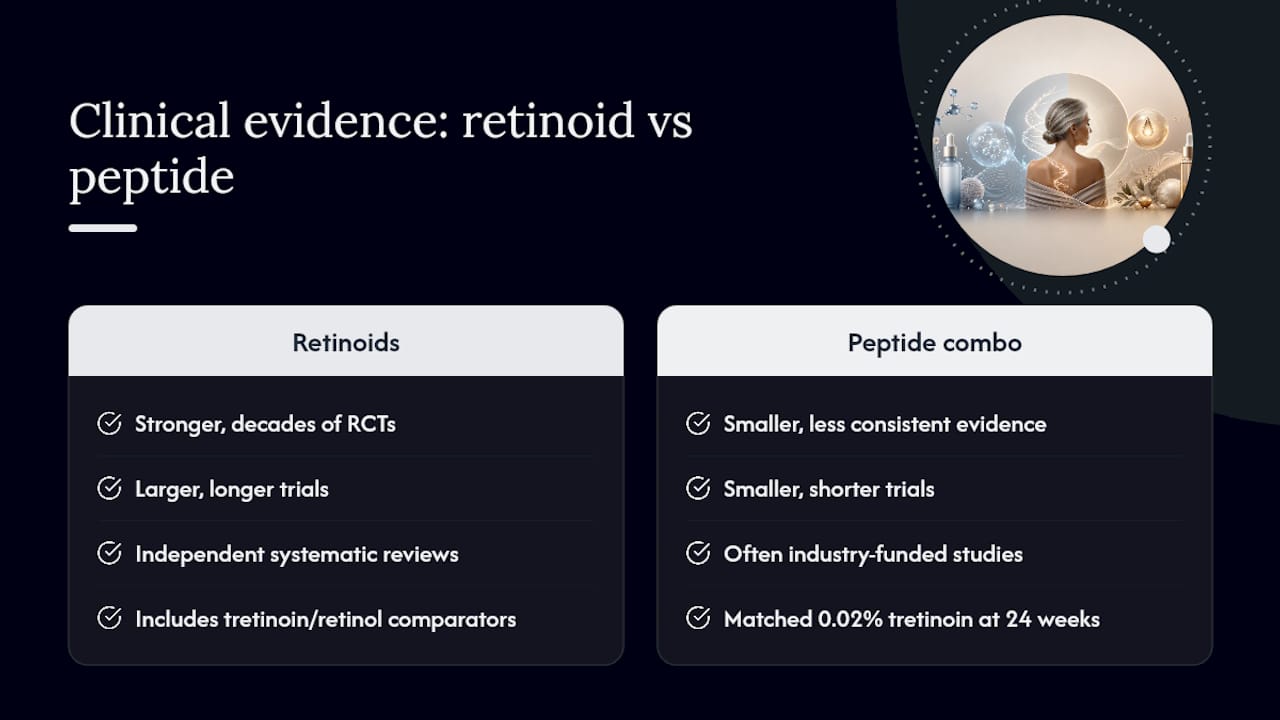
A recent industry review of head-to-head trials reached a similar conclusion: while some peptides show real benefit in modest RCTs, the overall peptide evidence base remains smaller and less consistent than the retinoid literature, and one widely cited 2025 trial favored a cyclized peptide only against a very low-dose retinol comparator. Dermatology commentary generally agrees on the split, noting that retinol still holds the stronger evidence base for texture and fine lines, while peptides win on tolerability and barrier support.
What should you take from all this? If your priority is maximum, fastest wrinkle reduction and your skin can handle it, retinol (or tretinoin, prescribed) has the deeper research behind it. If you want a gentler regimen with a smaller but still real body of support, peptides are a legitimate, evidence-aligned choice, not just a marketing substitute.
Retinol Side Effects, Sun Sensitivity, and When to Stop
Retinol’s adjustment period is real, predictable, and temporary for most people. Expect redness, flaking, tightness, or mild peeling in the first several weeks as your skin adapts to the faster turnover rate.
- Weeks 1 to 2: Mild dryness and occasional flaking are normal as skin cells begin shedding faster.
- Weeks 3 to 4: Irritation often peaks here for higher concentrations or daily use started too aggressively.
- Weeks 4 to 8: Most people see irritation settle as skin builds tolerance; this window is where dermatologists say retinoid dermatitis typically peaks and resolves.
- Beyond 8 weeks: Persistent burning, swelling, or blistering is no longer “adjustment” and warrants a pause and a check-in with a clinician.
Peptides don’t put you through any of that. Because they don’t accelerate skin turnover, there’s no barrier disruption phase to wait out, which is part of why they’re the go-to when tolerance is the deciding factor.
Daily sunscreen isn’t optional with any retinoid. The faster cell turnover that makes retinol effective also leaves newer, less UV-resistant cells exposed at the surface, so skipping SPF while using retinol invites sunburn and undercuts the very results you’re chasing.
Retinoids are contraindicated during pregnancy and breastfeeding, a point backed by clinical guidance on tretinoin’s prescription-only status and risk profile. Peptides carry no such restriction, which is exactly why they’re the default recommendation for anyone pregnant, breastfeeding, or otherwise avoiding vitamin A derivatives.
Pro Tip: If your skin burns, swells, or blisters rather than just feeling tight or flaky, that’s not “purging.” Stop the retinoid and let your barrier recover before trying again at a lower frequency.
How to Introduce Retinol and Peptides Without Wrecking Your Skin
Rushing retinol is the single most common reason people quit it. Dermatologist guidance is consistent on this point: start slow, escalate gradually, and buffer with moisturizer rather than diving in at full strength.
- Weeks 1 to 2: Apply retinol two nights a week, after a moisturizer, not before. This “sandwich” technique, moisturizer first, retinol on top, sometimes another moisturizer layer after, blunts the intensity without blocking absorption entirely.
- Weeks 3 to 4: Move to every other night if skin has adjusted without significant flaking or burning.
- Weeks 5 to 8: Progress to nightly use if tolerated, applying a pea-sized amount to a fully dry face.
- Ongoing: Once skin has adapted, you can drop the moisturizer sandwich if you want faster absorption, or keep it as a permanent buffer if your skin runs dry or reactive.
Peptides slot in easily around this schedule because they don’t compete with retinol for the same reaction. Apply peptide serums in the morning, or on the nights you skip retinol, and let each product do its own job rather than layering both actives on top of each other at once. If irritation shows up despite titrating slowly, dropping to peptides-only for a week or two lets the barrier recover before you reintroduce retinol.
If your skin still won’t tolerate OTC retinol after a careful titration, or you want faster, more dramatic results than retinol delivers, that’s the point to talk to a dermatologist about prescription tretinoin. It’s stronger, requires more careful monitoring, and works fastest under clinical supervision rather than trial and error at home.
Pro Tip: Track your skin weekly with the same lighting and angle photo. Redness and flaking are obvious in the mirror day to day, but slow wins like softened lines only show up when you compare week one to week eight side by side.
What If You Can’t Use Retinol At All?
Bakuchiol is the strongest evidence-backed substitute for anyone who needs to skip retinoids entirely. It’s a plant-derived compound that triggers some of the same gene-expression pathways as retinoids, and systematic review data shows comparable results for wrinkle scores and hyperpigmentation with significantly less irritation. For pregnancy, breastfeeding, or severe sensitivity, it’s the closest thing to a retinol swap without the retinol risk profile.
Two other ingredients matter here, not as retinol replacements but as support:
- Niacinamide strengthens the skin barrier and calms inflammation, which makes it a natural pairing for anyone dealing with retinol-related dryness or redness.
- Ceramides and humectants (like hyaluronic acid) rebuild the lipid layer retinol can thin out and hold water in skin that’s flaking or tight. Comparing peptides vs hyaluronic acid misses the point slightly. They’re not competing; hyaluronic acid hydrates while peptides signal repair, and most solid routines use both.
Peptides alone are a completely reasonable long-term strategy if your goals are subtler: firmer skin, better barrier function, and steady maintenance rather than aggressive correction of deep wrinkles. If you’re mainly managing early fine lines, dehydration, or reactive skin, a peptide-forward routine may get you further than a retinol you can’t actually stick with. You can browse retinol alternatives built around exactly this logic. Readers weighing procedural options alongside topicals sometimes also look into treatments like anti-wrinkle injections, though that’s a different category of decision entirely.
Where Miraclegelnaturalskincare Fits Into This Choice
A skincare brand has developed formulations focused on peptides, including a 2 Minute Miracle Gel that uses a moisture complex alongside peptide actives, aiming to deliver visible tightening and hydration without a multi-week retinol adjustment period.
The product line was developed around a common customer frustration: wanting anti-aging results without spending two months managing flaking skin. A peptide-forward formula is designed to address this need.
If you read the routines above and thought, “I don’t want to titrate retinol for eight weeks,” a peptide-first product is a sound, evidence-aligned choice rather than a compromise. It won’t replicate what prescription tretinoin does for deep, established wrinkles. For firmness, hydration, and barrier support, especially on skin that reacts to actives, it’s a legitimate direct route. You can see how the formulation approaches this in the brand’s guide to peptides in skincare.
Why the “Which Is Better” Question Misses the Point
The honest answer to “which is better, peptides or retinol” is that the question is framed wrong. Retinol wins on raw evidence for wrinkle depth. Peptides win on the thing most people actually fail at: sticking with a routine long enough to see it work. A gentle regimen used every night for six months beats an aggressive retinol schedule abandoned in week three out of frustration, every time.
The conventional advice pushes everyone toward retinol as the automatic “serious” choice, treating peptides as a lesser fallback for people who can’t handle the real thing. That framing ignores tolerability as a variable that determines outcomes, not just comfort. Skin you can’t stay consistent with won’t improve, no matter how strong the active ingredient is on paper.
My take: start by being honest about your actual tolerance and lifestyle, not your ambition. If you’ve tried retinol twice and quit both times from irritation, stop forcing it and build a peptide-forward routine you’ll actually maintain. If your skin handles actives fine, titrate retinol properly and let peptides work alongside it, not instead of it.
— Barbara
Try a Peptide-Forward Routine Built for Sensitive, 40+ Skin
Some skincare products offer peptide-forward formulas that target firmness and hydration from the first application, using barrier-supporting ingredients instead of an irritation phase requiring an adjustment period.
This approach fits three kinds of shoppers best: those with reactive or sensitive skin who’ve struggled with retinol before, anyone pregnant or breastfeeding who needs to avoid retinoids entirely, and women 40 and older who want visible anti-aging results without a multi-week adaptation window. If any of that sounds like you, start by reviewing the ingredient list on Natural Skincare: Radiant, Age-Defying Beauty for 40+ to see how the formulation lines up with your skin’s needs, and check with a dermatologist first if you’re managing a specific skin condition or currently using a prescription retinoid.
Sources
- Stanford Medicine — Does retinol deserve the hype?
- The Exosome Edit — Retinol vs Peptides for anti-aging
This article is general information, not a substitute for advice from a qualified doctor. Consult a qualified healthcare professional about your own circumstances before acting on anything here.