
The most evidence-backed skin-firming natural compounds include Haberlea rhodopensis extract, fermented bilberry, propolis PAPE, fucoidan from brown seaweed, Centella asiatica, Kigelia africana, pomegranate, turmeric, licorice, and aloe vera with Vitamin A precursors. Your immediate next step: choose a product that names a standardized extract with a stated percentage concentration, not just a vague “botanical blend.”
- Evidence strength varies widely. A handful of these have randomized human trials with Cutometer elasticity data; others have strong preclinical or in vitro evidence only.
- Remodeling takes time. Surface-tightening effects can appear within days, but genuine collagen and elastin remodeling typically requires 4–12 weeks of consistent use.
- Concentration matters. Studies report effects at specific percentages for some extracts, such as Haberlea cream and propolis PAPE. Products that omit concentration details make it difficult to connect their claims to actual trial outcomes.
- Patch testing is non-negotiable. Even well-tolerated botanicals can cause contact sensitization in some people.
Pro Tip: When scanning product labels, look for the INCI name of the standardized extract (e.g., “Haberlea rhodopensis leaf extract,” “Vaccinium myrtillus fruit extract fermented”) and a stated percentage. If neither appears, treat the product’s firming claims with skepticism.
Key Takeaways
The most effective skin-firming natural compounds are those with human trial data tied to instrumental elasticity endpoints, used at standardized concentrations, and applied consistently over weeks to months.
| Point | Details |
|---|---|
| Prioritize human trial data | Choose actives with Cutometer elasticity or wrinkle-depth endpoints, not just in vitro claims. |
| Concentration drives outcome | Propolis PAPE at 3% outperformed 1.5% in the same trial; always look for a stated percentage. |
| Remodeling takes weeks to months | Expect 4–12 weeks for structural change; surface tightening from film-formers is not the same result. |
| Combine topical and oral routes | Fermented bilberry’s RCT supports oral supplementation alongside topical remodeling actives. |
| Miraclegelnaturalskincare | Offers standardized botanical formulations for women 40+ aligned with the evidence criteria in this article. |
Table of Contents
- How do skin-firming natural compounds actually work?
- The top natural compounds for skin firmness: what the evidence shows
- How to use these compounds safely and get real results
- How to choose a product with real skin-firming natural compounds
- What works at home, what’s temporary, and what to skip
- What do human trials actually show for natural firming actives?
- What I actually recommend for integrating natural firming actives
- Miraclegelnaturalskincare brings evidence-backed firming actives to one place
- Sources
How do skin-firming natural compounds actually work?
Natural compounds can support skin firmness through four distinct biological routes: stimulating collagen and elastin synthesis, inhibiting matrix metalloproteinases (MMPs), neutralizing oxidative damage to the extracellular matrix (ECM), and forming temporary surface films that create an immediate tightening sensation. The first three drive real structural remodeling. The fourth is cosmetic, not therapeutic.
Collagen and elastin induction is the most durable route. Fibroblasts in the dermis produce both proteins in response to certain plant actives. Elastogenesis, the process of new elastin fiber assembly, is particularly relevant to firmness because elastin governs the skin’s ability to snap back after deformation. Some botanicals, including Centella asiatica and Haberlea rhodopensis, have demonstrated upregulation of collagen VI, collagen XVI, and elastin mRNA in fibroblast models, which is a meaningful mechanistic signal when paired with a clinical endpoint.
MMP inhibition protects the matrix you already have. MMPs are enzymes that break down collagen and elastin; UV exposure and chronic inflammation both upregulate them. Fucoidan from Sargassum horneri, for example, reduced MMP-1 and MMP-3 expression in UVB-stressed fibroblasts in a dose-dependent pattern, according to research on fucoidan polysaccharides. Blocking that degradation pathway slows the net loss of structural proteins.
Antioxidant protection works indirectly. Reactive oxygen species generated by UV, pollution, and metabolic stress fragment collagen fibers and cross-link elastin in ways that reduce its elasticity. Polyphenols from pomegranate, fermented bilberry, and propolis scavenge those radicals before they reach the ECM. A broad review of plant-based anti-aging strategies frames antioxidant scavenging, MMP inhibition, and collagen stimulation as the three core mechanisms worth targeting.
Film-formers (egg white, certain polysaccharides, silicones) create a temporary tightening sensation by drying on the skin surface. They feel impressive and can reduce the appearance of fine lines for a few hours, but they do not remodel the dermis. Knowing the difference saves you from chasing the wrong endpoint.
Signs a product targets remodeling rather than surface tightening:
- Claims reference Cutometer elasticity, wrinkle depth measurements, or biopsy/gene markers
- A trial duration of at least 4 weeks is cited
- The active ingredient is a standardized botanical extract at a stated concentration
- Results are described as improving “over time” rather than “immediately”
For a deeper look at how collagen biology connects to these mechanisms, the role of collagen in aging explains the structural picture clearly.
Statistic callout: In a small human trial, a Haberlea rhodopensis cream increased skin elasticity notably versus placebo in a small clinical trial at 15 days, with biopsy data confirming collagen VI and elastin mRNA upregulation, illustrating how a mechanistically paired study can triangulate a clinical effect.
The top natural compounds for skin firmness: what the evidence shows
Each profile below starts with the mechanism and the highest-quality evidence available. “Small clinical” means a human trial with fewer than 50 participants; “randomized clinical” means a controlled trial with randomization and a placebo arm.
Haberlea rhodopensis (myconoside-rich extract)
This resurrection plant extract is among the most compelling skin-firming natural compounds in the current literature. A 3% cream increased skin elasticity roughly threefold versus placebo at 15 days in a 20-person human trial, with effects sustained at 30 and 60 days. That combination of a clinical endpoint and a mechanistic biopsy is unusually persuasive for a botanical ingredient. Best suited to normal-to-dry skin; no major safety flags in the published data.
Fermented bilberry (Vaccinium myrtillus)
The fermentation step matters here. In a randomized, double-blind, placebo-controlled trial of 66 participants, oral fermented bilberry extract reduced wrinkle depth by 10.6% and improved Cutometer firmness (R0) by 13.3% and elasticity (R2) by 12.4% at day 84, with statistically significant between-group differences. This is the oral route, not topical, which matters for formulation decisions. Suitable for most skin types; generally well tolerated as a supplement.
Propolis PAPE (phenolic acids polymer extract)
Standardization is the key word with propolis. A clinical study of standardized propolis PAPE reported wrinkle reductions of approximately 25% with a 1.5% formula and 34% with a 3% formula after 28 days versus baseline. In vitro data from the same paper showed modulation of inflammation and tissue-remodeling biomarkers. Avoid if you have a known bee-product allergy.
Fucoidan (Sargassum horneri-type)
Fucoidan is a sulfated polysaccharide from brown seaweed with a dual action: it protects fibroblasts from UVB-induced MMP-1 and MMP-3 upregulation, and it supports the skin barrier. Research on Sargassum horneri fucoidan reported reduced transepidermal water loss (TEWL) after three weeks versus placebo in a cosmetic product context. The barrier improvement is relevant because dehydrated skin looks and measures as less firm. Evidence level: in vitro plus a short clinical observation. Suitable for sensitive and barrier-compromised skin.
Centella asiatica (asiaticoside / madecassoside)
Centella’s triterpenoids, particularly asiaticoside and madecassoside, stimulate fibroblast proliferation and collagen synthesis. It is one of the most studied botanicals for wound healing and skin remodeling, with plant-derived anti-aging research consistently citing it as a collagen-induction active. Evidence level: multiple small clinical trials and strong in vitro data; a full large-scale RCT for firmness specifically is still limited. Well tolerated by most skin types, including sensitive.
Kigelia africana (sausage tree)
Traditional use of Kigelia africana poultices for skin firming is documented in ethnobotanical literature, with phytochemicals including isoflavones and steroid saponins that may act as phytoestrogens on skin tissue. Clinical evidence is limited, and the broader botanical review notes that in vivo human data are needed to substantiate the traditional claims. Formulation matters: raw fruit extracts used in traditional poultices differ significantly from standardized cosmetic-grade extracts. Patch test carefully; sensitization risk is not well characterized.
Pomegranate (Punica granatum)
Pomegranate’s ellagic acid and punicalagins are potent antioxidants that also show MMP-inhibitory activity in cell models. Evidence level: mostly in vitro and animal studies, with some small human trials showing improved skin texture and hydration. No large RCT for firmness specifically, but the mechanistic rationale is solid. Seed oil additionally contains punicic acid, which may support barrier function. Suitable for all skin types.
Turmeric / curcumin (Curcuma longa)
Curcumin inhibits NF-κB-driven inflammation, which is one of the upstream drivers of MMP upregulation and collagen degradation. Evidence level: strong in vitro and animal data; human topical trials for firmness specifically are limited, though curcumin’s anti-inflammatory effects are well documented. Bioavailability is the main challenge, both topically (poor penetration without a carrier) and orally (rapid metabolism). Look for phospholipid-complexed or nanoparticle curcumin in supplements. Can stain skin yellow at high concentrations topically.
Licorice (Glycyrrhiza glabra / licochalcone)
Licorice root extracts, particularly licochalcone A, combine anti-inflammatory and antioxidant activity with some evidence for MMP inhibition. They are also well established for brightening (glabridin inhibits tyrosinase), which makes licorice a dual-purpose active in anti-aging formulas. Evidence for firmness specifically is mostly in vitro; the brightening data in humans is stronger. Generally well tolerated; one of the gentler botanicals for sensitive skin.
Aloe vera and Vitamin A precursors
Aloe vera gel provides immediate surface hydration and a mild film-forming effect, but its acemannan polysaccharide also shows some fibroblast-stimulating activity in cell models. Evidence for structural remodeling in humans is modest. Vitamin A (retinol and retinal) is the clinical benchmark for collagen induction and wrinkle reduction. Harvard Health’s review of retinoids confirms well-documented instrumental and visual effects on wrinkles and collagen. Plant-derived precursors (beta-carotene) convert to retinol at low efficiency, so they approach some benefits with a gentler tolerability profile but a smaller effect size.
Evidence comparison
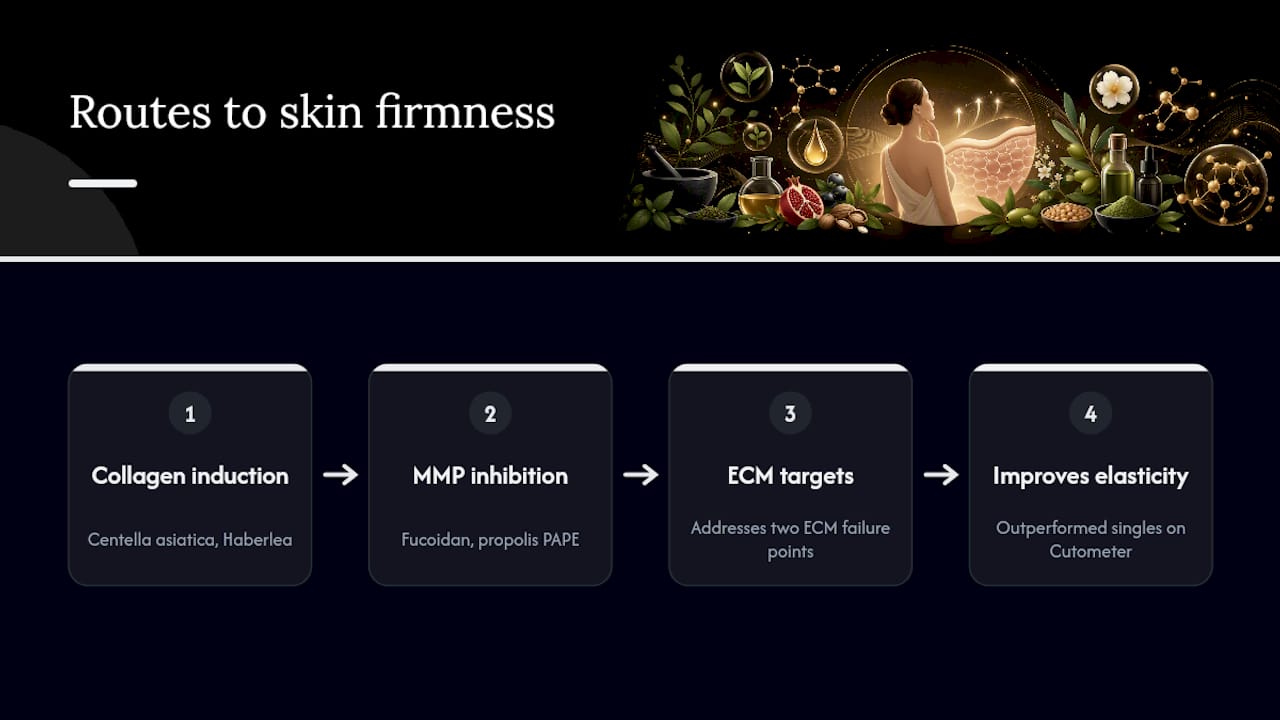
Pro Tip: Combining a collagen-inducing active (Centella asiatica, Haberlea) with an MMP inhibitor (fucoidan, propolis PAPE) in the same routine addresses two separate failure points in the ECM. A blackberry-dill extract study found that a two-extract combination outperformed either single extract on Cutometer elasticity measures, which is a useful model for thinking about synergy.
How to use these compounds safely and get real results
The single most important safety rule is this: use standardized extracts at concentrations that match or approach the study data, and patch test every new active before applying it to your full face.
Topical vs. oral routes are not interchangeable. Haberlea rhodopensis and propolis PAPE have human data specifically for topical application. Fermented bilberry’s randomized trial used an oral supplement. Fucoidan’s clinical data came from a cosmetic product applied to skin. When you see a botanical on a supplement label and a serum label, the evidence behind each route may be completely different, so check which route the trial actually used.
Practical checklist for safe use:
- Patch test procedure: Apply a small amount to the inner forearm or behind the ear. Wait 24–48 hours before applying to the face. If redness, itching, or swelling appears, discontinue.
- Layering with retinoids or acids: Introduce only one new active at a time. If you are already using retinol, wait until your skin is fully adjusted before adding a new botanical. Applying multiple actives simultaneously makes it impossible to identify the cause of any irritation.
- Sun protection: Retinol, AHAs, and some botanical extracts (including certain citrus-derived actives) increase photosensitivity. Use SPF 30 or higher every morning when any of these are in your routine.
- Pregnancy and breastfeeding: Retinol and retinoids are contraindicated during pregnancy. For botanical actives, the safety data in pregnancy is generally insufficient; consult a healthcare provider before use.
- Concentration cues: If a product lists a botanical extract without a percentage, you cannot map it to trial data. Products that specify “3% Haberlea extract” or “1.5% propolis PAPE” are giving you something you can actually evaluate.
Full formulations matter beyond the hero active. A well-formulated product stabilizes the active ingredient, ensures adequate penetration, and avoids excipients that cause irritation. An unstabilized polyphenol oxidizes before it reaches the dermis.
For broader guidance on protective routines that support ECM health, organic skin protection methods covers antioxidant strategies worth pairing with any firming routine.
Pro Tip: If you develop persistent redness, peeling, or a burning sensation that does not resolve within a few days of starting a new product, stop using it and see a dermatologist before resuming. Irritation accelerates the very inflammation that degrades collagen.
How to choose a product with real skin-firming natural compounds
Prioritize products that name a standardized extract with a stated percentage concentration and tie their claims to a clinical endpoint, not just a vague “plant extract” listing.
The FDA’s cosmetics labeling guide requires ingredients to be listed by INCI name in descending order of concentration. That means you can cross-reference what you see on the label against the standardized extract names used in published trials.
Label and marketing checklist:
- Standardized extract name: The INCI name should match a recognized botanical extract (e.g., “Haberlea rhodopensis leaf extract,” “Propolis extract”). Generic terms like “plant stem cells” or “botanical complex” without a named species are red flags.
- Stated concentration: Look for a percentage. If it is absent, you cannot connect the product to any trial outcome.
- Clinical claim with a named endpoint: “Improved Cutometer elasticity at 8 weeks” is a verifiable claim. “Visibly firmer skin” is marketing language.
- Dermatologist involvement: Formulated or tested with a dermatologist is a positive signal, though not a guarantee of efficacy.
- Preservative and stability information: Polyphenols and retinol degrade quickly. Opaque or airless packaging, and a stated shelf life after opening, suggest the manufacturer has addressed stability.
Common marketing red flags:
- “Proprietary blend” without ingredient names or percentages. This makes independent verification impossible.
- “Instant lift” or “immediate tightening” as the primary claim. These phrases typically describe film-formers, not remodeling actives. A product can do both, but if the only claim is instant, the long-term remodeling evidence is probably absent.
- No concentration listed for the hero active. Concentration drives outcome, as the propolis PAPE dose-response data clearly shows.
- Claims that reference only in vitro data. Cell studies are a starting point, not a finish line. Look for at least one human endpoint.
- Vendor-only data without a published study. Commercial ingredient suppliers like Seppic market biomimetic anti-sagging actives with compelling descriptions, but independent published human trials are what you actually need to evaluate the claim.
A quick shopping checklist:
- Find the INCI name of the hero active on the label.
- Search that name plus “clinical trial” or “elasticity” in PubMed.
- Check whether the product’s concentration matches or approaches the study concentration.
- Confirm the packaging protects the active from oxidation.
- Verify the claim type: remodeling (weeks to months) or surface-tightening (immediate).
What works at home, what’s temporary, and what to skip
Immediate tightening from household ingredients is almost always a surface effect. Egg whites, for example, form a thin protein film as they dry, which temporarily reduces the appearance of fine lines. It washes off. That is not a criticism; it is just a different category of effect from structural remodeling.
Common household ingredients and their honest verdicts:
- Aloe vera gel: Mild surface hydration and some fibroblast-stimulating activity in cell models. Useful as a base; not a remodeling active on its own.
- Coconut oil and olive oil: Emollients that improve surface texture and reduce water loss. No meaningful evidence for collagen induction. Can clog pores in acne-prone skin.
- Honey: Humectant with mild antimicrobial properties. Temporary smoothing effect; no structural remodeling data.
- Egg whites: Classic film-former. Immediate tightening sensation, zero remodeling. Allergic reaction risk if you have an egg sensitivity.
- Coffee grounds (as a scrub): Mechanical exfoliation improves surface texture temporarily; caffeine may have mild vasoconstrictive effects. No evidence for long-term firmness.
- Cucumber slices: High water content; mild cooling and soothing effect. Temporary reduction in puffiness around the eyes. No remodeling activity.
- Yogurt (lactic acid): Mild AHA exfoliation from lactic acid can improve surface texture over time. Not a firming active, but a useful supporting ingredient for cell turnover.
Kigelia africana occupies a middle ground. Traditional poultice use for breast and skin firming is documented across several African cultures, and the phytochemistry (isoflavones, steroid saponins) offers a plausible mechanism. But the gap between a traditional poultice and a standardized cosmetic extract is significant. Concentration, extraction method, and formulation all affect whether the active compounds reach the dermis in meaningful amounts.
What tightens skin immediately? Film-formers: egg white, certain polysaccharides, silicones, and some plant gums. The effect is real but temporary, lasting hours at most.
Which household ingredients support long-term firmness? Aloe vera has the most plausible mechanistic case among common kitchen items, though the evidence for structural remodeling in humans is modest. For meaningful long-term results, standardized botanical extracts at studied concentrations outperform anything you are likely to find in your pantry.
Safety notes for DIY applications: undiluted essential oils can cause chemical burns. Citrus juices applied to skin before sun exposure cause phototoxic reactions. Baking soda disrupts the skin’s acid mantle. When in doubt, the risk-to-benefit ratio of kitchen experiments rarely justifies the potential for irritation or sensitization.
What do human trials actually show for natural firming actives?
The clearest human evidence sits with Haberlea rhodopensis and fermented bilberry, both of which have controlled trials with instrumental elasticity endpoints. Propolis PAPE adds a 28-day clinical dataset with a dose-response signal.
The Haberlea rhodopensis trial (n=20) used a 3% cream versus placebo and measured elasticity at 15, 30, and 60 days. The approximately threefold elasticity improvement at 15 days, paired with biopsy data showing collagen and elastin mRNA upregulation, makes this one of the more persuasive small-sample botanical studies in the literature. Small-sample studies paired with mechanistic biopsies are unusually credible because they triangulate a gene-level signal with a clinical measurement.
What these results mean practically: the fermented bilberry RCT (n=66) carries the most statistical weight because it is randomized, double-blind, and placebo-controlled with a larger sample. The Haberlea study is smaller but mechanistically richer. The propolis data show a clear concentration-response, which is a strong signal even without a full RCT design. Fucoidan’s three-week barrier data are encouraging but represent a shorter observation window.
Weigh small-sample trials against larger RCTs by asking: does the study have a placebo arm? Were endpoints measured instrumentally? Was the extract standardized? A 20-person study that answers yes to all three is more informative than a 100-person study that uses only self-reported outcomes.
Statistic callout: In the randomized, double-blind fermented bilberry trial (n=66), oral supplementation improved skin antioxidant capacity by 20.8% alongside the elasticity and wrinkle-depth improvements at day 84, suggesting systemic antioxidant support contributes to the structural outcome.
For a broader look at how clinical results translate to real-world product choices, clinically proven skincare results for women after 40 connects the trial evidence to practical formulation criteria.
What I actually recommend for integrating natural firming actives
Start with standardized extracts that have human data and a stated concentration. That narrows the field considerably, and it should.
The most practical sequencing: begin with a topical Centella asiatica or Haberlea-based product as your remodeling foundation, since both have human evidence and a reasonable tolerability profile. Give it a minimum of eight weeks before judging the effect. If you want to add an oral route, fermented bilberry is the only botanical supplement with a randomized controlled trial specifically measuring Cutometer elasticity and wrinkle depth. Add it alongside, not instead of, the topical.
Retinol remains the benchmark for collagen induction. The plant-derived precursor route (beta-carotene) is gentler but delivers a smaller effect.
Resist the temptation to layer five new actives at once. You will not know what is working, and you increase the risk of irritation that accelerates the very collagen breakdown you are trying to prevent. One new active every four to six weeks, with consistent SPF use throughout, is a more reliable strategy than a complicated stack.
Products that match the evidence criteria in this article, meaning standardized botanical extracts, stated concentrations, and formulations designed for mature skin, are what to look for. Miraclegelnaturalskincare’s plant-derived anti-aging formulations are built around exactly this kind of ingredient-level thinking, which is the right starting point.
Miraclegelnaturalskincare brings evidence-backed firming actives to one place
Choosing a firming product that actually maps to clinical evidence is harder than it sounds. Most “natural” labels offer no concentration, no standardized extract name, and no trial data. Miraclegelnaturalskincare takes a different approach: formulations built around botanical actives with stated ingredient rationale, designed for women 40+ who want results without harsh chemicals or guesswork.
The brand’s firming product range features multi-functional formulas that combine remodeling actives with barrier-supportive ingredients, matching the layered approach the clinical evidence supports. Gentle enough for sensitive skin, specific enough to matter. If you are ready to move from pantry experiments to a formulation that reflects the science, browse the natural anti-aging collection for women 40+ and look for products that name their actives and back their claims.
Sources
- Antiaging, Brightening, and Antioxidant Efficacy of Fermented Bilberry Extract (Vaccinium myrtillus): A Randomized, Double-Blind, Placebo-Controlled Trial
- Fucoidan-rich polysaccharides extracted from Sargassum horneri and antiaging effects
- Skin Ageing: Natural Weapons and Strategies – PMC
This article is general information, not a substitute for advice from a qualified doctor. Consult a qualified healthcare professional about your own circumstances before acting on anything here.